Germany – Don’t Trust Your Hands
On November 23, a brain tumor was removed at the Technical University of Munich (TUM) clinic. During part of the operation, she remained conscious and answered questions from doctors. No one touched her hand. Yet the patient described a slight tingling sensation, as if someone had touched her finger. The source of the sensation was not in the skin, but in the brain: doctors sent an electrical impulse there. German news in Russian
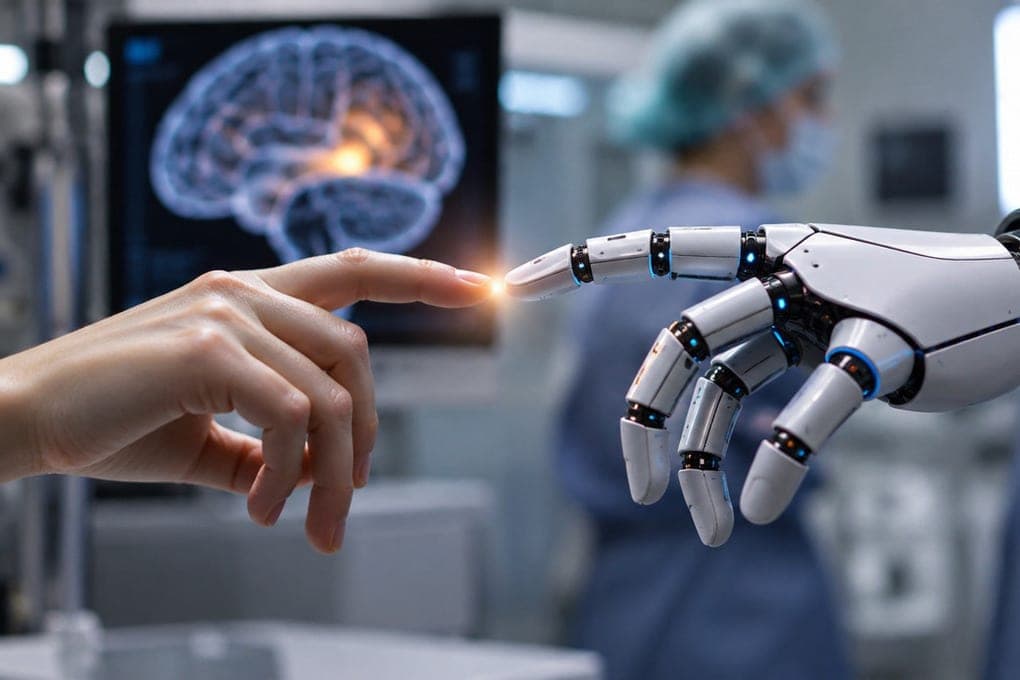
Robots have long learned to perform movements that require human dexterity and precision. They assemble cars, sort parts, carry out complex manipulations. But there is an important difference between the mechanical hand and the human hand: the second constantly talks to the brain, reports the pressure, position of the fingers and the nature of the contact. For an artificial limb to become a full-fledged assistant, engineers will have to teach it to maintain the same dialogue.
What is touch? An event that happens to the skin, or a signal that the brain receives? These two things are usually inseparable. But it is necessary to intervene electronics - and the usual logic begins to fail. It turns out that the brain can be told an event that didn't actually happen. And he will take this information as a real feeling.
Point on the little finger
On November 23, a brain tumor was removed at the Technical University of Munich (TUM) clinic. During part of the operation, she remained conscious and answered questions from doctors. No one touched her hand. Yet the patient described a slight tingling sensation, as if someone had touched her finger. The source of the sensation was not in the skin, but in the brain: doctors sent an electrical impulse there. Sounds fantastic. But the scientific value of experience is exactly that.
Professor Bernhard Mayer’s team placed a thin matrix of 512 microelectrodes on the surface of the brain, created by the Munich company FUTRUE Neurosciences. According to Mayer, it was possible to cause sensations even in two adjacent points on the arm. After about twenty minutes, the matrix was removed. The patient was not given a permanent implant: she was operated on for a tumor, not treated for paralysis. The researchers tested the accuracy of the stimulation.
Blind grip
Why create artificial touch? Try to take a thin plastic glass without feeling the compressive force. Weakly grasp - drop, too tight - doubt. The skin constantly tells the brain how to handle objects. The neural interface, or BCI, connects the brain to the computer. Some devices read neural activity and turn it into commands for a cursor or robotic arm. But it is not enough to perform the movement: it is important for a person to feel the result. The goal of scientists is two-way communication. The user mentally directs the prosthesis to the cup, sensors register the grip, and the implant transmits a touch-like signal to the brain. So far, this is a promising scheme, not a ready-made technology for everyday rehabilitation.
The scalpel remains
The new matrix differs in that the electrodes do not enter the brain tissue, but are located on its surface. Developers expect to accurately affect the desired areas without piercing sensitive structures. However, "does not penetrate the brain" does not mean "does not require surgery": surgical access is required for installation. If the device ever becomes permanent, you will need to prove its safety, durability and stability of operation. The result of one brief experience does not replace clinical trials.
Thought leads the cursor
At TUM, a different approach is being explored in parallel. Michael Meringer, paralyzed after a motorcycle accident, received a permanent implant of 256 microelectrodes in the summer of 2025. Unlike the new device, they penetrate brain tissue and read activity associated with the intention to move. Meringer trains to control a computer cursor; the next landmark is a robotic arm. This is an independent project, the results of which cannot be confused with the November experiment: one system tries to recognize commands, the other - to transmit sensations. They could complement each other in the future.
Bayern vs Mask
The 512-electrode system is being developed by entrepreneur Clemens Fischer. FUTRUE Neurosciences intends to compete with the American Neuralink Elon Musk. Fischer has announced plans to invest about 100 million euros in a new research and production center in Munich. But the number of electrodes alone does not determine success. The companies have different designs and test stages, and there are no reliable independent comparisons yet. For the future user, it is not more important to win the technological race, but to be able to pick up a cup yourself.
Password brain
With the direct connection between the computer and the brain, strange questions arise. Who gets access to the Nervous Activity Records? How to store this data and who will allow it to be used? Neuroethics experts are also working on similar problems at TUM. At the same time, the plot about a chip that reads any thoughts is still fantastic. In Munich, the consciousness of a woman was not deciphered - directed electrical stimulation caused a specific sensation. Now it's a tingling without touch. Scientists hope that one day a person will be able not only to hold a cup with a prosthesis, but also to feel it in the “hand”.
This is what Germany says:
Germany - Nice paradise. But in different apartments. Love without a common address: more than half of singles 60-69 years old admit a serious relationship with separation. Why do not even lovers rush to move?
Germany – The Greens have a Black Monday. A dozen participants. One stranger. Three victims. What was behind the mask, political hatred or something else?
Germany is the Godfather Stollen. Dad, you got a package! How did care for a fragile gift become a matter of parliamentary scrutiny?
Germany - Five-Year Plan - in eight years! The passport is being asked to wait: why does the old rules seem attractive to conservatives again and what prevents a deal with the SPD?
Germany -- Time, wait! Tablet against calendar: metastatic pancreatic cancer has received a new opponent. How does the drug work, who can it help and how much does hope cost?
Germany – The investigation is carried out by sensors. Police are investigating why carbon monoxide has accumulated in the Bad Grenenbach chapel. How did the service turn into a large-scale rescue operation?
Germany: Lessons of Defiance. Instead of school desks – city squares, instead of the usual complaints – mass actions. What do young people want, and why did the demonstrations not end peacefully?
Germany is not all net as gross. There was no sadness - the salary was raised. Why did the Zeders support the Greens and the CDU allies demand to find 4.2 billion euros first?
Germany is a quiet night, dear sip. In Munich for mulled wine with champagne ask 18 euros. How much does the holiday mood in different cities of Germany cost and what are buyers willing to overpay for?
Germany – The rich are afraid, too. Looking for a Lost Buyer: German trade looks to the wealthy and the 50+ generation. Why don't people with money rush to the checkout?
Germany: Citizenship and Prejudice. Offenbach, Saarbrücken, Berlin: German cities are becoming more multicultural. What do passport ratings show and what conclusions can not be drawn from them?
Germany is an indulgence for a gas station. The Minister of Economy wants to free gas stations on the highways from the future price ceiling. Why is the government willing to put up with high prices for the sake of uninterrupted fuel sales?