
In Moscow began to connect Biryulevskaya and Zamoskvoretskaya metro lines
In Moscow began the passage of the connecting branch between Biryulevskaya and Zamoskvoretskaya lines, said the mayor of the capital Sergey Sobyanin in his Telegram channel.
In Moscow began the passage of the connecting branch between Biryulevskaya and Zamoskvoretskaya lines, said the mayor of the capital Sergey Sobyanin in his Telegram channel. Work will take place in the Danilovsky district, in the floodplain of the Moscow River.
The shield, called Esmina, is to build a single-track tunnel more than 565 meters long. It will go from the assembly chamber at the Zamoskvoretsky radius in the direction of the ZIL station of the Biryulevskaya line. The depth at which the work will be carried out reaches 23.8 m.
Sobyanin warned that the explorers will have to work in difficult hydrogeological conditions: mainly in bulk soils, water-saturated sands of various sizes and hard clays of the Oxford tier. In addition, on the way of the shield - dense urban development and many underground communications. “During the entire drilling, specialists will monitor the state of buildings and engineering networks in the zone of its influence,” he assured.
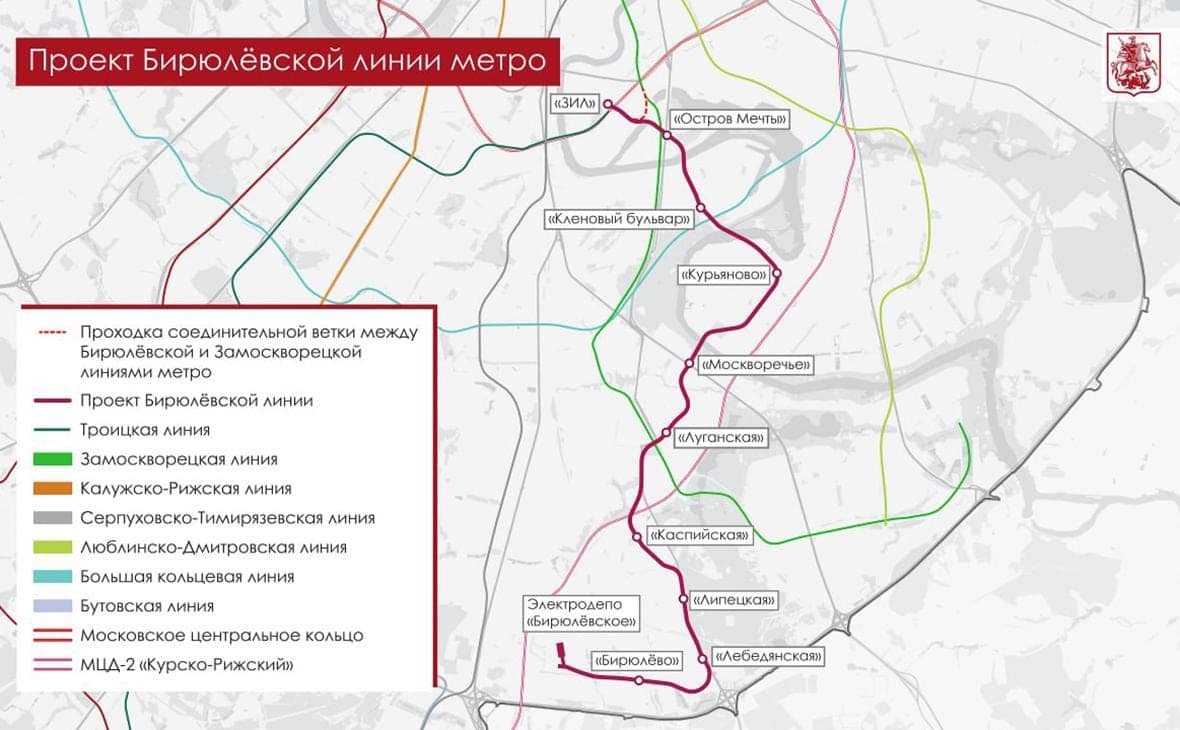
In addition, the construction of stations of the first section of the Biryulevskaya line continues. Completion of this stage is planned for 2028: the site will connect the Big Ring Line, the Moscow Central Ring, the Troitskaya and Zamoskvoretskaya metro lines. As a result, almost 300 thousand residents of three districts of Moscow will begin to live within walking distance from the new subway stations.
The Biryulevo metro line is designed to serve areas in the south of the capital. It will be the 18th in a row, on the scheme it will be designated in ruby color. Introduce the line is planned in stages. The construction of the first section of ZIL-Kuryanovo with a length of 8.65 km with four stations is planned to be completed in 2028, and the second - Kuryanovo-Biryulevo with a length of 13.55 km with six stations - in 2029.


