
Find out what interesting projects were proposed by the participants of the contest “100 innovations of young scientists”
What is needed to ensure that a promising scientific development does not remain on paper? Sometimes it’s just an opportunity to speak out loud. This opportunity gives everyone...

What is needed to ensure that a promising scientific development does not remain on paper? Sometimes it’s just an opportunity to speak out loud. This opportunity gives everyone interested the competition of startup projects “100 innovations of young scientists”, one of the main goals of which is to promote the commercialization of research results. The R correspondent spoke with this year’s winners and learned what solutions can be implemented in the near future.

Master of the Belarusian State University of Informatics and Radioelectronics Danila Kovalenko proposed the project “Cooper-containing silicone thermopaste with protected microparticles” for the competition:

Danila Kovalenko. The idea is aimed at solving the problems of import substitution in the field of heat-dissipating materials. The project is based on a unique technology for obtaining copper powder. What's the point? On the copper plates electrochemical method precipitate the so-called dendrites - branches of copper, from which it is subsequently possible to produce copper powder. In the future, it must be mixed with silicone oil and a special solution to achieve the desired homogeneity of the thermal paste.
The main application of development is industry. Thermopaste is used in computer processors, game consoles, powerful LEDs, power supplies, automotive sound amplifiers. It is applied between the heating element of the electronic device and the radiator to improve heat transfer and fill microscopic air gaps.
But that's not all. According to the young man, some of the copper powder can be replaced with black copper oxide. This will slightly reduce the effectiveness of the product, but at the same time will make it even cheaper. Although the initial version of the development is also very affordable.
Danila shared that it took less than a year to create the project:
- A lot of support was provided by my supervisor, he suggested how you can improve the development, what components you need to use to get the right texture. This significantly reduced the number of failed attempts before we achieved optimal results.
The master admitted that it was a surprise to him that his idea aroused such interest.
Thermopaste may not be the most visual and illustrative material for people not related to science, but it was very pleasant that not only scientists, but also ordinary visitors approached our stand at the Festival of Sciences, where we presented our idea. There were also organizations that showed special attention, including the Scientific and Practical Center of the National Academy of Sciences of Belarus for Materials Science, as well as private companies. I hope we will continue to cooperate with them, Danila said.
Speaking about further plans, the guy said that he intends to continue working on the optimal composition of the thermopaste and improve the efficiency of his product:
- I may also try to use metals other than copper. It would be cool to create a line of different thermal pastes of own production, but it is too early to think about it.
According to Danila Kovalenko, participation in the competition was an unforgettable experience for him.
Universities need to showcase their talented staff and students, and these initiatives give them the opportunity. The competition “100 innovations of young scientists” allows not only to grow in scientific terms, but also to find new useful acquaintances, which will also not be superfluous, the young man concluded. Diagnosis saves lives
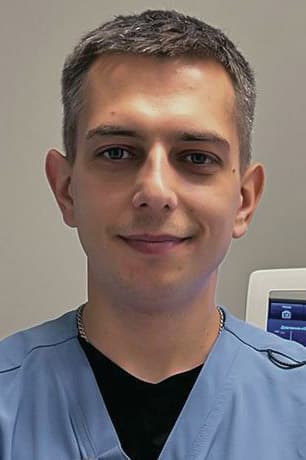
Denis Martsinkevich. Denis Martsinkevich, an anesthesiologist and resuscitator of the Minsk Scientific and Practical Center for Surgery, Transplantology and Hematology, developed an algorithm for detecting early triggers of pulmonary edema in patients in a critical condition caused by liver failure using ultrasound.
According to Denis, work on the project began in 2020. When the COVID-19 pandemic was raging in the country, he began to explore the possibility of diagnosing lung diseases in intensive care patients using ultrasound. Later, I decided to modify the generally accepted approaches.
- My supervisor and I proposed a protocol for a shortened version of ultrasound diagnostics, where only two key points on the body can determine the patient’s condition, and also determined the most advantageous position of the ultrasound sensor in order to better consider those areas that are especially important in imaging the lungs in patients after liver surgery. After that, an algorithm for infusion therapy was developed, Denis Martsinkevich explained the features of his idea.

According to him, the main goal of the project is to teach any doctor who works with patients in critical condition, a simple and quick method with which you can prevent pulmonary edema and choose the right treatment tactics.
- Initially, we simply studied the possibilities of ultrasound diagnostics of the lungs in pneumonia, and as a result we came to a method of preventing pulmonary edema and developing a new modified ultrasound protocol, Denis Martsinkevich noted.
The effectiveness of the method is noted not only by Denis’ colleagues, who also actively implemented such diagnostics in clinical work, but also by many doctors from district hospitals who got acquainted with the algorithm at the course on the use of ultrasound when working with a patient in serious condition at the Minsk Scientific and Practical Center for Surgery, Transplantology and Hematology:
- Sometimes, in the treatment of an intensive care patient, it is simply not possible to perform a CT scan of the lungs, and then our method is an excellent alternative - it helps to perform diagnosis right at the patient's bedside and determine further therapy tactics. I would also like to add that the proposed development has economic benefits, as it is cheaper than existing methods.
As Denis Martsinkevich admits, he had no experience of participating in such initiatives before this competition.
- So it’s especially nice that it turned out to be positive. Of course, such competitions are useful, because with their help you can not only demonstrate your ideas to the general public, but also convey them to the target audience, the young man said.
Speaking about the development of his project, Denis said that he plans to write a dissertation on this topic, publish a textbook, and distribute the method among the medical community of Belarus. Comfort for cows - the pledge of milk yields

Sergei Sapach. Design engineer of the Scientific and Practical Center of the National Academy of Sciences of Belarus for Agricultural Mechanization Sergey Sapach presented a set of equipment for the formation of a microclimate on dairy farms.
- During a visit to one of the farms, we were told that cow milk yields fall in the hot season. Our development is aimed at solving this problem. How does it work? In the barn are installed acceleration fans, which are placed along the forage table on both sides. In addition to them, special frames of pipes with nozzles designed to spray water that comes from a separate pumping station are also attached, Sergey explained the principle. The logic is as follows: if the barn holds high temperature and low humidity, the system automatically turns on fans and supplies water, if the humidity level is also high - only fans work.
Another feature of the system is that the fans are rotary. Thanks to this, they can capture the entire area of the barn with a relatively small number of installed devices.
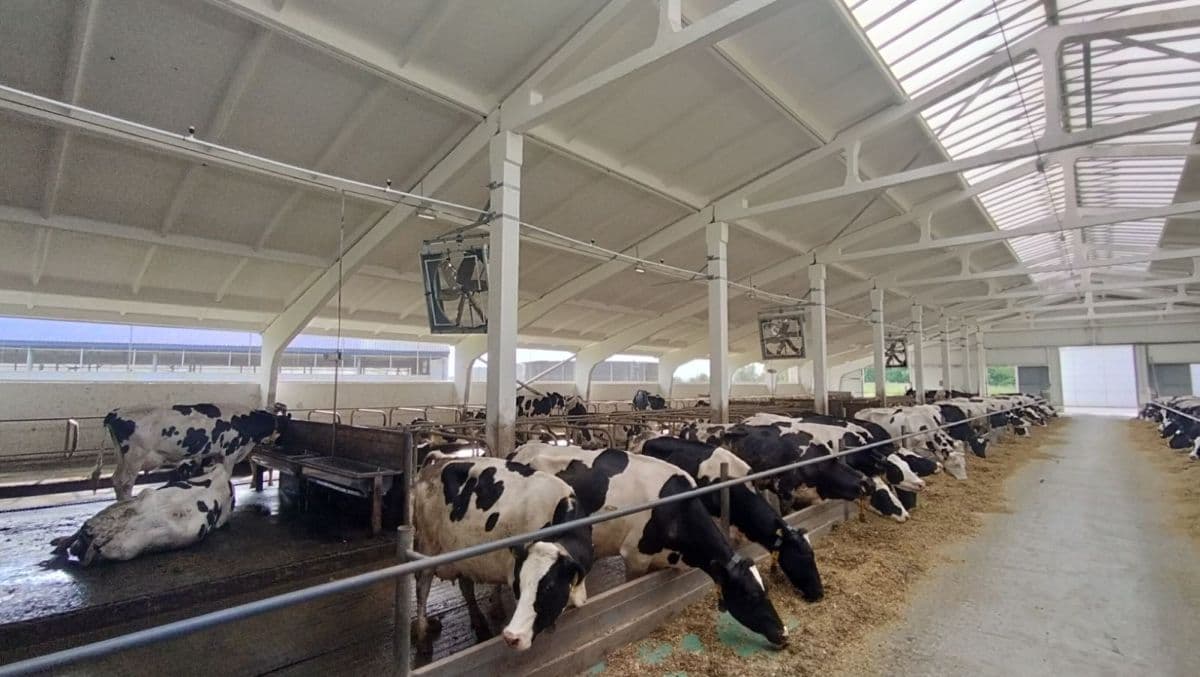
- Technical tests of the development were carried out at a temperature of 32 degrees Celsius. For half an hour of operation of the system, it dropped by 7 degrees and was quite comfortable for the animal 25 degrees. That's not a bad result. Our project is already operating in two farms in Nesvizh and Orsha districts. The leadership is enough, said Sergey Sapach.
He said the project took about two years to complete. At the same time, two prototypes of the system were initially developed - in the pipeline one pressure is about 2-3 bars, the second - 70. Practically it turned out that the efficiency of both installations is approximately the same, but the cost of the second is much higher, in the future it is impractical to produce it.
We have already handed over the design documentation to three organizations that are interested in its release. As far as I know, they already have orders to manufacture the system. For our part, we are ready to make some changes and finalize the equipment, if necessary, the source said.
Speaking about the competition “100 innovations of young scientists”, Sergey noted that such platforms help to assess the commercial potential of their idea, as well as attract the attention of relevant experts.
- Definitely, this is a good start for the implementation of its development, the expert concluded.
kurdo@sb.by


