Golden bird
The long-term environmental project “Preserve golden eagles!” continues: in the Almaty region, another release of incubator predators into the wild took place
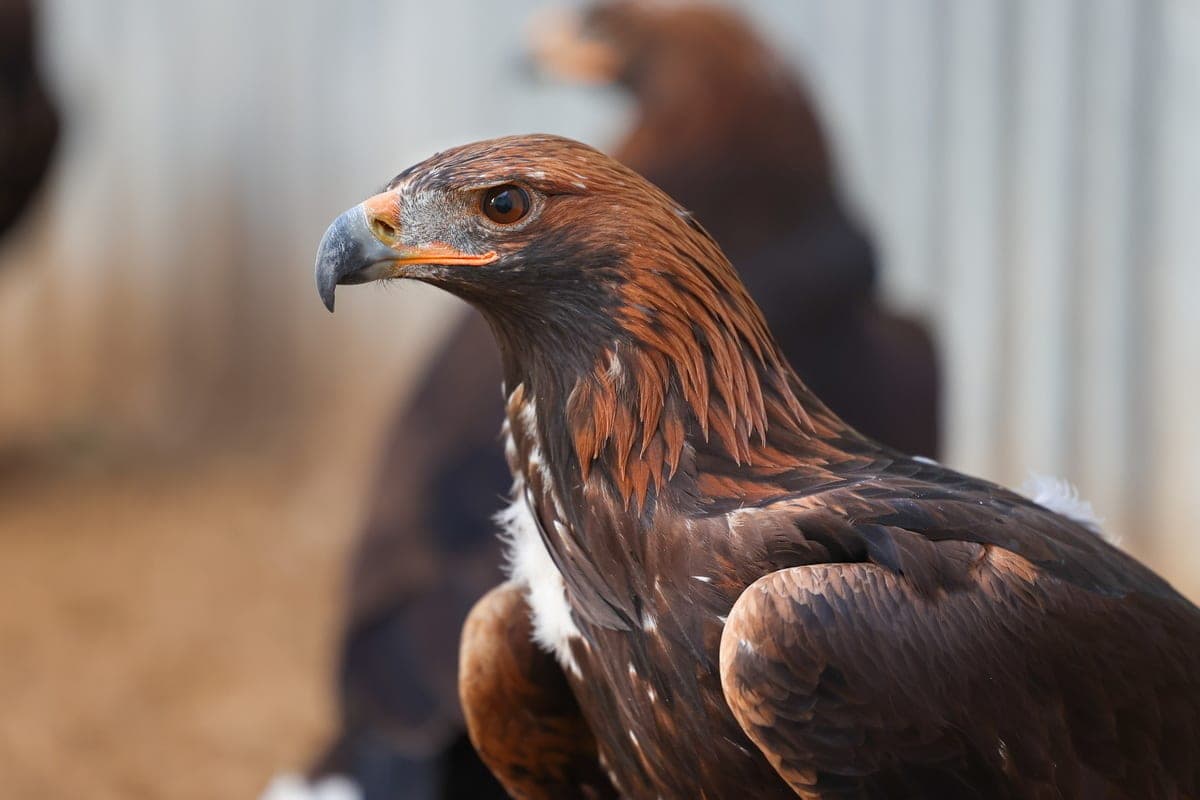
The population of eagles in Kazakhstan remains critically low. Because of this, the bird is listed in the Red Book of Kazakhstan with the status of a rare species with a declining population. At the same time, in the middle of the last century, this feathered predator of the Kazakh steppe felt quite comfortable. Accurate data throughout the republic for that period is not, since large-scale accounting was not carried out, but ornithologists recorded that the eagle was a common species.
A period of sharp decline in numbers occurred in the late 1990s and early 2000s, when poaching flourished in the country. "Entrepreneurs" caught young birds and robbed nests - all for quick profit. As a result, by the beginning of the 2010s, there were only a couple hundred pairs across the country, and in some regions there were only a few.
Now the birds are protected, but this is not enough for the population to recover to its former numbers. To a large extent, this process can be accelerated by rare initiative projects, including “Preserve the Eagles!”. For seven years, thanks to the collaboration of the Sunkar Falcon Center, Efes Kazakhstan and the Institute of Zoology of the Republic of Kazakhstan, 29 birds were released into nature. Last week, seven more individuals were released, which have yet to find their mate and choose a nesting site.
“Berkut occupies a special place in the history and culture of Kazakhstan and is one of the main symbols of our country. Continuing this project for the eighth year, we strive to make a practical contribution to the conservation of biodiversity and natural heritage of Kazakhstan. Today, seven more eagles have returned to the wild, and the total number of birds released within the framework of the project has reached 36, said Chingiz Kaskeyev, director of relations with state agencies of Efes Kazakhstan.
On the eve of the release, a press tour to the Sunkar nursery was organized for journalists, where experts told how birds are raised and prepared for life in the wild. The nursery itself is home to more than 450 birds of prey, only about 15 different species: falcons, eagles, hawks, vultures and vultures, owls and owls. For eagles, which are being prepared for release, a special flight enclosure about six meters high was built, where birds hone their hunting skills and gain muscle mass.
To the main question about the cost of breeding one chick, the director of the center Ashot Anzorov answered abstractly, stressing that the birds come out really gold.
For one eagle, the norm for meat is 500 grams per day, small ones eat twice as much. That is, up to three months, the chick eats about a kilogram of meat per day. But it is not entirely correct to count only food. When you calculate the content of one chick, you must necessarily calculate the content of the parents. That is, at least a year before the birth of the chick, we support the parents. This should also be added to the salaries of employees who monitor the birds, repair and care for the aviaries. Veterinary costs. And the same food. First, it should be diverse: rats, rabbits, chickens, etc. Secondly, closer to release, we give them live food, which also needs to be kept. If all this is summed up, then the bird turns out to be golden, Anzorov summed up.
All chicks raised by Sunkar hatch in the incubator, while the method of gestation itself is hybrid in nature. The expert explained that in the natural environment, many chicks die only because of the wrong position of the egg. That is, in the wrong position, the chick cannot split the shell and dies. In turn, the placement in the incubator completely eliminates this development, since all eggs are illuminated and placed in the correct orientation.
“The first 10-15 days when the egg is laid are very important for the embryo. During this period, we leave it under the mother, as there are ideal conditions for temperature and humidity. When the embryo comes to the hatched one, we lay the dummy and take the egg. After the chick appears, we feed it for two or three days, observe and then return it to the parents, the expert explained.
A completely separate topic is the definition of the place to release. Anzorov noted that the historical habitat of the eagles is well known, but the anthropogenic factor can interfere here. The construction of roads, geological exploration, pastures for livestock - all this acts as stress factors that negatively affect the bird.
Before the release, an expedition is organized, which includes employees of the Institute of Zoology of the Republic of Kazakhstan. The inspectorate assesses the factors of concern, checks the feed base and only then makes a conclusion whether the area is suitable for the release of eagles. The release itself is also not an immediate action. Opening the cells in the steppe, scientists for about a week to observe the behavior of birds.
“Experts must make sure that the eagle is physically healthy, that it flies freely. The first week they feed the birds, release small chickens, rabbits, mullets. Every day, the bird returns less and less to the place of release, as it begins to produce its own food. No one usually returns by the end of the week. Again, the eagle is such a “machine”, it can do everything. In the natural environment, turtles are also included in the diet. Predators catch them, then find some rocky massif, climb 300-400 meters and throw them down. So they break the shell and get to the meat, says Anzorov.
All predators have the most favorable time for release - spring and autumn. Even those who are bred in captivity have natural instincts. Adult birds move from the northern regions slightly to the south, and young can fly long distances, up to the territories of Afghanistan, Pakistan, Iran, etc.
The issue of chipping / tracking, as before, remains behind the scenes. According to Anzorov, today there are many technologies that allow you to track birds even from a smartphone screen. However, pleasure is very costly. The cost of one beacon is from one and a half to four thousand dollars, while they work only one year. That is, it is possible to track the migration of birds, but this requires support at the state level.
The eagle production project should last at least another two to three years, which means that at least one dozen birds in the country will be more.