Documentarians Win Awards for Bold Immersion in Life and the Underworld
The 36th International Film Festival “Message to Man” has ended in St. Petersburg
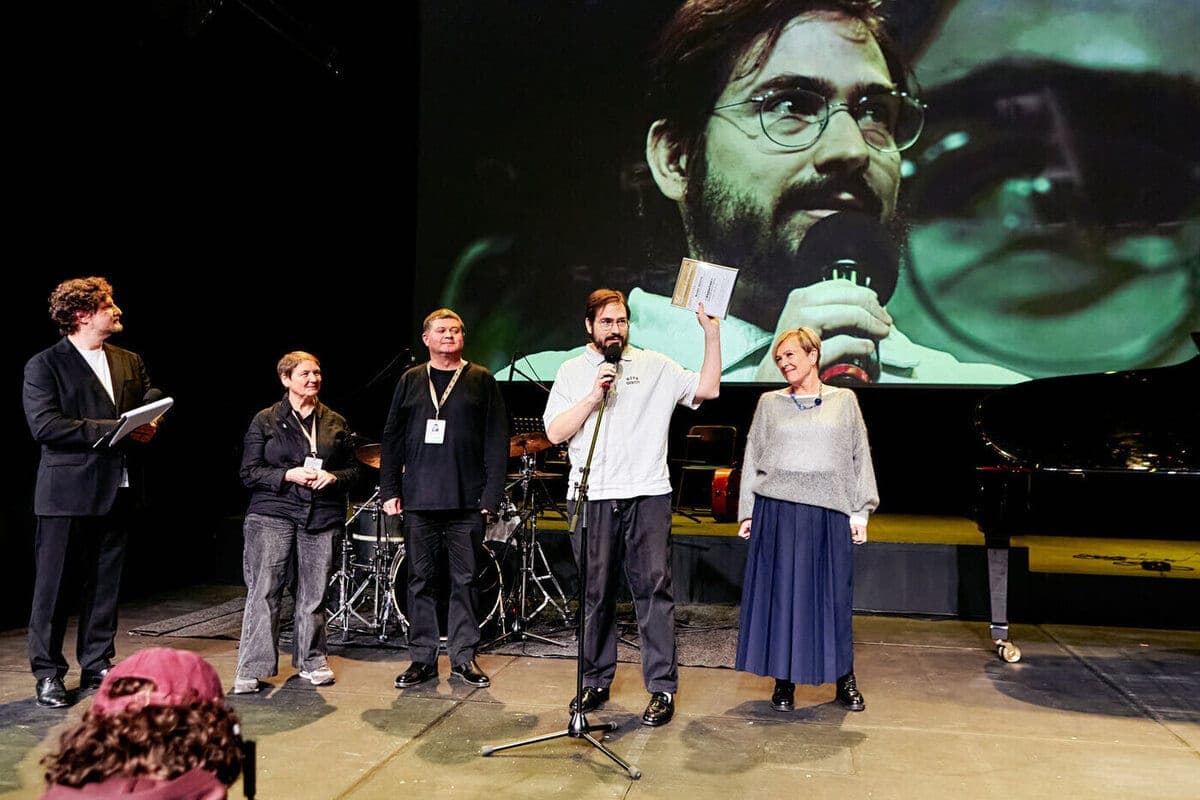
Stavros Psillakis, before becoming a director, worked as an electrical engineer, then studied directing at the film schools of Athens and Paris, became a laureate of many festivals, shot about forty documentary films.
The award ceremony began with the awarding of the prize of the founder of the “Message to Man”, now its honorary president, documentarian Mikhail Litvyakov. He gave his prize to Alexei Fedorchenko for “The Adventures of Mosaics on Earth and Under.” The film director from Yekaterinburg participated in the national competition. Alexey’s world premieres, such as Mitrofan Aksyonov’s Sausage and Ully-Kale’s Big Snakes, also took place in previous years at the Message to Man.
The Adventures of Mosaics seems to have slightly fewer hoaxes than usual, though they may be hidden. The reality of Fedorchenko, a famous master of the mocumentary genre, is more fantastic than any fantasy. Mosaic film seems staid, without branded ridicule, although it may be just an illusion.
Heroes Fedorchenko are in different parts of the world, this time in Minsk and Warsaw, St. Petersburg and Moscow, but can be invented. As one of his characters once said, if filmed, then it was. In the first shots, the director himself appears, very exotic, with a phenomenal beard. On the example of children's mosaics, he very simply explains to uninformed viewers what a mosaic is, what its types exist. And then he talks to people about the fate of mosaic art in Russia, addresses the Frolov dynasty of masters and its ancestor Vladimir Frolov, who created amazing works in his workshop for the Savior on Blood, the Lenin Mausoleum, the Mayakovskaya and Paveletskaya metro stations. Mosaics begin to live their own unique life and are not always used for their original purpose. Cinema is the same mosaic that you fold and you never know what will happen.
The history of the Savior on Blood, where hundreds of tourists flock to St. Petersburg every day, is majestic and sad. The temple was to be demolished in the summer of 1941, but the war changed plans. He survived the blockade, it was equipped with a morgue and a decorating warehouse.
Frolov mosaics rose from the ashes, as happened with the temple of Alexander Nevsky in Warsaw. The surviving treasures were found in Belarus, and now the local priest tells about it. Knowing the creative method of Fedorchenko, you hardly doubt whether it really exists. Although Alexei never lies. It's just that his reality is fantastic.
In the center of Moscow, a theater was built for Vsevolod Meyerhold, they wanted to decorate it with mosaics from the Frolov workshop. However, the great stage reformer was arrested and vanished from the face of the earth. And the mosaics started a very different life.
Frolov’s works on the sketches of the artist Alexander Deineka were supposed to decorate the Moscow metro station “Paveletskaya”, but were partially used on the “Novokuznetskaya”. The Donbass cycle of 14 mosaics was delivered to Moscow before the Great Patriotic War, but was never installed in accordance with the plan. Some of Frolov’s works were buried in the ground. One of the experts in the frame determines where they can be stored.
“Golden Centaur” for the best documentary in the national competition received Elizaveta Bobyleva for the film “Mother” with the formulation “For the ability to remain a director, shooting the closest.” Elizaveta graduated from the Perm National Research University and filmed her film for a year and a half, watching with a camera in her hands for her loved ones, for her mother, who began life anew after her husband left.
“Mother” was awarded the prize named after director Alexander Rastorguev, who tragically died in the CAR, “For the Secret Cinema”. The second award of his name, “For the best directorial debut”, was awarded to Alisa Tamarova, a graduate of the St. Petersburg Institute of Film and Television, for the short film “Before the Sun” about a summer camp on the Black Sea coast, where teenagers experience their first joys and sorrows.
Nikita Kartsev, who started his career as a film critic in MK, received two diplomas for the full-length non-fiction film Shelter. The jury of the national competition awarded him “for his ability to read the secret language of reality”, and the press jury issued a diploma “For resistance to destruction and fear”. Nikita filmed about the city in which he lives, about the premonition of fatherhood.
The awards of the festival have been received for more than thirty years by outstanding masters such as Herz Frank. The last time he attended the Message to Man was in 2007. And now the films of the Soviet-Latvian, and then the Israeli director were shown as part of a retrospective to the 100th anniversary of his birth. He was a brave documentary filmmaker, filming his own death on the operating table. The retrospective included his outstanding paintings: “10 Minutes Older”, “Supreme Court”, “Flashback”. Look at the doorstep, as well as lesser-known works.