
How Russian regions are being robotized
The density of robotization of Russian industries should grow five times by 2030. The volume of the market will help to increase the national project “Means of production and automation”
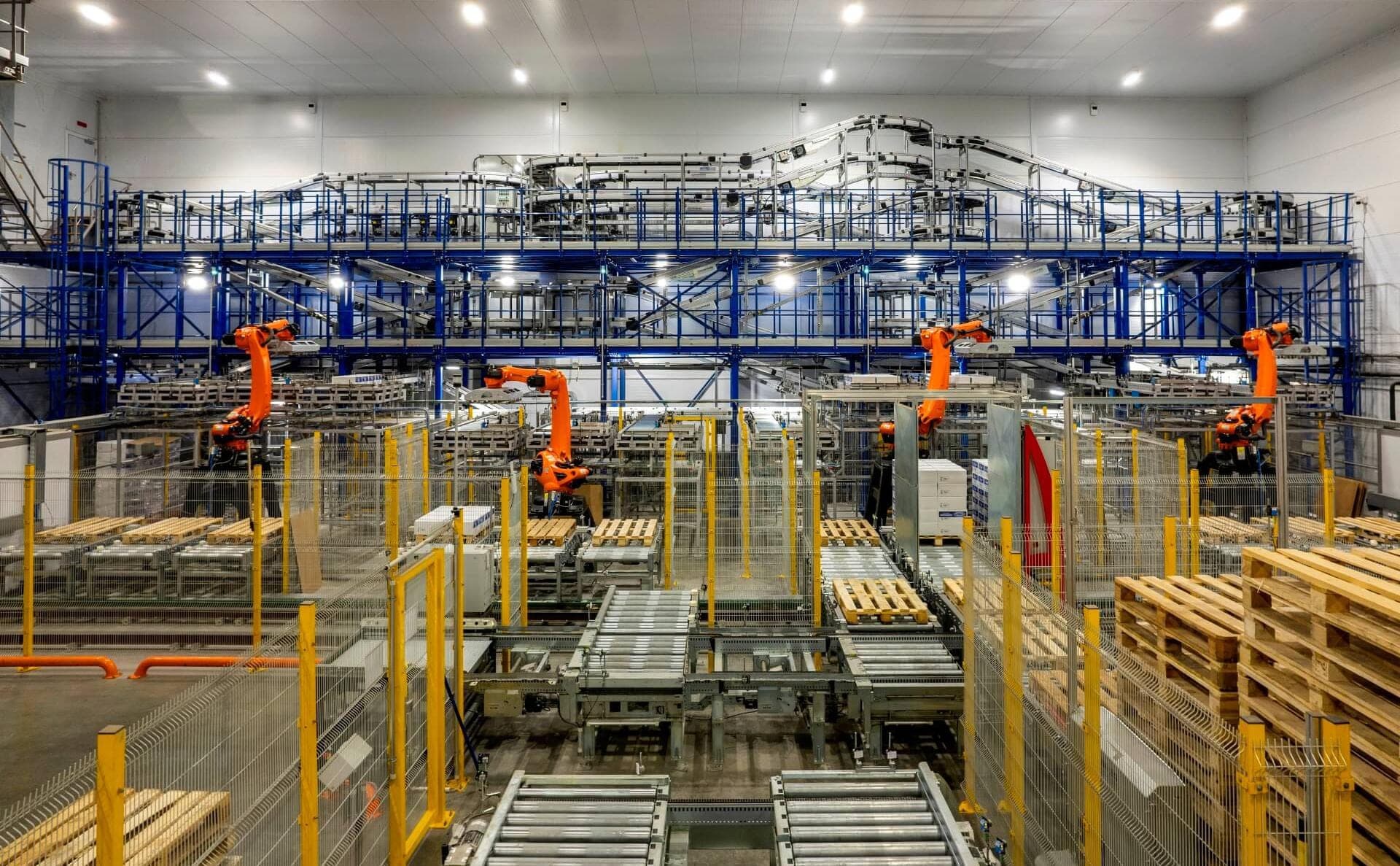
According to the Ministry of Industry and Trade of Russia, by the end of 2025, 21,857 industrial robots were introduced at Russian enterprises. For comparison: in 2023, this figure was 12,841 units. The largest number of robots installed in the Central Federal District — more than 7.3 thousand.
By 2030, Russia should enter the top 25 countries in terms of robotization density – this indicator is recorded in the national project “Means of Production and Automation”. For every 10,000 workers, there will be about 145 industrial robots (currently 29).
According to Rosstat, among the leaders in the introduction of robots in enterprises are the automotive industry, the food industry, metallurgy, pharmaceuticals and warehouse logistics. Alexander Evseenko, Director for Development and Cooperation with Government Agencies of Komitas, a manufacturer of logistics robots, believes that today a number of major players from retail, pharmaceutical industry, and e-commerce show their effectiveness in robotics projects.
How to accelerate industrial robotics
“It is necessary to stimulate not so much the robotization of industries as the development and manufacture of robotic solutions within our country,” says Alexander Rodikov, head of the project office of Uvelka Petfood. The production of machines and robots, along with the stimulation of robotization of domestic enterprises, will ensure the tasks of import substitution and increase productivity. Robots make it possible to create more high-quality goods at lower costs, both human and financial.
According to the Federal Center for Competence in the field of labor productivity, on average, robotization allows to increase the efficiency of the enterprise two to four times due to a continuous cycle of work, high accuracy and speed of operations.
The greatest impact robotics gives in three types of tasks, according to the company “Promobot”. First, these are monotonous and repetitive operations, since the robot works without interruptions, ensuring a stable speed and eliminating errors. Secondly, the loading and unloading of machines – when the robot takes on heavy and dangerous work, freeing the operator for control and adjustment, while the machine does not stand idle waiting for a person. Third, welding and assembly, where repeatability and accuracy are important. In these processes, the robot will give a stable quality, independent of fatigue or skill.
Increasing efficiency of food production
The introduction of robots in the food industry helps to increase productivity, reduce cost and improve product quality. Basically, robots perform operations for moving products and palletizing, as well as sorting, packaging and quality control. According to the Ministry of Agriculture, robotization provides an increase in the overall efficiency of industry enterprises by 42%.
The introduction of automation and robotization are important drivers of increasing the volume of food production in Russia, confirms the study of the National Association of Robotics Market Participants. At the site of one of the largest Russian producers of pet food, the processes of stacking products in corrugated groves are being robotized today. The next step is group packaging on pallets with the application of the marking “Honest sign”. To do this without mistakes, using manual labor, too time-consuming - in the pallet there are more than a thousand packages, says Alexander Rodikov. To increase the efficiency of packaging operations and ensure further production growth, the company uses two palletizers and two casepackers of its own design.
Robotization, according to Alexander Rodikov, has already allowed the Chelyabinsk manufacturer to increase production by more than 50%, to 200 tons per day. He believes that the robotization of product packaging processes is becoming one of the most popular areas in the food and pharmaceutical industries.
How robots help in warehouses
According to the McKinsey Global Institute, the warehousing industry is among the top three sectors in terms of the potential for process robotization. In Russia, the level of robotization of warehouse complexes is still small - it is about 6-7%, Komitas notes. According to her, the total volume of investments in the warehouse robotization market in Russia for the period up to 2030 can reach 230 billion rubles. Alexander Yevseenko predicts that by this time almost 90% of Russian companies will use mobile robots in warehouses.
“Robotization is most effective where there are repetitive routes, high cost of error or a large physical volume: transportation on AMR / FMR robots, equipment – the most loaded areas for most warehouses, where now the principle of “goods-to-person” is increasingly used,” explains Alexander Evseenko. Thanks to this approach, when a warehouse employee stays in one place, and robots deliver boxes with the right loads, you can perform three to five times more operations.
Today, Komitas solutions can be implemented in warehouse logistics for any industry. In addition to conveyor systems and robotic platforms, its recent development is a new generation vertical crossbelt ranger.
This device provides high sorting accuracy and can work with a variety of goods: from small items to standard boxes and parcels. The company released it at its plant with the assistance of the Ministry of Industry and Trade of Russia.
The number of warehouses with large penetration of robots will grow, and new warehouses will immediately be built with zones for the free movement of robots, Komitas believes.
How robots are useful for industrialists and schoolchildren
Some Russian companies are just beginning to take the first steps in robotics. “For such cases, we have developed educational programs and business games for process automation,” says Maxim Borodin, Development Director of Promobot. According to him, collaborative manipulators Promobot M13 are in demand today from machine tool, metalworking enterprises and educational organizations. In 2025, their share of sales accounted for more than 50% of the total revenue of Promobot. The equipment is included in the register of Russian industrial products (in accordance with the PP of the Russian Federation dated July 17, 2015 No. 719 "On Confirmation of Production of Russian Industrial Products"), which gives the company the right to reimburse the costs of providing the buyer with a discount of up to 50% of the cost of the equipment. This measure of support is provided by the Ministry of Industry and Trade under the national project “Means of Production and Automation”. Thanks to it, the manufacturer does not lose profit, and the buyer purchases equipment at a bargain price.
Promobot manipulators, according to Maxim Borodin, are widely used to automate the loading and unloading of parts from machines - this is one of the most popular operations, since it eliminates downtime of expensive equipment and reduces the risk of injuries. Also on the basis of M13 together with the company "XVeld" and the Perm Polytechnic developed a robotic cell for laser wire metal in vacuum. The solution allows you to grow parts of complex geometry with high quality and work with materials sensitive to the atmosphere, including titanium alloys.
In addition to the industrial segment, Promobot M Edu educational manipulators are actively being introduced into schools, colleges and universities throughout the country. The equipment has already been delivered to dozens of educational institutions from Kaliningrad to Chukotka, educational programs and methodological support have been developed. With the help of these robots, schoolchildren and students learn programming, automation and mechatronics in practice.
For example, in the Orenburg Humanitarian and Technical College, students program machines for the tasks of local enterprises: assembly, sorting and welding. And in the Chukotka village of Coal Copy Promobot M Edu is included in the program of additional education. This is a systematic work on the formation of a personnel reserve for the industry, says Maxim Borodin.
In the next five years, the number of locomotives of the Russian industry will include industrial robots, said at the exhibition “Innoprom.Belarus” the head of the Ministry of Industry and Trade of Russia Anton Alikhanov. He stressed the variety of support measures available in this area, and also highlighted the importance of the work of the centers for the development of industrial robotics.
The Russian robotization market is in a phase of active growth. Many projects are scaling, showing efficiency, and, as a result, robotization will become more accessible for small and medium-sized businesses, sums up Alexander Evseenko.
