How Microfluidics Accelerates Import Substitution in Chemistry
Microfluidics is designed to reduce the industry's dependence on imports and increase its own technological competencies - a technology that accelerates the development of new substances and the transfer of processes from the laboratory to production
For many years, the Russian chemical industry depended on imports: active substances for drugs, catalysts for petrochemicals, special materials for electronics were imported from abroad. However, at present, this dependence has decreased significantly: domestic production is growing in a number of segments, new technological chains are being mastered. The industry is developing with the support of the national project “New materials and chemistry”. One of its goals is to replace critical chemicals and bring the industry’s technological independence to 100% by 2030. By the same time, the volume of production of the chemical industry should exceed 11 trillion rubles, and the share of imports of chemical products in the volume of consumption will decrease to 30%.
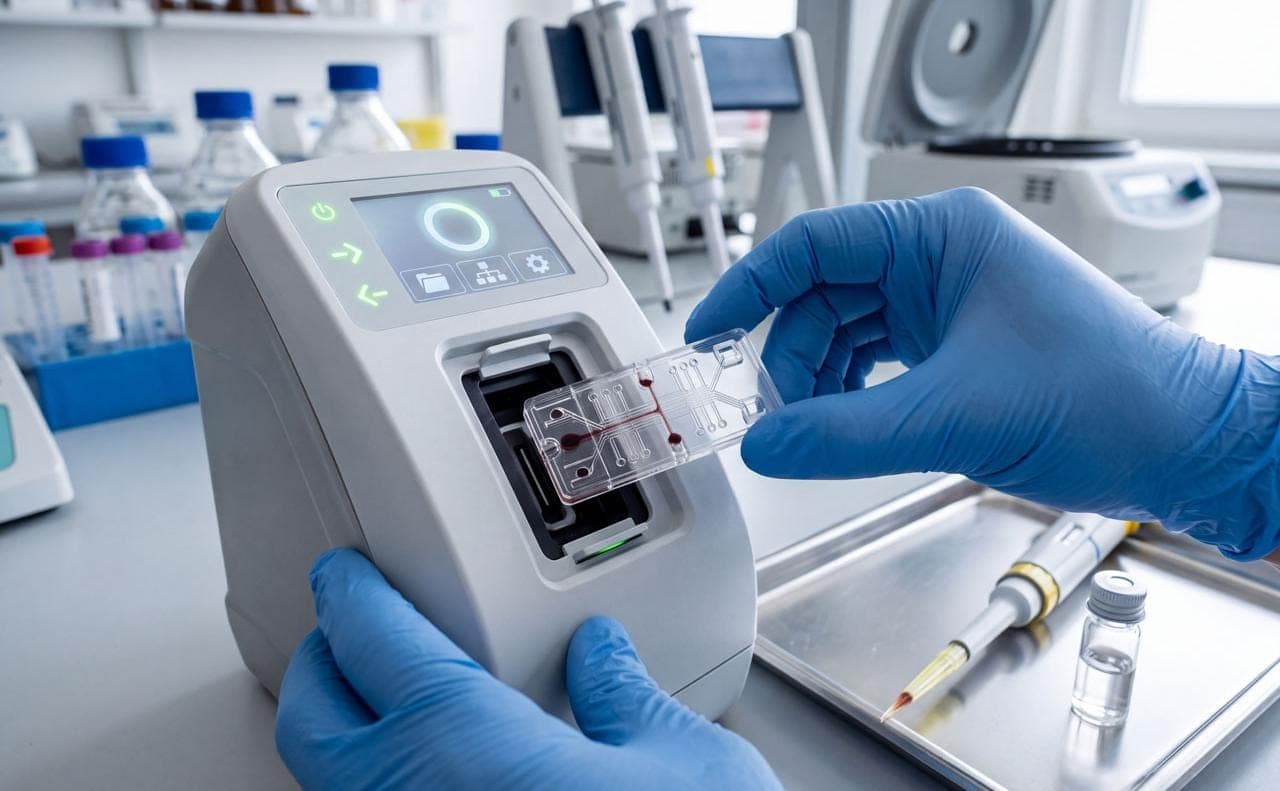
Traditional chemical synthesis in laboratory flasks and industrial reactors is a slow and expensive process: to create a single product, it takes years of trying out recipes. The tool that makes this task feasible is microfluidics, or flow synthesis. Here, the reaction is not in portions in a large reactor, but continuously in thin channels: the substance flows through a transparent chip the size of a bank card, and the entire reaction is visible through a microscope.
There are enough microliters of reagents, so hundreds of experiments can be carried out per day. The process used on the chip does not have to be developed anew: during the transition to industrial production, the channel is expanded, several modules are installed in parallel and retention time is increased - the selected conditions are transferred to the workshop without reworking. Domestic microfluidic systems withstand pressure of more than 600 atmospheres and temperatures up to 400 degrees.
From flask to chip: how flow fusion works
When transferring the process from the laboratory to the plant, it is important to preserve the conditions on which the output and quality of the product depend. In a microreactor, the heat exchange area relative to the volume of the mixture is much larger than in a capacitive reactor, so heat is dissipated faster, explains the founder and CEO of Arska Tech Artem Volovikov (the company is engaged in engineering chemical production). The special geometry of the channels allows, according to him, to control the mixing of reagents and the time of their stay in the reactor. This ensures more stable quality and reduces risks when working with hazardous substances: at the same time, a small amount of reagents is in the system. Performance is increased by combining the same channels and modules: the tested reaction conditions are preserved.
An example of practical application is the Center for Micro and Low-tonnage Chemistry at the Southern Federal University (SFU): microfluidic platforms there are controlled by artificial intelligence, which allows you to move from laboratory methods immediately to production, bypassing the expensive pilot stage. Among the pilot processes is the synthesis of metal-organic frameworks for hydrogen storage and functional silica for catalysts. Sibur, together with SFU, uses microfluidics to develop a domestic catalyst for the production of premium polyethylene, which is now imported from China.
According to Minister of Industry and Trade Anton Alikhanov, microfluidic technologies make it possible to make the production of small and medium-tonnage chemicals - substances that produce in volumes from kilograms to thousands of tons per year - cost-effective without scaling as in China. “And most importantly, it is necessary if we want to claim technological leadership,” he said at a meeting of the chemical industry and bioeconomy subcommittee in Omsk in the spring of 2026.
Technology developed in laboratories does not always reach the plant. The main limitation, according to Artem Volovikov, is the complexity of organizing the transition from a laboratory result to a sustainable industrial process. Customers are reluctant to invest in this transition and want to buy off-the-shelf technology without scaling risks. The company needs to confirm the possibility of long-term operation of the plant on real raw materials, solve the issues of sediment formation in the channels and product purification, check the cost of production. “I would prioritize affordable pilot sites and financing projects with the participation of the future industrial customer before the release of the first commercial batch,” says Artem Volovikov.
Such sites are already appearing: in Russia, an infrastructure is being formed that translates microfluidics from laboratory exotics into an industrial tool - microfluidic technology centers are being created within the framework of the national project New Materials and Chemistry.
From testing to production site
The Center for Microfluidic Technologies of the Titan Group of Companies opened in Moscow in December 2024 - a platform for the development of technologies and production of equipment for microreactor synthesis in small and medium-tonnage chemistry. The goal is to shorten the path from laboratory development to industrial production.
The company produces metering systems, microreactors-mixers and thermostat reactors; the design capacity is more than 250 pumps and up to 360 tubular reactors per year. According to Mikhail Sutyaginsky, Chairman of the Board of Directors of GC Titan, the center solves two tasks of the national project - creates domestic equipment and accelerates the development of technologies for obtaining demanded substances.
During the first year, the center conducted equipment tests together with SFU, ITMO University and St. Petersburg State Technological Institute (Technical University) - SPbGTI (TU). With SFU, the company has completed research and experimental work on allyl alcohol, gamma-butyrolactone and propylene oxide, is working on technologies for obtaining silica fillers; the microfluidic system was tested on tin octoate (analogue of DABCO T-9), siloxanes and materials for membranes.
“The key advantage of the microfluidic approach is the precise control of reaction conditions in a small volume: narrow channels allow controlling heat transfer and accelerating synthesis. According to the SFU, the reaction time was reduced by two to ten times, the yield exceeded 90%. The second advantage is modularity: performance is increased by parallel connection of modules, notes Mikhail Sutyaginsky.
"Titan" forms technical tasks and conducts an examination of solutions. The advantage over foreign analogues is the combination of own equipment development and technological support in Russia. In a project with a large petrochemical company, over 50 formulations were processed in 20 days instead of many months and the target product yield was more than 99%. The same technology is transferred to the synthesis of pharmaceutical substances - without a new workshop and imported equipment, emphasizes Mikhail Sutyaginsky.
Microreactors ready for deployment
The Department of Optimization of Chemical and Biotechnological Equipment of SPbGTI (TU) developed the theoretical basis for the functioning of several new classes of microreactors. Employees of the department conducted experimental studies and synthesized more than 25 types of materials with improved characteristics. When synthesizing inorganic materials with specified properties - catalysts, sorbents, pigments - the productivity of one device reaches 200-300 kg per day (about 7 thousand kg per month), and five to six such installations can be placed on the desk area.
Among the developed types are devices with twisted flows and colliding jets for obtaining nanoscale and submicron particles, microdispersants for fine mixing and crushing of droplets, microreactors and microbioreactors for synthesis of organic substances in two-phase streams. Microscale heat tubes and microheat exchangers for heat removal and a continuous microscale autoclave – a high-pressure reactor for hydrothermal synthesis of nanoscale particles – were also created.
The institute emphasizes: the peculiarity of developments is the possibility of direct use in production. Patents of the Russian Federation have been obtained for methods of synthesis and device, and a number of industrial enterprises and institutes of the Russian Academy of Sciences have already expressed interest in acquiring installations.
Skoltech: the link between laboratory and production
Skoltech University in 2027-2030 plans to create a Center for the development of technologies of microfluidics and flow synthesis to give the industry access to the development infrastructure and prototyping, which is now almost non-existent in the country. The work of the center will be aimed at solving the problems of the national projects “New materials and chemistry” and “Effective and competitive economy”. It is designed to close the gap between the laboratory and production: it will develop and scale technologies, create prototypes of reactors and prepare initial data for design.
According to the Ministry of Industry and Trade, the share of imports in the consumption of small and medium-tonnage chemicals is 31%. The national project “New Materials and Chemistry” is intended to reduce it, which provides for the creation of 23 technological chains for the development of domestic chemical production. However, each new substance requires its own technology and equipment, and without multiple acceleration of the prototyping cycle, this task cannot be solved, said Alexey Cheremisin, director of the Skoltech Center for Hydrocarbon Science and Technology.
The cycle includes three stages: testing the process on a microfluidic chip, its transfer to a flow reactor with subsequent testing and the creation of an industrial plant. The first two require rapid prototyping, which is what the center is aiming for. In the microreactor at every moment there are grams of reagents, so nitration, diazotation and hydrogenation cease to be a safety limitation. In world practice, flow synthesis already gives such results: in China, at the production of Zhejiang Weihua, the diazotization time was reduced from eight hours to seconds, and the payback period was less than 20 months.
The center plans to engage in design, modeling, prototyping, production of pilot batches, testing and small-scale contract production. “High-tech companies are growing around such centers: they create new flow synthesis systems, become contract manufacturers of low-tonnage chemicals, and an industry ecosystem is gradually developing,” notes Alexey Cheremisin.
The demand confirms the experience of Labadvans, which grew out of Skoltech and already supplies microfluidic solutions to oil and gas customers – seven graduates of the institute work in it. At the same time, the center will be responsible for standardization and certification and will train process synthesis engineers.
Each of the centers has its own specialization - from the production of equipment to the development of technologies for a specific customer. But the task of the national project is broader - to form not individual production, but integral technological chains.
For several years, microfluidics has gone from single laboratory installations to centers that are ready to produce equipment and work out technologies to order. The national project “New Materials and Chemistry” sets goals and allocates resources, but the transition to working production depends on how quickly it will be possible to create pilot industrial infrastructure and find customers willing to invest in scaling, experts emphasize.