
Germany - Time, back! From pensioner to pioneer
The University of Bonn reported the results of a study published in the journal Aging Cell. The University Hospital Bonn and Aachen Technical University (RWTH) also participated. Professor Oliver Bryustle's team studied the precursors of red blood cells. The oldest donor was 101 years old. In the material from an 80-year-old person, after reprogramming, the epigenetic “clock” showed an age of less than 20 years. German news in Russian
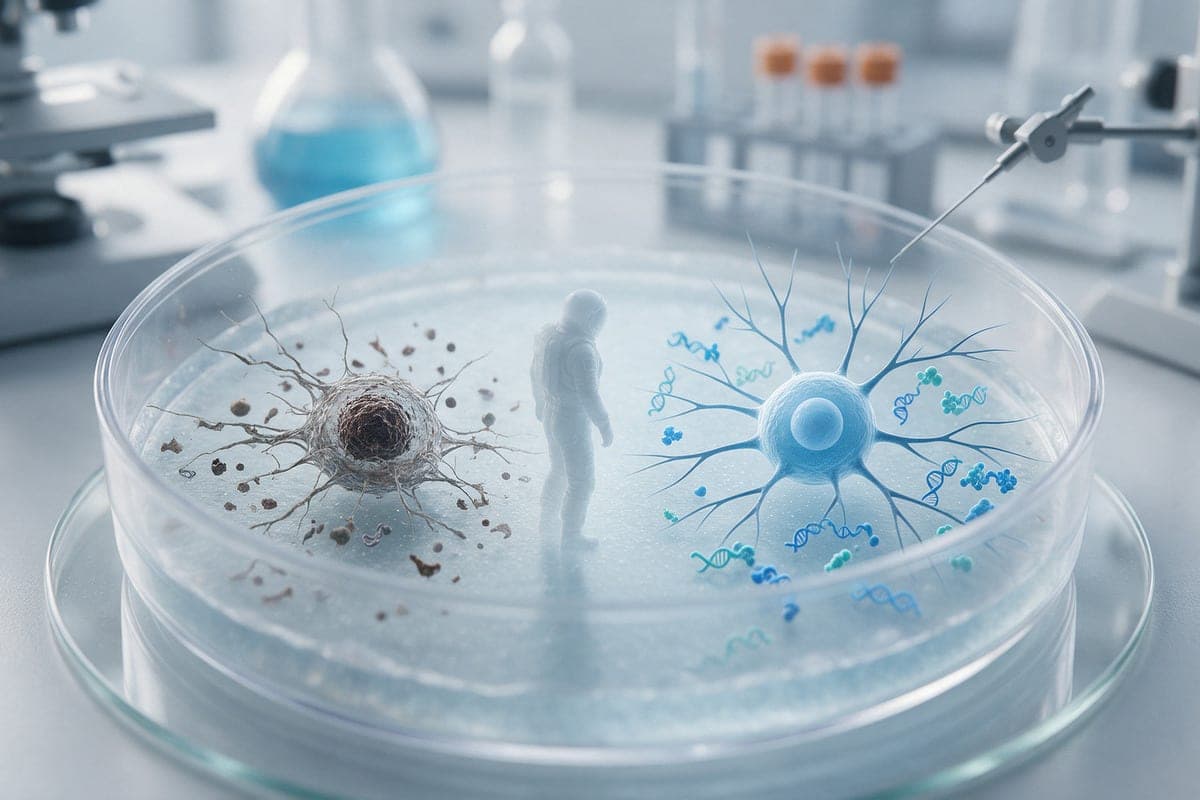
Time has an amazing privilege: it promises nothing, but always takes its own. Over the years, a person loses strength, and the body is slowly recovering. However, German biologists have shown that some molecular traces of age can be erased by changing the cell's profession.
In the Bonn lab, the chemical labels on DNA gradually changed, as if someone were rewriting a cellular biography. The molecular clock went backwards - without a time machine and miraculous serum. But is it possible to achieve this effect in the human body without paying too high a price?
Minus 60. But who?
On October 9, 2026, the University of Bonn reported the results of a study published in the journal Aging Cell. The University Hospital Bonn and Aachen Technical University (RWTH) also participated. Professor Oliver Bryustle's team studied the precursors of red blood cells. The oldest donor was 101 years old. The researchers turned these cells into neural stem cells, from which cells of the nervous system can subsequently be obtained. In the material from an 80-year-old person, after reprogramming, the epigenetic “clock” showed an age of less than 20 years.
Six decades seem to have been erased from biography. But the caveat is fundamental: the donor is not younger. We are talking exclusively about cells in the laboratory and certain molecular parameters.
Passport for cage
Date of birth is not the only way to estimate age. DNA stores hereditary instructions, and chemical tags help regulate gene activity. Over the years, the pattern of these marks changes. According to him, scientists calculate epigenetic age - indications of a peculiar biological clock. After cell transformation, the numbers dropped dramatically. The authors found other signs characteristic of a younger condition. However, this does not mean complete biological renewal. The clock reflects only part of the aging process; in addition, the cells changed their specialization, which should also be taken into account when assessing the experiment.
Change of profession
In the common two-step approach, the cell is first returned to a pluripotent, almost universal stem state, and then directed to a new specialization. The Bonn team passed that stop. Two regulatory proteins, SOX2 and cMYC, helped blood cell precursors directly become neural stem cells. The main find is not only the impressive “minus 60”, but also the opportunity to see the process in development. Most of the age-related epigenetic traits disappeared in about 50 days, and the follow-up lasted over a hundred. Instead of the usual “before” and “after” images, scientists received an almost time-lapse chronicle of changes.
Cellular “rejuvenation” itself is not new: in 2022, British researchers reported a decrease in the molecular age of skin cells by about 30 years. The Bonn method is especially interesting because it allows you to observe restructuring for a long time and find out what substances can accelerate or slow down its individual stages.
Brain instead of mirror
The hopes of researchers are not associated with cosmetology, but primarily with diseases of the nervous system. Age is a major risk factor for Alzheimer’s and other neurodegenerative diseases. Understanding cellular mechanisms could open up new avenues for studying them and finding treatments.
Earlier, the Bonn group showed in experiments on mice: neurons obtained in this way are able to establish connections with nerve cells of animals. But the results of the experiment in mice do not mean success in patients. There is no cure for Alzheimer's based on current work.
An injection into the future
Meanwhile, in the United States, another method of partial cellular reprogramming is being tested on humans. Experimental gene therapy ER-100 is injected into the eye in patients with optic nerve lesions. The goal is to change the age-related properties of cells without depriving them of their usual functions. On October 8, developer Life Biosciences reported the first data on three participants with open-angle glaucoma. No serious adverse events were observed for 56 days. Two showed preliminary signs of improvement in their field of vision.
However, this is the message of the company itself, the group is small and there is no control comparison. Phase one trials primarily evaluate safety; the therapeutic effect has yet to be proven. This technology is not directly related to the Bonn experience.
Reset price
Why not turn on the countdown all at once in the body? Because the cell is not a smartphone with a “reset” button. Reprogramming can disrupt its functions, and errors in the control of division can increase the risk of tumors. In addition, a young epigenetic profile does not promise a person additional decades of healthy life. In Bonn, there was no cure for old age. Scientists have obtained a tool to observe how certain signs of cellular aging recede, and to understand the causes of these changes.
Passport years have not been canceled yet. But the cell clock seems to have reversed. Now the main thing is to find out whether it can be used without breaking the mechanism itself.
This is what Germany says:
Germany – Shamond: evidence is there, no verdict. In France, the first infected virus in Germany on farms. Epidemic or anxiety without cause?
Germany - Who will check the last yes? German experts have developed 45 recommendations to assess the voluntariness of the decision to die. Where does freedom of choice end when necessary help is not available?
Germany: Experience and Prejudice. After fifty, even a rich resume does not always open the doors of the personnel department. What will help – a new diploma, a subsidy or a rejection of stereotypes?
Germany is looking for a discount with a flashlight. The prime ministers agreed, but not the money. Who will pay the promised discount on electricity?
Germany: Love and the Blue Pills. When to take, how long to wait and why not repeat the dose at your own discretion? Medical rules of the most intimate medicine
Germany - Mold is eating the treaty. When housing deficiencies allow you to require a reduction in rent or early termination
Germany: Don’t be born healthy, be born private. While patients with different insurances compete for a place with a specialist, the authorities want to make the queues fairer, but doctors are afraid of new restrictions
Germany – The investigation is conducted by gas stations. The treasury will miss 2.5 billion euros, drivers - the promised benefits. How not to overpay for a full tank?
Germany - Ear on charge - silence in retirement? Medicine opens up new ways to return to sound and human communication. What do modern implants give and why does the brain play a crucial role?
Germany - Who planted chlorine? After the alarm in the "Subtropical Bathing Paradise" under suspicion came chemistry. Two people were taken to hospital. But the main "suspect" found an unexpected alibi
Germany - Ivan Vasilyevich changes the excise tax. The German Ministry of Finance inadvertently moved the tobacco reform from 2027 to October 2026. How did one line of the law nearly stop factories and why can a pack of cigarettes cost almost €12?
In the morning money, in the evening chairs? Merz counted nearly 230 billion euros of investment. But the file found old promises. Who will make the real money, and when?
