
Israel’s Imports-2026: Green Taxes Become a Red Cloth for the Market
October 2026 was the month when Israeli imports re-emerged, not just in numbers, but in drama worthy of Swift’s pen
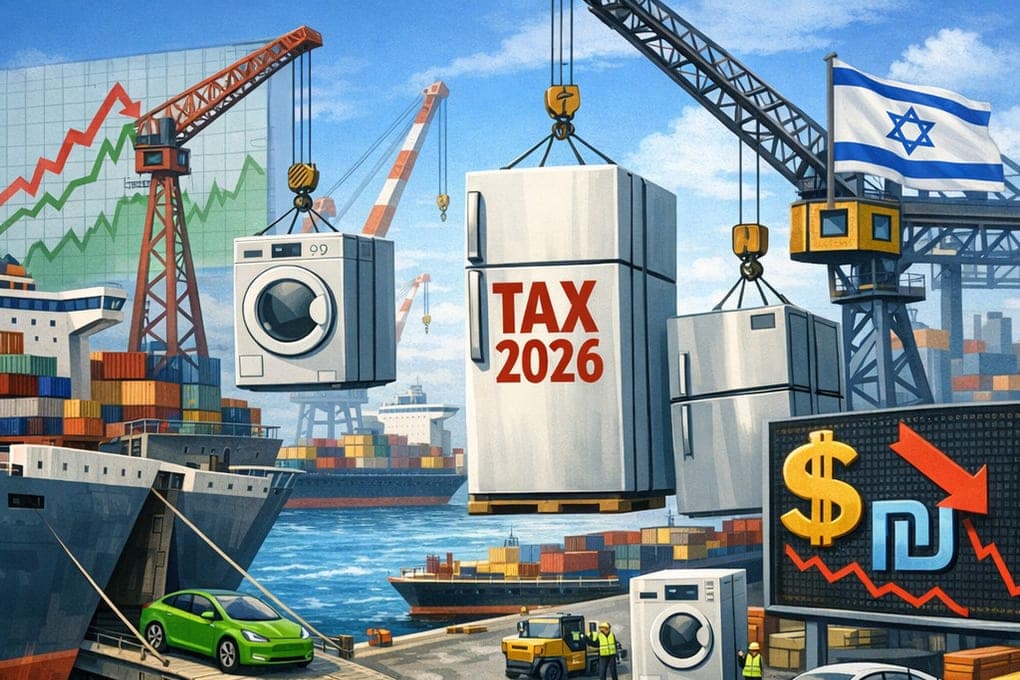
Imports are not just statistics, but a mirror of an era
In Israel, where even the weather sometimes seems to be the result of parliamentary intrigue, imports have long ceased to be boring bookkeeping. October 2026 is a clear proof of this. This month, as if at the command of the director, all the main characters of the economic play took to the stage at once: cars, household appliances, tobacco, fuel and, of course, the eternal antagonist - tax policy.
Car Theatre: Green taxes and mass escape in December
Let’s start with cars – they were the real heroes and victims of the tax drama this year. In October 2026, 24,399 passenger cars were imported to Israel - 25.3% more than a year earlier. Commercial transport is also not behind: plus 32.8%. But don’t be in a hurry to applaud – behind this growth lies not so much real demand as the low base effect. October 2025 was abnormally weak, because in December 2024 the country experienced something of a “car panic”: importers, anticipating an increase in the tax on electric cars from 35% to 45%, staged a mass importation to meet the tax guillotine. Economic historians may someday compare this December to sugar queues in the late Soviet Union - only instead of BYD and Hyundai sugar, and instead of scarcity, excess in warehouses.
In January 2026, the tax on electric cars increased again to 48%. And again, as notes say, in December 2025 there was another, albeit more modest, import race. As a result, the whole of 2025 the market was recovering after the December marathon, and 2026 was a year of recovery and new records: 246,559 cars were imported in January-October - 40.4% more than in the same period last year.
Israel’s tax policy encourages not so much the environment as the creativity of importers and accountants. Each new round of green tax turns into a massive import flash mob, and the market into a field for tax maneuvers.
Currency swing: when the dollar is cheaper, warehouses are full
But it's not just taxes that dictate the rhythm of imported symphony. In 2026, another conductor appeared on the stage - the dollar rate. From February to June and August, the shekel strengthened, and importers, without waiting for new tax surprises, rushed to seize the moment. The result is another spike in imports, especially noticeable against the backdrop of a sluggish 2025.
Home appliances: refrigerators in ecstasy, dryers in depression
If cars are a drama, then the appliance market is a comedy of positions. In October 2026, the import of refrigerators increased by 59%, washing machines - by 27.7%, dryers - by a modest 1%, but dishwashers decreased by 11.8%. But it is worth looking at the accumulated data for the year, and the picture changes: refrigerators and dryers are in the negative (-9.8% and -48.2%, respectively), but washing machines and dishwashers are in the positive (+27.4% and +15.1%). Here, as in the old joke: "The average hospital temperature is normal." The Israeli consumer seems to have decided that cleanliness is more important than cold, and you can dry laundry on the balcony.
Television: Stable Growth in an Age of Change
Against this backdrop, the TV market looks like an island of stability. In October, imports increased by 15.6%, and in ten months - by 16.7%. Apparently, Israelis prefer to watch tax battles and currency storms comfortably on new screens.
Tobacco paradox: fewer cigarettes, more dollars
The tobacco market occupies a special place in this play. In October 2026, the import of cigarettes in physical terms decreased by 5.6%, but their dollar value increased by 20.7%. How is that possible? It’s simple: the shekel has strengthened, global tobacco prices have risen, and excise taxes – even more so. As a result, each pack imported costs more, although there are fewer of them. This is the case when a smoker pays for bad habits not only with health, but also with the exchange rate. Imports of other types of tobacco (for hookahs, cigars, pipes and heating devices) fell by 20.7%, possibly in protest against the Treasury’s tax ingenuity.
Fuel: Gasoline decline and diesel paradox
September 2026 brought a decrease in gasoline marketing by 4% compared to September 2025, and for the year by 1%. Diesel, by contrast, fell by 9% in September, but grew by 3% at the end of the year. There are two reasons at once: first, Sukkot in 2026 fell in September, which means less trips and fewer gas stations; secondly, the growth in the number of electric vehicles is gradually undermining the demand for gasoline, but commercial transport is still holding on to diesel.
International context: Israel Between Green Rhetoric and Fiscal Reality
Amid the global electric-vehicle boom, with Europe and China competing in subsidies, Israeli politics looks like a paradoxical hybrid: on the one hand, the Netanyahu government is broadcasting its commitment to the green agenda from the podium, on the other hand, raising the tax on electric cars every year, turning the environment into a source of budget revenues. Chinese brands like BYD and Korean giants like Hyundai and Kia are forced to maneuver between new tariffs and demand, while European manufacturers are forced to find trade-offs between price and environmental image. Israel, as always, is going its own way: it is encouraging the import of electric cars... to immediately impose a new tax.
Israel’s “green” reform is one in which the state simultaneously rewards and punishes sustainability, while the market learns to live in a state of permanent tax schizophrenia.
Imports as a Mirror of Politics and Society
October 2026 was the month when imports again turned into an arena for political, economic and even cultural battles. Behind each figure is a story: how taxes shape market behavior, how currency fluctuations stimulate importers, how seasonal holidays affect the fuel balance, and international trends affect local paradoxes. Israel, as always, remains a country where even imports are not just statistics, but a reflection of the national character: inventive, ironic, able to turn any reforms into an occasion for new stories.
Summary tables
Car Imports - October 2026 vs October 2025
Category Oct 2025 (s) October 2026 (s) Growth (s) Growth (%)
Passenger cars 19,478 24,399 4,921 +25.3%
Commercial vehicles 760 1,009 249 +32.8%
Accumulated growth Jan-Oct 2026 / Jan-Oct 2025: +40.4%
Import of household appliances - dynamics
Goods Oct 2026 g/g (%) Jan-Oct 2026 g/g (%)
Refrigerators +59.0% -9.8%
Washing machines +27.7% +27.4%
Dryers +1.0% -48.2%
Dishwashers - 11.8% + 15.1%
Television imports
Period of Izm (%)
October 2026 / October 2025 +15.6%
January–Oct 2026 / Jan–Oct 2025 +16.7%
Cigarette imports - October 2026 vs October 2025
Indicator Izm October 2026 g/g Interpretation
Number (s) -5.6% Physical volume decreased
Cost ($) +20.7% Rising price/excise/currency
Fuel imports (September 2026)
Fuels Saint 2026/Saint 2025 (%) Janv–Saint 2026/Janv–Saint 2025 (%)
Gasoline - 4% -1%
Diesel -9% +3%
Total imports of Israel
Period Total import Imports Y/Y (%)
October 2026 $10.5 billion +44%
Visualization: Import of Israel - October 2026
Summary:
Israeli imports in 2026 are not just a set of figures, but a chronicle of an era where every government measure, every currency spike and every seasonal holiday becomes part of a big economic spectacle. And as always, the audience — you and I — are watching this with interest, irony and hope that the next act will be equally exciting.
