Our main bet - on the fusion of grain growing experience and active young energy - has been justified
Autumn time for farmers is a time of summing up, evaluating the work done and honoring those who, with their selfless work, provide...
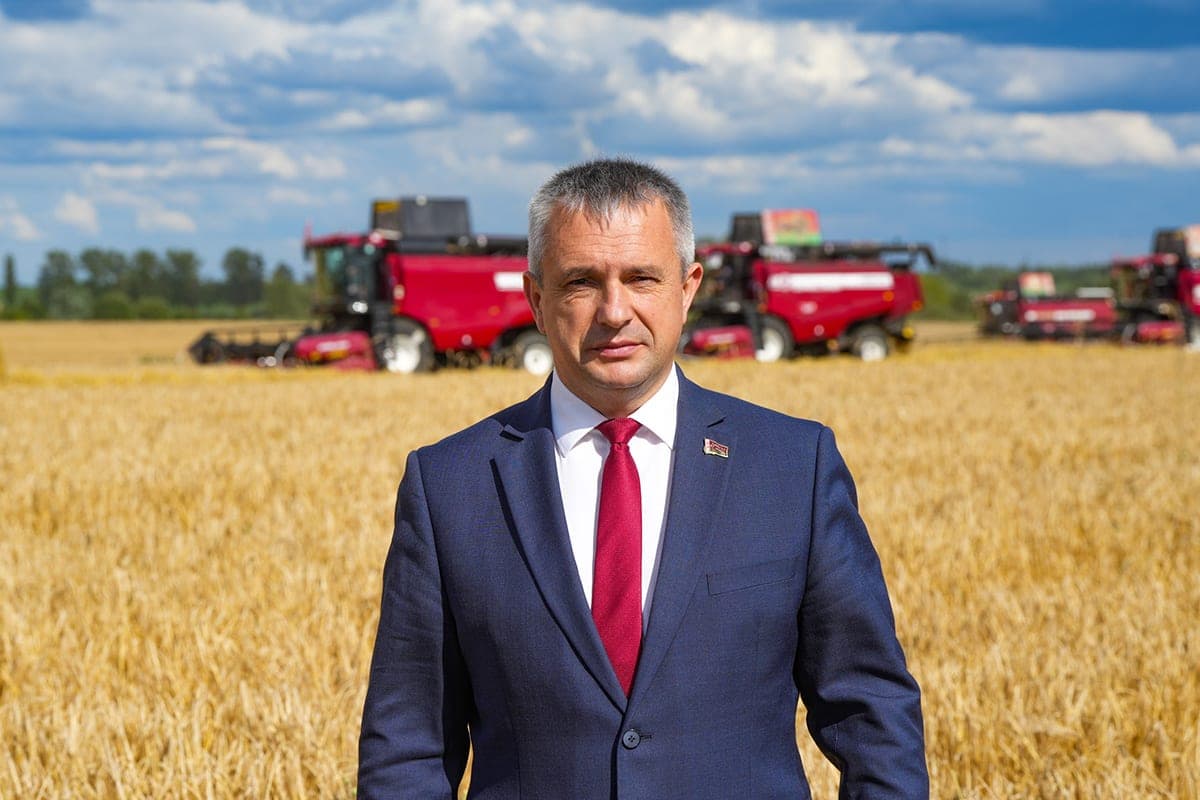
Autumn is a time for farmers to sum up the results, assess the work done and honor those who, with their dedicated work, ensure the food security of the country. In 2026, Gomel region made a significant contribution to the general republican loaf, proving that even in conditions of risky agriculture, you can take landmark milestones.
On the eve of the regional festival of grain growers "Dazhynki-2026", which will be held today in Kalinkovichi, the chairman of the regional executive committee Ivan KRUPKO answered the questions of the SG correspondent.
Ivan Ivanovich, farmers of the Gomel region almost every year have to pass the test for strength. 2026 was no exception. To what extent did the vagaries of the weather adjust the plans, how did they affect the winter crops sown last autumn, and did I have to shift the timing of spring sowing?
- There are no simple periods in agriculture, and this season has once again demanded maximum concentration from us. A long spring with precipitation was replaced by May frosts and summer moisture deficit. However, a worthy result of this year confirms that our agrarians managed to quickly navigate in difficult climatic conditions. We found the necessary balance of time and moisture in time, quickly joined the work and sowed early spring crops in the shortest possible time.
But we must understand that agriculture cannot pause. This is very important for winter crops, which before leaving in winter must accumulate the amount of active temperatures and synthesize substances for wintering. Our people understand this, so all forces are mobilized on autumn sowing. On the sowing of early spring factors even more: there any delay threatens to dry the soil, especially on our light lands, so in the spring the timing should be as compressed as possible. In this regard, in recent years, we have shifted the focus to the winter wedge: these crops use spring moisture more effectively and manage to pass critical stages of development before the onset of summer heat.
- Despite the resistance of nature in past seasons, this year the region has overcome important production milestones. What are the final figures for the threshing of grain and rapeseed and due to what technological solutions managed to keep the bar?
- This year will go down in the history of the region as one of the most productive. The region confidently threshed 1.15 million tons of grain of spike and rapeseed oil. Moreover, in rapeseed, we exceeded the level of last year by 73.2 thousand tons, or twice. The average yield of oilseeds was 21.9 centners per hectare, and the gross harvest was the highest in history - 144.4 thousand tons. Grain spike harvested 922.4 thousand tons. The result is 56,000 tons more modest than last year, but the “high base effect” worked here. The main thing is that over the past two years, the region not only fully provides the livestock industry with its own grain, but has created a reliable transferable reserve for the next season.
Corn for grain traditionally helps the region in dry periods. What is the average yield of the queen of fields in the Gomel region this year and are you satisfied with the results of its harvesting?
- For our region, corn for grain is the foundation of the feed base and a reliable reserve. We are already used to: in dry periods, when other cultures “burn” in the sun, it shows character and allows farmers to stay with the harvest.
Corn for grain is planned to be removed from the area of 63 thousand hectares – almost at the level of 2025. Each district has its own soil nuances, but on average we have reached indicators that will completely cover all domestic needs. An important technological innovation of recent seasons: the obtained corn grain is prioritized for ivying, which allows you to seriously reduce the financial costs of drying.
- Food security is not just about grain. What is the harvest of potatoes and open ground vegetables this season and how is filling the stabilization funds of the region in the off-season progressing?
- Quite right, stability on the table depends on the "borsch set." On October 7, potatoes were removed from the area of 2 thousand hectares (this is 76 percent of the plan), 55.4 thousand tons were dug up. Active cleaning of dining beets and carrots (61 and 53 percent of the area, respectively), collected 3 thousand tons of beets and 2.4 thousand tons of carrots. By the end of October, we will move on to the late varieties of cabbage. Due to the September rains, onion harvesting was suspended, but at the end of the month the work intensified - 8.4 thousand tons were collected, less than 10 percent of the area remained to be removed.
The process of bookmarking in stable funds is strictly on schedule. It is noteworthy that peasant (farm) farms are increasingly involved in this work. Along with large farmers, such as Shrub M.G. or “Apple Garden”, the farms “Romanenko A.V.”, “Agrocombinat Kamenka”, “MVG-Agro”, “Chubenko V.A.” and others make a significant contribution. In vegetable storages, we emphasize technology: products are carefully sorted so that an exclusively high-quality product reaches the consumer.
The execution of the state order is the number one priority. How did the region cope with the supply of food grain for the republican needs this year?
- The state order for oilseeds of rapeseeds for the Gomel Fat Plant has been completed in full - 9 thousand tons have been delivered. Procurers of food grain for bakery – OJSC Rechitsky KCP, OJSC Kalinkovichhleboproduct, OJSC Gomelkhleboproduct – received 45.5 thousand tons of grain, obligations to the state were fully fulfilled.
In addition, the region perfectly fulfilled the task of supplying 5,000 tons of wheat for the production of amino acids. There were strict requirements for it: vitreousness - at least 40 percent and gluten - at least 23 percent. Now the supply of buckwheat at the expense of the state order in OJSC Gomelkhleboproduct is in full swing.
- Has the state order for the production of hybrid corn seeds for the Krinichny plant been brought to the Gomel region this season and how is this supply schedule being fulfilled?
- Yes, the state order was brought in the classic volume for our region - 14 thousand tons. For the region, this is a strategic direction, given that the plant in KSUE "Krinichnaya Experimental Base" of the Mozyr district is one of the most high-tech enterprises in the republic. Raw materials zones were distributed among the leading farms even before the start of sowing.
Now specialized harvesters "Krinichnaya" clean strictly according to schedules, which are synchronized with the capacity of the plant for acceptance of cobs. At the moment, 9.1 thousand tons of corn cobs have already been delivered to the enterprise, which is 65 percent of the plan. Delivery is on schedule.
The status of “risk farming zone” is confirmed almost every year. How does the region adapt to the changing climate?
- This is a daily reality for our region. Judge for yourself: the anomalous May drought is replaced by frosts, June and July torrential rains - arid August, and the beginning of autumn again brings sharp temperature changes. In conditions when the old methods cease to work, shifting the focus to winter barley is a calibrated strategy. Domestic varieties have been introduced that can perfectly overwinter. Barley manages to take spring moisture and form a harvest before the onset of the summer heat. This is the most reliable way to insure the crop.
As for herbs: capricious clover likes coolness, in drought its yield falls. Alfalfa is a real “camel” of the plant world. Its powerful root system goes deep, extracting water where the clover dries. It gives stable 3 – 4 pricks per season, is rich in protein and resistant to heat. But we do not completely replace clover with alfalfa, they occupy their places in the structure along with cereal herbs. Our goal now is to get consistently high-energy feed, balance the diet and reduce costs.
Harvest is always a competition. What areas of the Gomel region in 2026 made the most significant contribution to the regional loaf?
- If you look at the slice of leaders in harvesting grain and legumes, the tournament table of the region was headed by Zhitkovichi district. Its flagship OJSC "Turovshchyna" showed a result of 60.1 centners per hectare.
Among the best are the farms of Otor OJSC of Chechersky District (55.2 centners per hectare), a branch of Lebedev Agrofirm of Vetkovo District (53.5).
The bar of high yield from 45 to 49 centners per hectare is confidently held by several of our flagships. Among them are the Antonovka-Agro SPU of Zhlobinsky District, Iskra-Vetka OJSC and Halch OJSC Vetkovsky, Belorusneft-Osobino RUE Buda-Koshelevsky, Sovkhoz-Combine Zarya Mozyrsky, Agro-Lyaskovichi Petrikovsky OJSC and Tikhinichi Rogachevsky OJSC. — How successfully this year were the bites of grasses, what bar for feed harvesting plans to step over the region and is the need for grain feeding completely closed?
- Our crop production is focused on livestock production. Weather this year allowed to form a good grass mass and good corn.
As of October 7, the region's farms harvested 143.1 thousand tons of hay (which is 24 thousand tons higher than the level of 2025), 1365 thousand tons of hay and 2215 thousand tons of silo. According to advanced technologies, 68 thousand tons of herbal feed are laid in plastic film. 26.67 centners of feed units were harvested for one conditional head of cattle, which is 0.34 centners higher than last year's level. State veterinary services regularly monitor quality.
- In recent years, there has been a positive trend in milk and meat production in the region. How is the modernization of livestock facilities and the construction of new dairy complexes? Over the past three years, the growth rate of dairy herd productivity has increased by 121 percent. This is due to breeding work and the introduction of new capacities. From 2023 to 2025, 21 dairy complexes were built and put into operation in the region. At these new facilities, an average of 19.7 kilograms of milk per cow per day is milked, and at 13 complexes the productivity exceeds 20. The leaders in the region are OJSC Tikhinichi of the Rogachevsky district, where the daily yield exceeds 30 kilograms, as well as KSUE Experimental Base Krinichnaya and Slobodskoye named after Lenin of the Mozyr district - over 25. The construction of new MTK directly allows to increase production volumes.
— Ivan Ivanovich, what do you see as the main reserves of the agro-industrial complex of the Gomel region in terms of increasing the profitability of the industry and how is the personnel issue being solved today?
- The provision of management personnel and specialists in farms today is 85 percent, working professions - 89. There are vacancies, but the number of labor dynasties is increasing, specialists of related professions are actively involved. This year, an additional 415 people are involved in the field - from employees of industrial organizations to employees of the Ministry of Emergency Situations and law enforcement agencies.
So, the teacher of the extended day group, 20-year-old Victoria Poznyak, was the first in the country among girls to transport 2,000 tons of new crop grain, and then set a personal, and at the same time a national record - more than 4,000 tons! For the ninth season in a row, during the holidays, bread is being cleaned by a rural physical education teacher Dmitry Mikhailov from Otor OJSC in the Chechersky District. Important help - student groups. Young people are engaged in weeding, harvesting fruits and vegetables and in grain drying complexes.
Every year about 700 young professionals come to us. The largest number of them works in Gomel, Buda-Koshelevsky, Zhlobinsky, Mozyr and Rechitsky districts. It is from this young shift that we expect fresh ideas, breakthrough approaches and high economic returns. Our main bet - on the fusion of grain-growing experience and active young energy - was justified.
- It is time to name the heroes of suffering. How many crews and drivers have crossed the thousandth line and how did the leading-edge Russian technology help to set records?
- 935 combine harvesters participated in the harvesting campaign of 2026, of which 924 units were produced by Gomselmash. More than 700 MAZ cars worked on transportation.
The absolute leader of the region was Alexander Tishchenko from the Buda-Koshelevsk RUE "Belorusneft-Osobino", threshing 3663.91 tons. The top three also included speech crews: Vladimir Dorofei and Pavel Lapatkin (the branch of "Soviet Belarus" - 3366.2 tons), as well as Dmitry Velikoborets (KSUE "Agrocombine "Holmech" - 3150.1 tons). Important results were shown by Alexander Glushachenko (3082.85 tons) and Andrei Martselev (2938.88 tons) from Belorusneft-Osobino.
Among the youth there were no equals Anton Derzhanovsky from the agricultural plant "Holmech", who recorded 3007.6 tons. A special pride - 17 crews with female participation. Here the leaders are the family tandems of Igor and Diana Bondarenko from the Rechitsky district (2118.2 tons), as well as Dmitry and Tatiana Baranov from the Buda-Koshelevsky district (2081.18 tons).
On the delivery of grain, real miracles of labor heroism were shown by our drivers: 350 people crossed the thousandth line, 128 became two-thousanders, and 33 - three-thousanders. The bar of 4,000 tons was conquered by two drivers, one of which belongs to a woman.
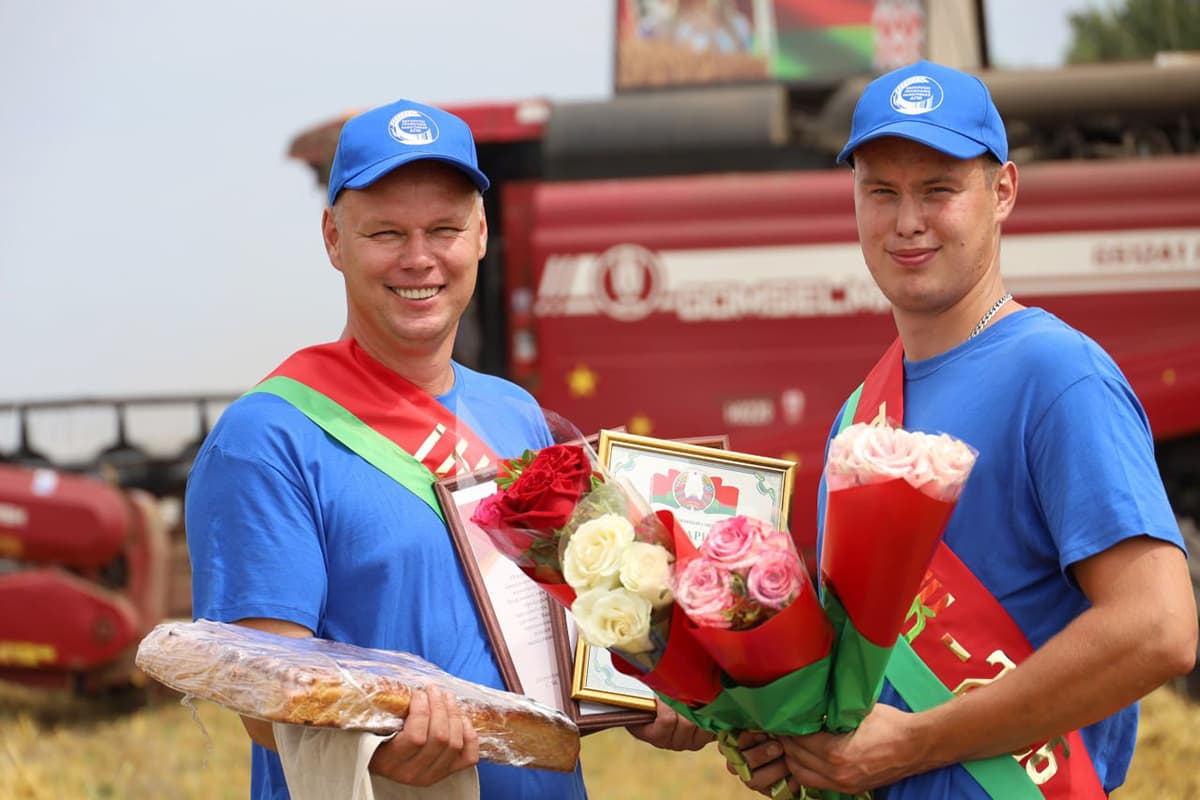
The family crew of the experienced mechanizer of OJSC Derbin of the Oktyabrsky District Mikhail Mazur and his son Dmitry, a 4th year student of BelSUT, consolidated last year's success and for the second year in a row overcame the landmark mark of a thousand tons of hammer.
- What would you like to wish on the eve of the main holiday of bakers to all the workers of the village of Gomel region, their partners?
- The completion of the harvest is always a moment of special pride and deep gratitude. On behalf of the Gomel Regional Executive Committee and on my own behalf, I want to say thank you to everyone who worked tirelessly in the fields so that there was bread in every house. Our generous Gomel land again responded to this concern with a decent harvest. Combiners and drivers, agronomists and mechanizers, workers of grain currents and processing enterprises, you have passed this stressful path as a single team, investing all your experience, skill and soul. Your work is the basis of food security of the country and the guarantee of stability of the entire region.
On the eve of the holiday I wish you good health. Let stressful working days do not affect your health, strength is quickly restored with the arrival of your home, where peace, comfort and harmony always reign, and loved ones surround you with warmth and care. Know that behind your shoulders is a reliable back. Let this home stability be supported by confidence in the future: state support and attention to the agricultural sector will continue to help you develop farms, introduce modern technologies and achieve new records. I wish you good weather in the shower. Leave behind all the worries of the harvest. May this day bring you well-deserved joy, warmth and a sincere sense of pride for your success. A small bow to you for your selfless work, for loyalty to your native land and for the loaf that you have grown for the Gomel region and Belarus!
vaschenko@sb.by
Photo provided by the Gomel Regional Executive Committee