
We learned how winter crops are sowing in Belarus, what problems arise and what the delay in terms leads to
On September 25, President of Belarus Alexander Lukashenko during a working visit to Logoi district instructed to pay special attention to the rates of sowing winter crops:.
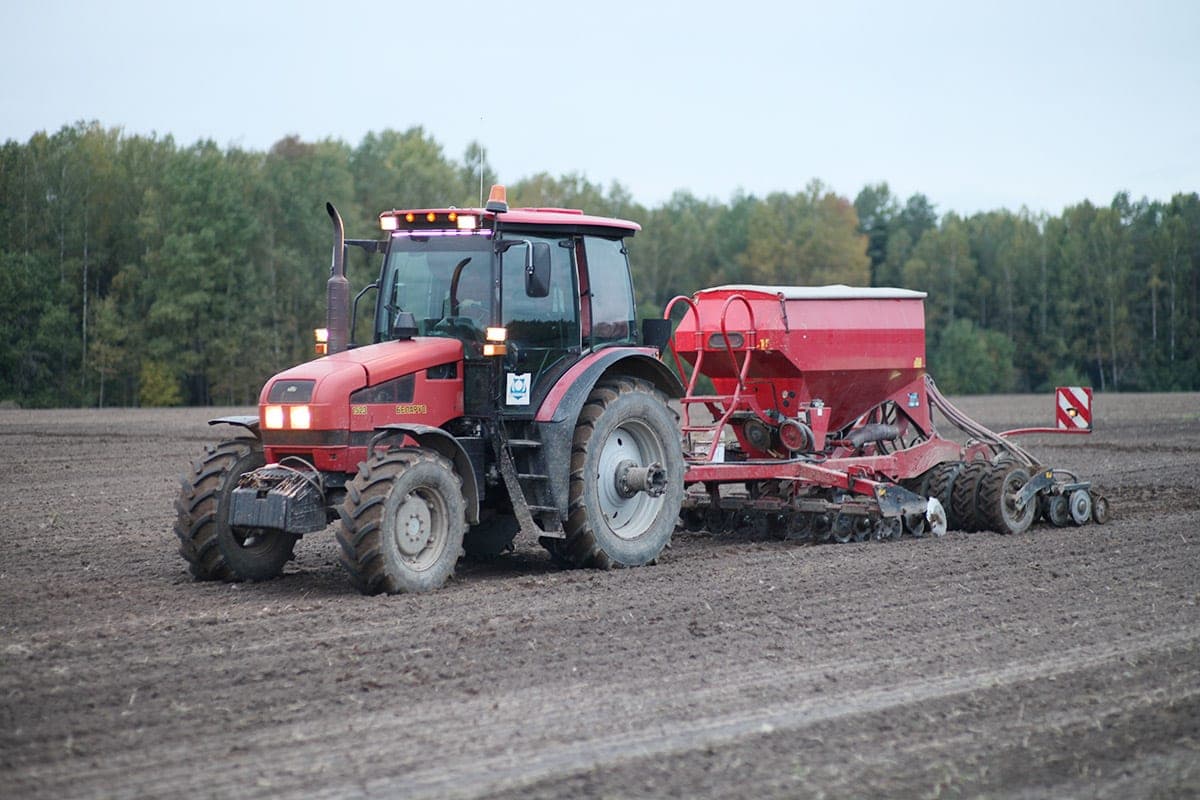
On September 25, during a working visit to Logoi district, President of Belarus Alexander Lukashenko instructed to pay special attention to the pace of sowing winter crops: “We need to understand that we need to sow immediately.” Not fast, not fast, just instantaneous. We probably have a warm week when the seeds can grow. I understand: cyclones, rains and so on. But we will not explain anything in the spring.” How is the sowing of winter crops, what problems arise, what is the result of a delay in terms, as well as other work in the fields - in the SG op-obzor
To finish cleaning different cultures a little earlier or a little later is not an emergency. However, this does not apply to the winter sowing of grain, which is now in full swing. Late deadlines have negative consequences.
Preparation of soil for winter sowing is better than last year. As of yesterday, 84 percent of the plan has been plowed (65 a year ago). In Brest region — 98 (76), Vitebsk — 72 (62), Gomel — 79 (51), Grodno — 90 (67), Minsk — 85 (73), Mogilev — 77 (60).
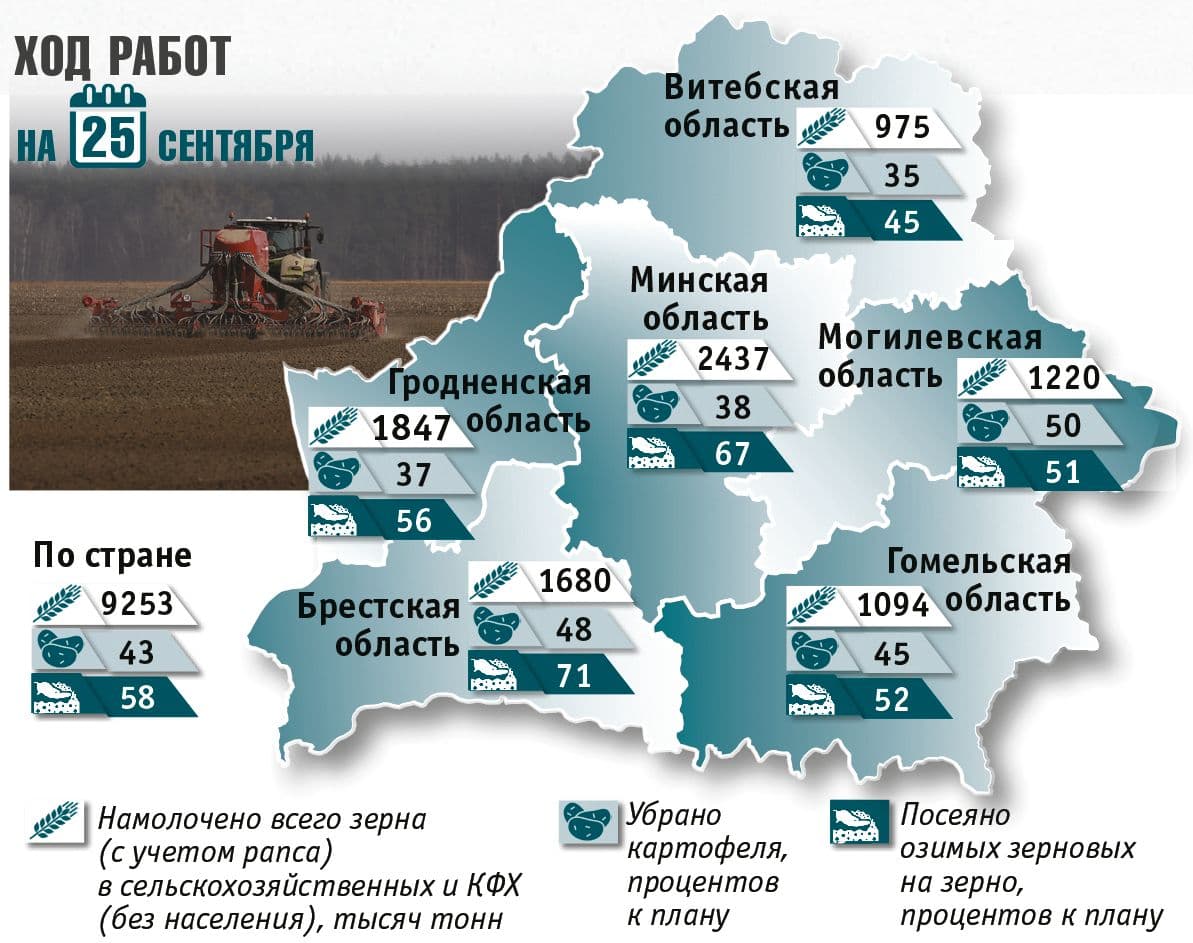
This is the situation directly with the sowing itself. In the country, work was carried out on 58 percent of the area. In the Brest region - 71, Vitebsk - 45, Gomel - 52, Grodno - 56, Minsk - 67, Mogilev - 51.
Earlier, taking into account climatic features, it was recommended that Vitebsk and Mogilev regions complete sowing until September 30, Minsk and Grodno - until October 5, Gomel and Brest - until October 10.
- Now we consider it expedient to keep sowing for a week more, said the first deputy general director for scientific work of the RUE "SPC of the National Academy of Sciences of Belarus for Agriculture" Eroma Urban. At a later date, sowing significantly increases the likelihood of the absence of autumn seeding, weed control is difficult and the intensity of the accumulation of sugars decreases, which can lead to significant erosion of crops due to death during wintering. At the same time, the extension of winter sowing is more profitable than an increase in the area of spring wedge, since winter wedges use winter moisture reserves better and are on average more productive than spring crops in recent years.
What is the situation on the ground? In the Mogilev region in the leading Shklovsky, Kirov and Klichevsky districts, 60-69 percent of the fields were sown, and in Bykhovsky, Chaussky and Mogilev - 41-42.
In Mstislav district, this figure is also 42 percent. Can we speed up the process? The first deputy chairman of the district executive committee, head of the Department for Agriculture and Food Andrey Lapo, said that last year they tried night sowing, but there were difficulties. It is difficult to find additional people for the second shift. And attracted from the city tractor drivers such a responsible operation can not be trusted.
- It is more realistic to ask people to work an extra few hours in the dark with their headlights on. The second option: use all backup seedlings. For example, some six-metre-long tractors are not only power-saturated.
Other jobs. The rains that have been going on all week have slowed their pace. Some processes have stopped altogether. For example, you can not raise a flax trust. However, the harvesting of corn, potatoes, sugar beets and some other crops continues. Farmers are looking for weather windows to use equipment in difficult conditions.
According to operational data as of September 25, 9 million 253 thousand tons of grain were threshed in agricultural organizations and peasant farms, taking into account rapeseed. In the Minsk region - 2 million 437 thousand tons, Grodno - 1 million 847 thousand, Brest - 1 million 680 thousand, Mogilev - 1 million 220 thousand, Gomel - 1 million 94 thousand, Vitebsk - 975 thousand.
Corn on the silo removed from 417 thousand hectares — 44 percent of the plan.
603 thousand tons of hay — 84 percent, 12 million 771 thousand tons of hay — 89 percent, 8 million 680 thousand tons of silo — 42 percent. All herbal feed - 6 million 255 thousand tons of feed units - 62 percent of the plan.
Sugar beets were removed from an area of 37,000 hectares - 34 percent of the plan. 1 million 659 thousand tons of root crop with an average yield of 451 centners per hectare were dug up. In the Minsk region — 682 thousand tons, Grodno — 570 thousand, Brest — 248 thousand, Mogilev — 140 thousand, Vitebsk — 18 thousand, Gomel — 1 thousand.
Potatoes removed from more than 9 thousand hectares - 43 percent of the plan. 317 thousand tons of average yield of 338 centners per hectare were dug up. In the Mogilev region — 86 thousand tons, Minsk — 77 thousand, Brest — 66 thousand, Gomel — 35 thousand, Grodno — 31 thousand, Vitebsk — 22 thousand.
42 percent of open ground vegetables were harvested. 55,000 tons with a yield of 335 centners per hectare were collected.
gedroiz@sb.by
Photo on the announcement: archive "SB"
