Blackshirt killed four girls and tried to revoke his pardon
Serial killer searched for black tights, key and prints. He was detained after attacking two girls, sentenced to death, and years later he demanded a limited life sentence.
In 2011, life sentence Yuri Tsyuman appealed to the Supreme Court of Russia with an unusual demand. He asked to repeal the clause of the presidential decree that saved him from the death penalty.
The Rostov Regional Court sentenced Tsyuman to death on 11 February 1994. The sentence was not carried out. The convict himself filed a petition for clemency, and on March 22, 1999, the Russian president commuted his execution to life imprisonment.
After 12 years, Tsyuman said that the pardon made his situation worse. According to him, for crimes committed under the Criminal Code of the RSFSR, the death penalty could be replaced by imprisonment for a maximum of 20 years. The life sentence came later and should not be applied.
Tsyuman did not seek the return of the death sentence. He expected to receive a limited period of time and the opportunity to be released. The Supreme Court disagreed with his arguments. The pardon did not increase the punishment, but replaced death with a milder measure.
By then, Tsyuman had been imprisoned for nearly two decades. In Taganrog, his name was associated with four murders of young women and a detail, because of which the offender was nicknamed the Blackhead.
The first murder occurred on the evening of May 13, 1990. In Taganrog killed 17-year-old student of metallurgical technical school Anna Linerberger.
The body was found in the 1st Fortress Lane. The girl was raped and strangled. After the murder, the perpetrator put black tights on her.
At first, this detail did not look like a sign of the series. Investigators were checking on people seen near Anna. Shortly before her disappearance, a drunken man molested her, but passers-by intervened. The suspect was found, but the examination ruled out his involvement in the rape and murder. Checked the taxi driver who drove the girl. No evidence was found against him either.
Two weeks later, another murder occurred.
On May 27, 16-year-old Irina Kislyakova did not return home. That evening she was dating a young man. He walked her to a tram stop near the house, after which they broke up.
The young man was under suspicion. His testimony was confirmed by the tram driver, who saw the moment of separation. The young man was excluded from the list of possible killers.
Irina's body was found in an unfinished building. She was raped and strangled. The girl was left with torn black tights.
The crimes coincided with the choice of the victims, the method of attack and the actions with clothes. Investigators realized that a serial sex maniac appeared in Taganrog.
Rumors quickly spread throughout the city. Parents asked their daughters not to go home alone and give up black tights. The usual detail of women's clothing began to be perceived as a possible bait for the criminal.
Such caution only created a sense of protection. The danger did not come from the clothes or the behavior of the victims. The black tights were part of a script repeated by the killer himself.
There were prints and biological traces at the crime scenes. But to make a comparison, the police needed a suspect. Tsyuman did not get into the circle of the auditors.
He was born on January 30, 1969 in Taganrog. At the time of the first murders, he was 21. His childhood was later described as dysfunctional. Parents allegedly abused alcohol, and there was violence in the family.
This information was repeated many times later. However, a difficult childhood does not explain the series of murders and does not reduce the responsibility for them.
Tsyuman is linked to the attack committed on the night of 24-25 December 1986. According to this version, the criminal entered the apartment of the girl, tied her up, beat and raped her. Before he left, he took his belongings and started a fire. The victim survived.
In 1987, Tsyuman was drafted into the army. After demobilization, he returned to Taganrog. He is also linked to a 1989 attack in which she escaped.
The series of murders began the following spring.
The investigation of the Taganrog murders is associated with Viktor Burakov, one of the heads of the Rostov criminal investigation department, who participated in the search for Andrei Chikatilo.
Two serial killers were operating in the same region and at almost the same time. Investigators knew they were looking for different people. Chikatilo chose other locations, victims, and method of attack. The Taganrog crimes had their own handwriting.
Psychiatrist Alexander Bukhanovsky was involved in compiling a psychological portrait of the Black Pitchman. Previously, he analyzed the behavior of the not yet detained Chikatilo.
Police reinforced their outfits, ambushed and checked on men detained near possible attacks. Suspicious citizens were fingerprinted. But the killer remained out of sight.
On September 15, 1990, 20-year-old Olga Kudimova died. She was raped and strangled. The scenario with black tights repeated.
After the third murder, the perpetrator was contacted on television. They tried to convince him to voluntarily go to a psychiatrist. The local newspaper received a letter from a man who called himself a wanted killer, but the investigation considered the message a prank.
On November 20, 1990, Chikatilo was arrested. The Taganrog case remains open. Another serial killer was still at large.
The fourth murder occurred on June 2, 1991. The victim was 17-year-old Olga Novikova.
The method of attack and the actions of the criminal allowed to include her death in the famous series. The investigation had four episodes, the results of examinations and a description of the alleged killer. All I needed was a last name.
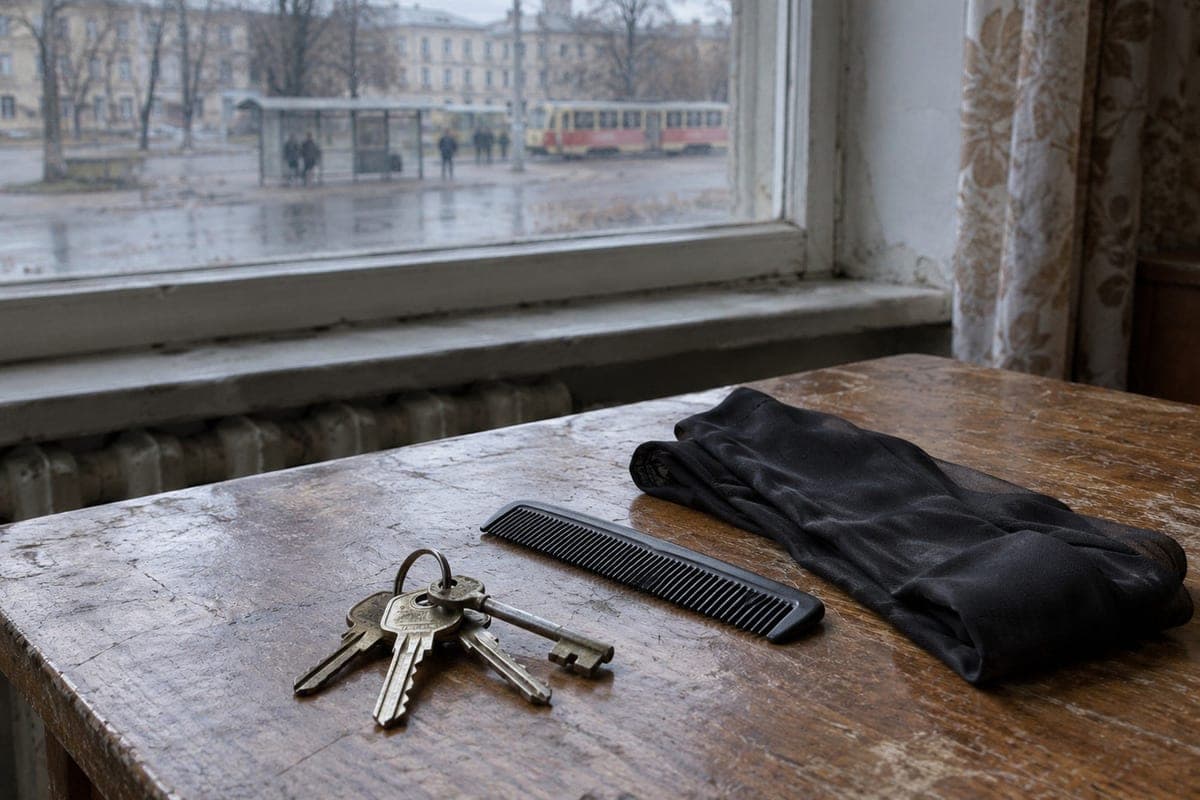
Among the found evidence mentioned a comb and a bunch of keys. One of the keys was associated with the products of the Taganrog Metallurgical Plant. The operatives hoped to find the castle he was opening.
The key was checked in the private sector and multi-storey buildings. The work took a long time, but did not lead to the owner.
After the death of Olga Novikova, the killings stopped. Tsyuman remained at large for almost a year and a half.
On the evening of November 26, 1992, two incidents occurred near the Taganrog market, which at first did not appear to be connected with a series of murders.
Drunk Tsyuman attacked the girl, knocked her down and took the flying cap. After some distance, he ripped off another girl's hat. She resisted and began to call for help.
The cries were responded to by men nearby (some Mikurov and Chizhevsky). They detained Tsyuman and handed him over to the police.
The next day, the Taganrog city court qualified the actions of the detainee as petty hooliganism and appointed him ten days of administrative arrest. Zyuman's serial murders were not yet suspected.
After serving a short sentence, he could be released. This was prevented by the check of detainees.
Tsyuman was fingerprinted and matched with unsolved crimes. Traces led operatives to the Taganrog murders case.
In the book by Nikolai Modestov "Maniacs ..." Blind Death" says that the detective Sergey Krivenko drew attention to the keys of the detainee. They were compared to a ligament found after the last murder.
Two torn caps led the police to a man who had been looking for several years for serious crimes.
After his arrest, Tsyuman was checked for involvement in other attacks. The charges include four murders between May 1990 and June 1991, as well as other violent crimes.
In some publications, the figure of five appeared later. However, they do not name an additional victim and do not cite the relevant episode of the accusation. Four murders are considered confirmed.
Black tights made it possible to combine the crimes into a series, but Zyuman’s guilt was not proved by the nickname and not one recurring detail. The investigation used physical evidence, examinations, testimony and the results of the check after detention.
On February 11, 1994, the Rostov Regional Court sentenced Yuri Tsyuman to death on a set of crimes.
On October 11 of the same year, the Judicial Collegium for Criminal Cases of the Supreme Court of Russia left the sentence unchanged. However, the sentence was not carried out.
Tsyuman's escape from execution is often attributed only to a moratorium on the death penalty. The final decision was made by individual pardon.
Tsyuman himself sent a corresponding petition to the President of Russia. Decree No. 374 of 22 March 1999 commuted the death penalty to life imprisonment.
The president did not review the court's findings or issue a new sentence. He exercised the constitutional right to pardon and replaced the execution with a milder sentence.
It was this decree that the convict later tried to cancel.
In a 2011 statement, Tsyuman referred to Article 24 of the Criminal Code of the RSFSR as in force at the time of the crimes. He claimed that he could be replaced by imprisonment for a term not exceeding 20 years. If the Supreme Court had accepted this logic, the time limit would have practically expired by the time of the trial.
The presidential spokesman objected that the pardon decree was adopted under the legislation in force in 1999. It allowed to replace the death penalty with life imprisonment or 25 years in prison.
On July 19, 2011, the Supreme Court rejected Zyuman’s application. Life imprisonment was considered a milder sentence than the death penalty. The court also indicated that the convict missed the deadline to appeal the decree.
In 2018, Zyuman made a new attempt to seek a review of the punishment. The district court refused to accept the motion. The same issue has already been resolved, and the criminal law has not since changed in favor of the convict.
Zyuman complained to the Constitutional Court. On January 29, 2019, he refused to accept the appeal. The question of punishment has already received a judicial assessment, and the contested rule in the case of Zyuman was not actually applied. He could not get a limited term instead of life.
According to regional media for 2026, Tsyuman continues to serve his sentence in the special regime penal colony “Black Dolphin” in Sol-Iletsk.
Over the past decades, the history of Tsyuman has been enriched with details known mainly from documentary programs.
Some publications claimed that he came to the graves of the dead and brought flowers. It is impossible to verify this from available court documents. Even if such visits have taken place, they cannot be considered proof of remorse.
Sources differ as to what murder the comb and keys were found after. Some link this evidence to the third episode, others to the fourth. It is only known that the items were used in the investigation of the series.
There is no doubt about the basis of the case. He was convicted of four murders of young women between May 1990 and June 1991. He was arrested on November 26, 1992, after minor hooliganism. In 1994, the court imposed the death penalty, and in 1999 the president replaced it with life imprisonment.
The Taganrog series came at a time when the Rostov region has not yet recovered from the crimes of Chikatilo. The two murderers were searched for almost simultaneously, and the same specialists participated in the investigations.
But the Blackhead case showed another weakness of the search at the time. Investigators have established a link between the killings. There was evidence on the ground. The operatives obtained a description of the perpetrator, checked the suspects and looked for a lock that could open the found key.
That wasn’t enough to name him.
Black tights allowed to see the series, but did not lead to the killer. The key narrowed the search, but didn't open the right door. Fingerprints became crucial only after apprehending a person with whom they could be compared.
Tsyuman was taken not during the preparation of a new murder, but after street hooliganism. He tore two hats off the girls and received ten days of administrative arrest. Routine inspection of the detainee led the police to a serial offender, who was unsuccessfully searched for several years.
The last turn occurred after the trial. Zyuman first asked to save his life and then tried to reverse the result of his own pardon to get a chance at his release.
The courts refused. The life sentence remains in place.
22-year-old farmer's daughter raped and beat workers to death
Apartment cannibal Spesivtsev became a trap for children in Novokuznetsk
Four complaints ended in rejection, and then the husband killed his wife and six children
Slivko hung children under the guise of filming: Honored mentor hid death in the tourist club
"Prison romance" Madueva ended with nagan in "Crosses"
Became known about the “gang of gamekeepers”: dozens of murders in the Siberian taiga were hidden for years
Chikatilo was released with a knife and ropes, after which the murders continued
They beat the family to death in a dream: Colonel of the Ministry of Internal Affairs Gosht was brutally killed along with his relatives
10 years of the blood of the rostov gang “amazon” – they killed and returned home
Angara maniac Mikhail Popkov took women to their deaths in his car for years
Major Yevsyukov shot people in a supermarket and became a symbol of the failure of the interior Ministry
Children's voices heard in the basement, but the police went home
Maniac took women to the forest and began hunting them: in the taiga found dozens of bodies
Supplemented sleeping pills and raped locked up: 2 years of hell from a good grandfather from Yakutsk
Reliable news is always at hand - in the channel "MK" in MAX