"Night Hunter" Richard Ramirez caught by residents of East Los Angeles
On August 31, 1985, in East Los Angeles, Richard Ramirez tried to retrieve a car from Angelina de la Torre. Her husband and neighbors caught up with him and held him until police arrived. Some pursuers only later learned that they had caught the wanted “Night Hunter”, who would later be convicted of 13 murders.
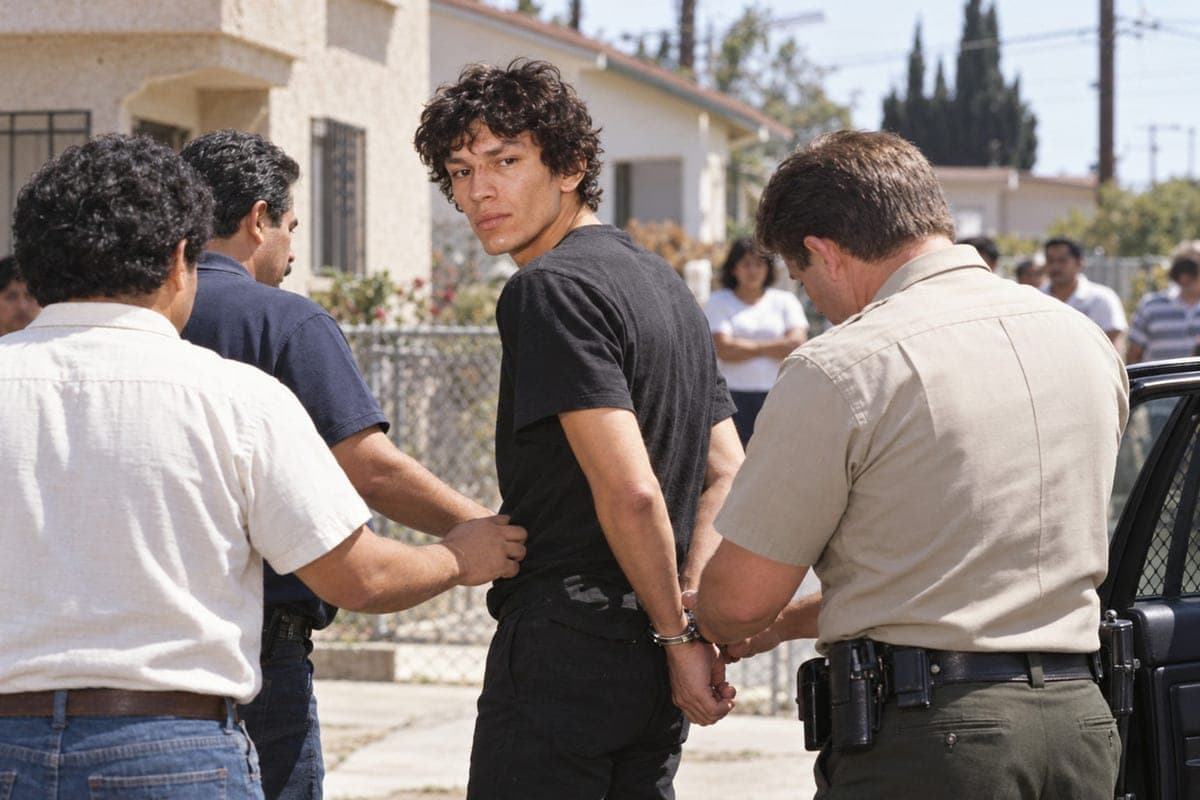
Before running up to Angelina de la Torre, Ramirez demanded the keys from Manuela Villanueva. She ran out of the car and called for help. Frank Moreno and Carmelo Robles chased him down the alley.
Ramirez climbed over the fence and ended up near Faustino Pinon, who was doing his daughter's red Mustang. The engine worked. Ramirez got behind the wheel and tried to drive away, but Pinon grabbed him and began to pull him out of the cabin. As they struggled, the car hit the smokestack at home. Ramirez jumped out.
Across the street, Angelina was sitting in a car. He demanded her keys and attacked the woman. Her husband Manuel ran to the noise with a metal rod. Ramirez was hit in the head. He ran again, Manuel ran after him.
Helped neighbors - Jose Burgoyne and his sons Jaime and Julio. Ramirez was caught and held in the street. People gathered, some had newspapers with his picture in their hands.
Not everyone immediately knew who they were stopping. Angelina later told reporters that she recognized the eyes of a man who was shown in TV news. Frank Moreno once said, “If I knew it was him, I would have called more people.”.
Deputy Sheriff Andres Ramirez first handcuffed the detainee. They were namesakes and peers - both were 25 years old. Andres grew up 4 blocks away. On the radio, he received a message about a fight involving a possibly armed man.
Arriving, Andres saw a man surrounded by residents. One of the men was still holding a metal bar. As the crowd grew larger and people started talking about the Night Hunter, the sheriff's deputy asked everyone to step aside. Later, he explained to reporters that he wanted to quickly take the detainee: the situation became dangerous.
“I had to say, ‘You’re under arrest,’ and handcuff,” Andres said of the city’s help.
The police crews who arrived gave the detainee first aid and took him to the station. They checked their fingerprints. Police confirmed Hubbard Street residents stopped Richard Ramirez.
A few months before this chase, Maria Hernandez met Ramirez in the garage of her home in Rosemide. Late on the evening of March 17, 1985, she returned home, heard a noise behind her back and turned around. The man pointed the gun in her face.
Hernandez raised her right hand. There was a gunshot. The bullet hit the brush; according to the prosecution, it was rejected by a bunch of car keys that the woman was holding in her hand.
She fell and remained lying, hoping that the attacker would mistake her for dead. Ramirez pushed the reclining Hernandez and walked into the residential part of the house. Hernandez got up and ran out of the garage. She tripped, fell, and when she got up, she heard a deaf gunshot from the house.
Around the building, the woman again faced the attacker. He pointed his gun at her again. Hernandez told her not to shoot her a second time. The man lowered his gun and ran away.
She found her apartmentmate Dale Okazaki murdered and called 911.
About an hour after the Rosemid attack in Monterey Park, Cai-Lian Yu was shot dead. Later, experts compared the bullets recovered from the bodies of both women: they were released from the same gun. So the investigation has material evidence of a connection between two murders committed in different places in one evening. Prosecutor Philip Halpin later told the jury about this comparison.
In the spring and summer of 1985, the killings continued. The perpetrator used different weapons and attacked men and women of different ages.
Los Angeles County police are investigating child abductions. Detective Gil Carrillo compared their stories with the description of Hernandez: the same height, clothes and darkened teeth. He passed the findings on to his colleague, Detective Frank Salerno.
Carrillo suggested that one person could have committed all these crimes. He later told reporters that many of his colleagues disagreed at first. To check the connection helped traces that the attacker left in the houses.
At the house of the murdered spouses Vincent and Maxine Zazzar, sole prints were found on a bucket under the window and in a flowerbed. In a house in Monrovia, a footprint was left on the kitchen sink. A handprint was also found there; experts later determined that Ramirez had left it.
At the scenes of various crimes, a drawing of the sole of the Avia 11th American size shoe was repeated. These prints provided a basis for comparing episodes in which the circumstances of the attacks differed.
Near the garage in Rosemead found a blue baseball cap AC/DC. Witness Esther Petchar reported seeing Ramirez buy such a cap at a used goods store. Her story linked the object to a man she had seen in person.
On the night of August 25 in Mission Viejo, 13-year-old James Romero left home for a pillow left in the family car. The family recently returned from Mexico. The boy slept on the road and could not sleep.
The car doors were locked. James went back to the garage, turned on the lights and took up his mini bike. He heard footsteps near the wall. Before that, he took the noise in the yard for an animal, but now he realized that there was a person nearby.
The boy hid behind the family car, then ran into the house. From the bedroom window I saw a stranger walking in front of the house. The noise woke my father. James said there was a stranger nearby.
Once again outside, he saw a man get into an orange Toyota with a trunk on the roof. The car turned and passed by. James memorized four numbers, 482 T, and recorded them in the kitchen.
The family immediately called the police. The arriving employee received a message and recording with part of the number. Romero described these circumstances in detail to journalists.
That same night, Ramirez broke into another home in Mission Viejo. He shot computer engineer Bill Carnes several times and raped his fiancée Ines Erickson. Both survived. Erickson was able to describe the attacker.
Police initially accepted the Romero family's appeal as a routine report of a suspicious person. Later that night, police called back and asked to describe the stranger's clothes.
Police showed James cars similar to the Toyota he described. In an interview, he talked about trips to Lake Forest and Newport Beach. He rejected both options: the make, color, number or trunk on the roof did not match.
Meanwhile, the owner of the plant in Los Angeles reported an orange Toyota abandoned in the parking lot. Her number was close to that recorded by a teenager. The police set up surveillance, hoping that the driver would return. Without waiting for him, the car was taken for research.
James was brought to the Orange County Sheriff's Office in Santa Ana. This time he recognized the car: the same color, trunk and number - 482 RTS.
In the cabin found suitable for identification fingerprint, which did not belong to the owner of the car.
The trail was sent to the California Department of Justice and checked through a computer fingerprint database. In the manual of the US Department of Justice in 1988, this case is described as an example of the operation of a new system: in 3 minutes it issued a list of possible coincidences. The check led to Richard Ramirez.
The police could search the registration card on the trail, not yet knowing the name of the suspect. As explained in the report of the Bureau of Forensic Statistics of the United States, the final match is established by a specialist comparing the track and the control fingerprint.
Ramirez's fingerprints were preserved in police records after his arrest in 1984 in a stolen car case.
Late on August 30, Los Angeles County Sheriff Sherman Block announced the suspect's name. Before that, investigators discussed whether to disclose it to the public. If Ramirez finds out about the manhunt, he can try to escape.
Block explained to reporters that the name still decided to publish for the sake of search and safety of people. Together with him published a photo taken after the previous arrest. The police knew who they were looking for, but did not yet know where they were.
On the morning of August 31, Ramirez saw his face on the front page of a newspaper in a shop. According to police, published in the media on the day of detention, he quickly got out and got on the bus. He was soon spotted in eastern Los Angeles. Attempts to take possession of other people's cars ended in a chase through yards and detention in Hubbard Street.
After his arrest, investigators matched Ramirez's fingerprints with those from unsolved cases. One of them is preserved on the window grid in the apartment of 79-year-old Jenny Winkow, who was killed in June 1984.
In early September 1985, Los Angeles Police Chief Daryl Gates announced that the print belonged to Ramirez.
Felipe Solano's possessions were seized by the police from Ramirez. The victims and relatives of the victims recognized their belongings. Linda Doi-Fick, the daughter of murdered William Doi, identified her mother's wallet and jewelry from her parents' home.
On February 1, 1989, Maria Hernandez became the first witness at the trial to identify Ramirez as the man who shot her. The sequence of events in the garage she laid out under oath.
The court also heard Virginia Petersen. On August 5, 1985, Ramirez shot her and her husband Christopher. Petersen, wounded in the head, chased the attacker. He shot again, then ran out the sliding door. Petersen took his wife to the hospital himself. Both survived. Virginia later pointed Ramirez at the I.D. and in court.
At the trial, lawyers Daniel Hernandez and Ray Clark questioned the reliability of the identifications. They pointed out that before meeting the suspect, witnesses had seen his picture in newspapers and on television. The defense argued that the publications could have affected people's memory.
Ramirez's father claimed that his son had been with him in El Paso in late May 1985, during several alleged attacks. Lawyers presented Ramirez as a thief not involved in the killings and called more than 30 witnesses in six weeks.
The prosecution presented fingerprints and palms, footprints, bullet comparison results and stolen property. According to media reports, 138 witnesses were called. Six of them were women who survived the attacks and identified Ramirez.
On September 20, 1989, a jury found Ramirez guilty of 13 murders. The indictment was issued on all 43 counts.
Ramirez was also found guilty of five counts of attempted murder, rape, other sexual offences and entering homes for criminal purposes.
In just one trial, 15 episodes were considered. According to media reports, the victims in these cases were 25 people.
The verdict concerned crimes in Los Angeles County. The attack on Carnes and Erickson in Orange County and the murder in San Francisco brought separate charges. These allegations were not included in this trial.
On November 7, 1989, Judge Michael Tynen sentenced Ramirez to death. He rejected applications for a new trial and the replacement of the death penalty with life imprisonment without the right to release.
Survivors and relatives of the victims spoke at the meeting. Colleen Nelson, Joyce Nelson’s granddaughter, said her family’s life would never be the same again, and that every murder left so many people with pain.
On August 7, 2006, the California Supreme Court upheld the verdict. He dismissed objections to joining the charges in one trial: different episodes linked stolen items and repeated footprints.
The execution did not take place. According to the California Penitentiary Registry, Ramirez died of natural causes on June 7, 2013.
James Romero for many years refused to talk about that night: he was afraid to interfere with the case and did not want to return to difficult memories. After Ramirez’s death, he told reporters, “I still have nightmares.”.
22-year-old daughter of a farmer raped and beat to death workers – revealed details
Apartment cannibal Spesivtsev became a trap for children in Novokuznetsk
Four complaints ended in rejection, and then the husband killed his wife and six children
Slivko hung children under the guise of filming: Honored mentor hid death in the tourist club
"Prison romance" Madueva ended with nagan in "Crosses"
Chikatilo was released with a knife and ropes, after which the murders continued
They beat the family to death in a dream: Colonel of the Ministry of Internal Affairs Gosht was brutally killed along with his relatives
10 years of the blood of the rostov gang “amazon” – they killed and returned home
Angara maniac Mikhail Popkov took women to their deaths in his car for years
Major Yevsyukov shot people in a supermarket and became a symbol of the failure of the interior Ministry
Children's voices heard in the basement, but the police went home
Maniac took women to the forest and began hunting them: in the taiga found dozens of bodies
Supplemented sleeping pills and raped locked up: 2 years of hell from a good grandfather from Yakutsk
Reliable news is always at hand in the channel MK in MAX