The Russians revealed the underside of school protests in France: “Faces like prisons”
In France, a wave of school protests
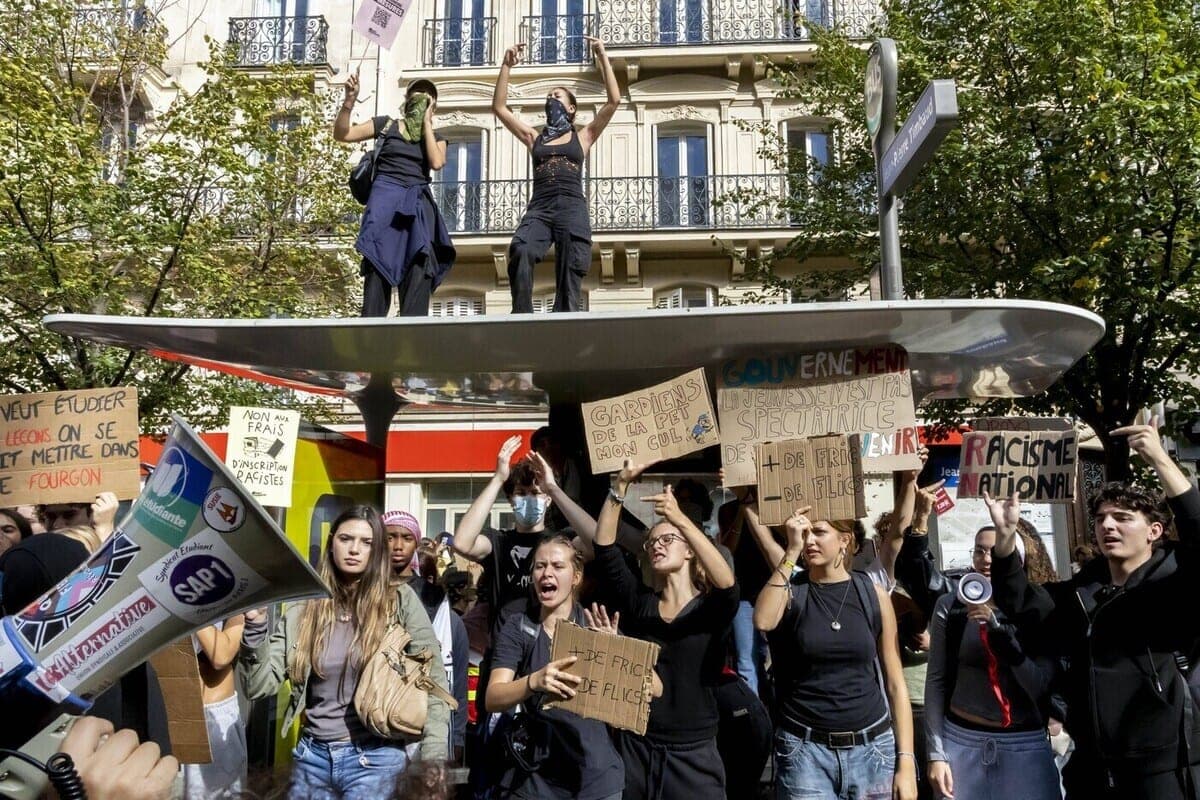
Russian-speaking residents of France in social networks shared what was happening inside: someone filmed the security forces and joked about the teenage revolution, others complained that poor children spend 12-14 hours in school, talked about the lack of teachers, strict rules and fear of attending an educational institution.
Russians in France have voiced their views on child strikes.
Russian-speaking residents of France actively posted videos from the protests. Here, in one of the videos, the girl shoots security forces in protective equipment, schoolchildren and a crowd on the street.
“I was in a revolution. Here they are, the knights in armor. The students are here. How much I love France, but I have to go for a manicure, laughs the blogger to the sound of clapping in the background.
But many Russians had no fun. A guide from Bordeaux said, “We woke up from firecrackers.” There was a huge fire. The lyceum burned, the lyceums burned the garbage.
A Russian-speaking resident of Nantes reported that during the riots, a modern lyceum in which her daughter was located partially caught fire: “I was so scared.” She barely evacuated.”.
Other parents said they now check every morning to see if the school is open, if another strike has been declared, or if the neighborhood has been closed. It was admitted that due to the frequent protests, people are forced to constantly change plans. Many believe that parents of teenagers should pay for what their offspring have done.
The strikes did not start from scratch. One reason: the state of the schools. A Russian-speaking woman who works in the education system said: Our institution does not have toilet paper and soap. One toilet per floor, the door doesn't close, there's been no light for three years. There is also a shortage of staff, and educational programmes and subjects are being reduced.”.
Many complaints are related to the training schedule. One of the students wrote online that his day begins around five in the morning, and he returns home after seven in the evening.
So it is right that we protest, the guy sums up.
He was supported by another schoolgirl's mother: "My daughter also leaves at six in the morning, comes back at eight in the evening." I gave up sports and clubs because there is not enough time. There are three tests a day. Walking like a zombie.
On the one hand, it seems that teenagers are just lazy. A Russian-speaking psychologist whose daughters study at a French lyceum believes that the protests cannot be explained only by the fact that teenagers do not want to study. Some young people are seriously concerned about education.
“There are young people who are defending their rights,” she said. In France, it is part of the culture. It is customary to go to demonstrations and demand.
The psychologist adds that the education system itself is in crisis: Children sit from eight in the morning to six in the evening with huge windows. Two hours of study, then four hours of walking, then another two hours of class. What kind of success can we talk about?”.
She points out the difference between public and private schools: “Just because you’re a great student at a public college doesn’t mean you can compete on an equal footing with a student at a strong private school.”.
However, the woman does not justify the riots: “Burning the lyceum is unacceptable. But what they present to the system does exist.”.
According to her, teachers themselves admit that it is difficult for them to work with teenagers: Children live in social networks, do not know how to talk to each other, quickly get irritated. Some do not understand why they need school.”.
In social networks argue what was the reason for the current wave of protests. Some users claim that schoolchildren took to the streets due to stricter rules for the use of phones and restrictions on artificial intelligence. Other parents deny it. One woman writes that phones in French schools have been restricted before: in primary school they can not be used, in colleges they are asked to keep in backpacks, and in some lyceums before classes, schoolchildren leave them in special boxes. So the phones don't have anything to do with it.
According to parents, the protest grew out of several problems: a shortage of teachers, canceled lessons, heavy schedules and poor condition of buildings.
One Russian-speaking mother reports that since that school year, her daughter's discipline has been so tightened that even going to the toilet is strictly limited. The woman claims that once the daughter did not have time to leave on time and was locked inside. She also criticizes the system of punishment for mobile phones and believes that some schools have crossed the line: “Educational institutions have been turned into a kind of prison. At the same time, schools lack teachers and health workers.”.
Not everyone in France sees this as a national disaster. The Russian-speaking resident notes that the TV picture looks scarier than reality: I have always been fond of talking about allegedly violent protests across the country. You walk in the center of Lille, in one place they rally, they burn something. Then at 12 o'clock everything calmly folded and went to lunch. When you watch the news, it seems very scary. Although there is a normal life outside the rally.”.
“I’m on strike, school is cancelled.”
Russian Olga, who has been living in Paris for several years and raising a child there, told about the situation with the protests.
The current protests have been called a revolution. Is it that serious?
Oh, come on, what revolution? That's loud. This picture on the web looks terrible. Protests are common in France. We made some noise for a few days and forgot. Although there are problems. It is true that teachers are lacking in schools. Moreover, the teacher may not be absent for a day or two, a week, but for six months, and there is no replacement. Parents are outraged. Well, imagine, a child has an important subject, exams ahead, and there is no teacher. You ask what's going on, and they tell you day after day, we're looking for a replacement. Overcrowded classes of more than 30 people are also bad. Plus, some of the buildings are old, need repairs. In summer it is impossible to stay there because of the heat, in winter it is cold.
In some regions, too, thank God, but teenagers because of this do not burn schools.
France has a different mentality and upbringing. Some parents approve of the actions of schoolchildren, believe that they will not be heard without protests. For a Russian, it seems strange that a 16-year-old child would seriously tell his parents, “I am going on strike tomorrow, school is canceled.” That's no reason for him to skip class. He's defending his rights.
Do parents let their children go to demonstrations?
Many fear for children because there have been clashes with police and detentions. When a child promises to stand at school, one thing. But when parents watch a video of schoolchildren running in smoke from the police, it becomes scary. I know the parents who walked next to the child, not because they are such activists, but because the child is 15-17 years old and afraid to leave him alone in the crowd.
There was a feeling that the protests were sweeping through Paris.
In social networks, this impression can be formed. In fact, there were protests in one block, and in the neighborhood people sat quietly on the terraces of cafes, tourists walked, shops worked. The protests were local.
- The French often strike. Maybe students have learned this from adults?
- To some extent, yes. The strike here is not incredible. Drivers, teachers, doctors are all on strike. Children have seen this since childhood. Therefore, the very fact that schoolchildren blocked the lyceum and came out with posters is perceived calmer than it would be perceived, for example, in a Russian school.
- But students were hurt in the protests?
When it comes to vandalism, burning tanks or flying objects, attitudes to protests change. Many teenagers were detained, and it turned out that the demands of the students and real problems receded into the background. Now we are not discussing the shortage of teachers, but who set what on fire and who was detained.
- What does your child say?
Children discuss this among themselves, watch videos, know which lyceum was blocked. Their attitude is simpler: adults do not change anything, so you need to go out and demand. Adults agree that children should be heard, but personally I say to my own: please just go to class and don’t go under the batons.