
The Russian Museum has completed the restoration of the “Ninth Shaft” of Aivazovsky
Specialists of the Russian Museum have completed the scientific restoration of the painting by Ivan Aivazovsky “The Ninth Shaft”, the general director of the museum Alla Manilova said.
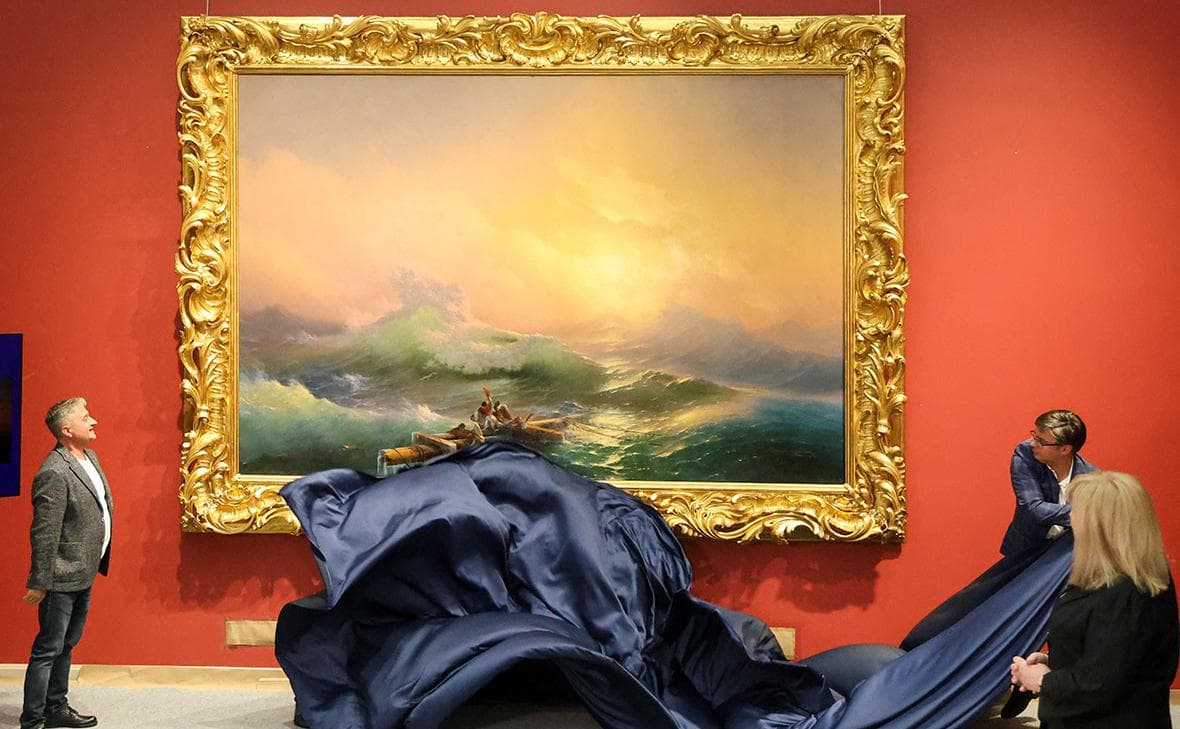
Specialists of the Russian Museum have completed the scientific restoration of the painting by Ivan Aivazovsky “The Ninth Shaft”, the general director of the museum Alla Manilova said.
“For us today at the Russian Museum is a very happy day, because we, I believe, for one century, for a hundred years, exactly give our visitors, the country, the museum fund of the Russian Federation restored to the latest standards, world standards of restoration science and art, the restored canvas of the great Ivan Aivazovsky and the historical frame,” said Manilova.
According to her, the restoration of the “Ninth Shaft” took only four months. In the Russian Museum, comprehensive scientific restoration always begins with technical, technological, chemical, biological and X-ray research. Experts study the condition of the colorful layer and canvas, and also identify even small damage that can be invisible to the naked eye.
Simultaneously with the picture, experts restored its historical frame. They remanufactured more than 100 lost thread fragments ranging in size from 1 to 65 cm. The new elements were cut from linden according to the preserved samples, then covered with soil and gilded with gold leaf.
In the painting itself, the soil and colorful layer were strengthened throughout the surface, the detachment areas were eliminated and the lacquer coating was restored.
“The Ninth Shaft” Aivazovsky wrote in 1850. The painting is considered one of the most famous works of the artist and is stored in the collection of the Russian Museum. In 2016, the canvas entered a large-scale exhibition of Aivazovsky in the Tretyakov Gallery.
Aivazovsky left a rich legacy. He claimed to have painted more than 6,000 paintings. Among his works were steppes, plot sketches, and even portraits. But for Russian painting it was he who opened the genre of seascape, which then turned into an important phenomenon in the fine arts of the XIX century.