
Neuroscientist spoke about the importance of the discovery of Nobel laureates in medicine
The discoveries in light-guided ion channels and optogenetics, for which American neuroscientist Karl Deisseroth and German biophysicists Peter Hegemann and Georeg Nagel received this year’s Nobel Prize in Physiology or Medicine, will help to identify the correlation between the activity of certain nerve cells in the body and changes in behavior and actually control behavior in this way.
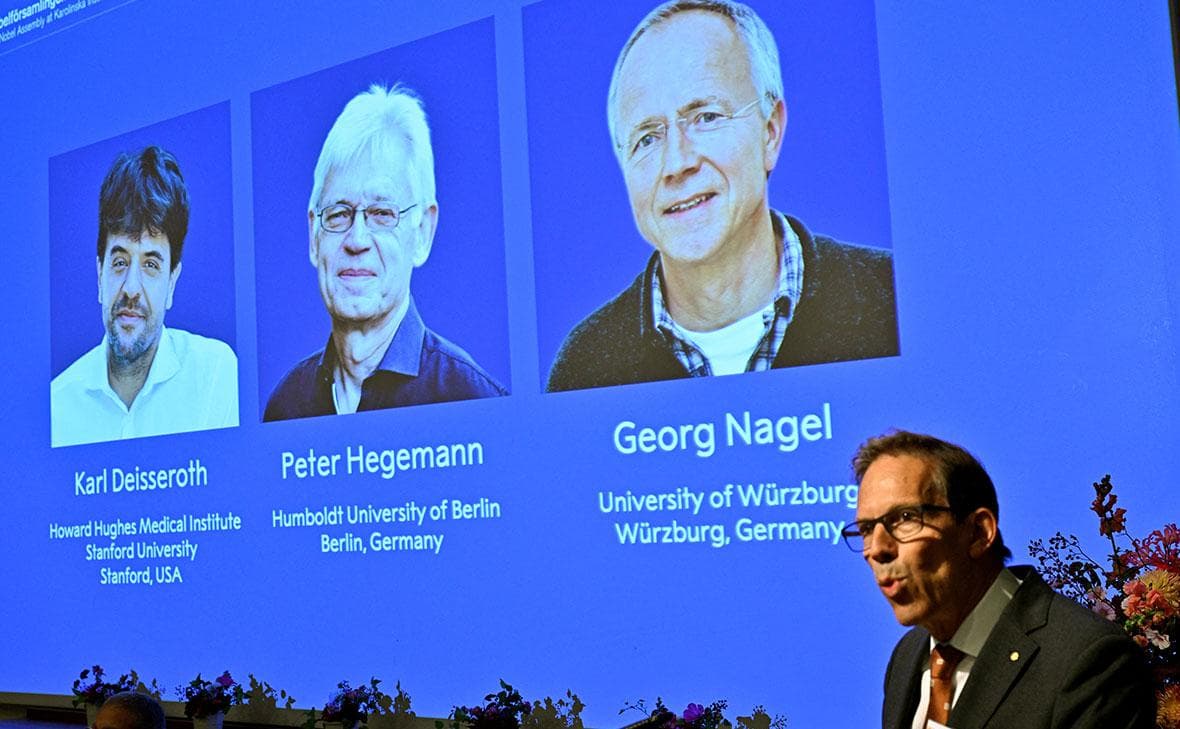
The discoveries in light-guided ion channels and optogenetics, for which American neuroscientist Karl Deisseroth and German biophysicists Peter Hegemann and Georeg Nagel received this year’s Nobel Prize in Physiology or Medicine, will help to identify the correlation between the activity of certain nerve cells in the body and changes in behavior and actually control behavior in this way. About this on the air of the program "ChEZ" on Radio RBC told a neuroscientist, doctor Vladimir Alipov.
“We need to edit the nerve cells genetically, and then the moment we shine on them, well, for example, there, you can use a laser, with fiber optics, we will activate them or suppress them when we need to,” he said, noting that this can be done selectively.
The neuroscientist gave an example of a conditional constellation of nerve cells responsible for remembering a person. According to him, it is virtually impossible to find this connection among the huge number of neurons and activate it only with the help of an older method - electrodes.
“Now what are we doing? We only label these cells with these special proteins, as if we were putting caps on them. And then, when we shine, we can illuminate the whole brain, and only these cells are activated, Alipov explained.
He also explained how such a mechanism works, using the example of a laboratory mouse. “When we turn on the blue light and activate these cells, a mouse that is in its home cage, it suddenly becomes afraid because it remembers what was done to it,” he said.
Alipov added that in this way it is possible to activate other groups of cells responsible for other processes, such as hunger.
“That is, this discovery, it can still affect appetite, it turns out, and it will be an alternative to Ozempik, which did not receive the Nobel Prize,” said the neuroscientist.
The announcement of the Nobel Prize laureates in 2026 takes place from 5 to 12 October. It is traditionally awarded in five categories: physiology or medicine, physics, chemistry, literature, as well as strengthening peace. In 2026, the Nobel Foundation established the prize size in each category of 12 million Swedish crowns (about $ 1.2 million).
In 2025, the Nobel Prize in Physiology or Medicine was awarded to Americans Mary E. Bruncoe, Fred Ramsdell and Japanese Shimon Sakaguchi for discoveries concerning peripheral immune tolerance. The laureates have identified “immune system protectors” – regulatory T cells that prevent immune cells from attacking their own body. These discoveries stimulate the development of treatments for cancer and autoimmune diseases, and may also lead to increased efficiency of transplants.