
Nobel in chemistry was given for the study of “mirror mapping” of amino acids
The discovery of scientists Henri B. Kagan and Kenso Soai “played a crucial role” for chemists working on the synthesis of drugs, noted the Nobel Committee
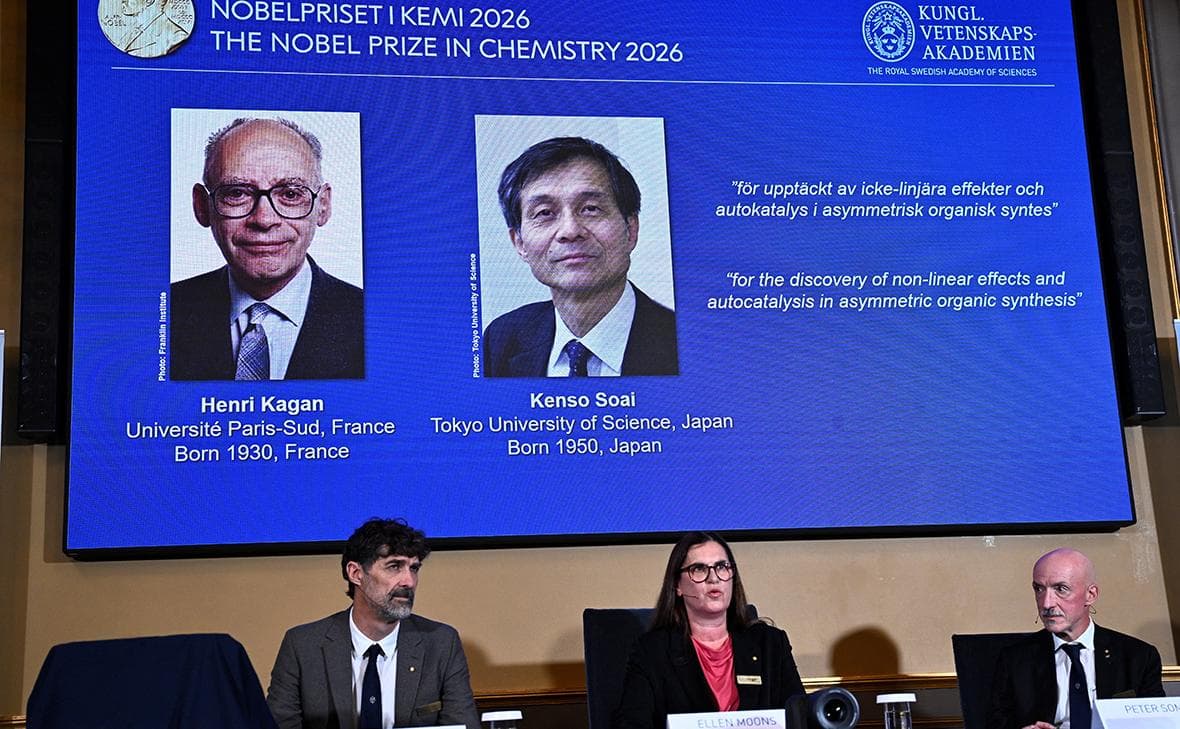
The Nobel Prize in chemistry was awarded to Henri B. Kagan and Kenso Soai, according to the website of the Nobel Committee.
They received the award "for their discovery of nonlinear effects and autocatalysis in asymmetric organic synthesis.".
On the website of the Nobel Committee explains that scientists were able to answer the question of how the chemical asymmetry of living things arose - a phenomenon in which molecules (for example, amino acids) are two mirror species, but the organisms contain only one.
Chemistry of living organisms is called homochiral, according to the Greek words "the same" and "hand". Like the hands, all amino acids exist as two mirror variants, but only one is found in the proteins of your cells. The other is extremely rare in nature. For a long time, chemists have wondered how homochirality can arise, the report said.
Thanks to Henri B. Kagan and Kenso Soai, the academic community now understands how homochirality can arise. Their discoveries "played a crucial role" for chemists developing reactions for the production of pharmaceuticals, the Nobel Committee said.
Henri Kagan and Kenso Soai have proposed a solution to a chemical mystery that has been around for more than a century: how homochirality can arise spontaneously. The chemical reactions they developed are impressive, said Heiner Linke, chairman of the Nobel Committee on Chemistry.
The Nobel Prizes were established by the will of Swedish inventor and entrepreneur Alfred Nobel. They are awarded in five fields: physics, chemistry, physiology or medicine, literature and peace promotion. The Alfred Nobel Prize in Economic Sciences was established by the Bank of Sweden in 1968 and was first awarded in 1969.
The Nobel Prize in chemistry has been awarded since 1901. Among its famous owners are Ernest Rutherford, Marie Curie. Most often, the winners were representatives of the United States (more than 70 times).
The award can be awarded to authors of articles published in peer-reviewed publications. The discovery should be significant and recognized by the entire world scientific community, so experimenters receive a prize more often than theorists, and theorists - only for a recognized explanation of a known phenomenon and often together with the experimenter who confirmed the theory.
In 2026, the Nobel Prize celebrates its 125th anniversary. In honor of the anniversary, the Nobel Foundation increased the size of the monetary part of the award by 1 million Swedish crowns (about $ 101,000) to 12 million crowns (about $ 1.2 million). If the prize is awarded to several scientists, the amount is divided between them. No more than three winners can receive one award.
Last year, the Nobel Prize in Chemistry was awarded to Susuma Kitagawa, Richard Robson and Omar M. Yagi "for the development of organometallic structures.".
Laureates have created molecular structures through which gases and other chemicals can pass. In these constructions, metal ions play the role of the foundation, they are bound by long organic (carbon) molecules and organize crystals containing large cavities. These porous materials are called organometallic frameworks (IOCs). With their help, chemists can design the capture and storage of certain substances. The IOC can also control chemical reactions or conduct electricity.
On October 6, the Nobel Prize in Physics for 2026 was awarded to Belgian Francis Halzen. The award was awarded for his decisive contribution to the creation of the IceCube neutrino observatory and the discovery of high-energy neutrinos of astrophysical origin. The committee described neutrinos as "ghost messages from space.".