
Alien mud crab from the Atlantic fully mastered the Gulf of Taman
Flat-spin mud crab (Eurypanopeus depressus) native to the Atlantic spread throughout the waters of the Taman Bay and mastered the southern part of the Sea of Azov.
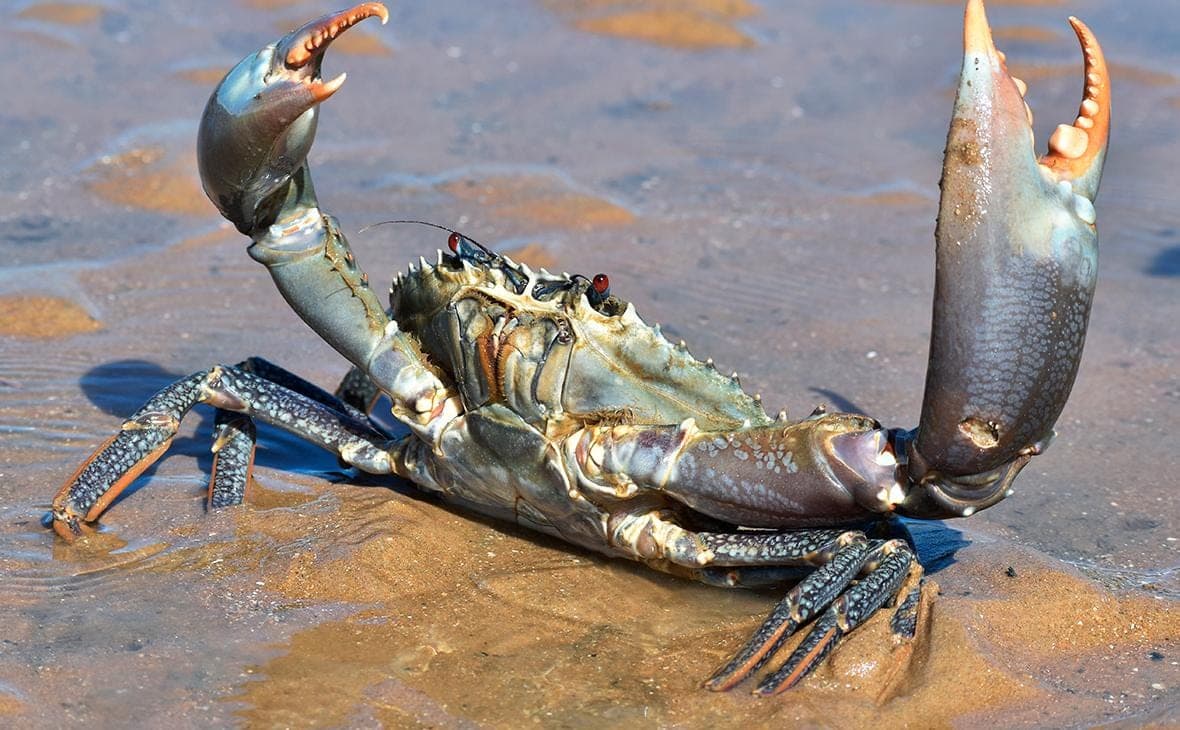
Flat-spin mud crab (Eurypanopeus depressus) native to the Atlantic spread throughout the waters of the Taman Bay and mastered the southern part of the Sea of Azov. This was told by a senior researcher at the Institute of Oceanology named after P.P. Shirshov RAS, Candidate of Biological Sciences Galina Kolyuchkina.
Mud crab was first noted in the waters of the European part of Russia by employees of FIC InBYUM in 2022 in the area of Arshintsevskaya Spit. Four years later, this crab mastered the southern part of the Sea of Azov and the Taman Bay.
“So far in other areas of the Russian Black Sea coast, this species has not been noted,” Kolyuchina said.
Mud crab leads a secretive lifestyle, it hides from predators among mussels and coastal boulders. The size of the shells of males varies from 9.7 to 34.8 mm, and females from 12 to 28.6 mm. The crab is almost omnivorous, it quickly and easily develops new territories.
The natural range of flat-backed mud crab is the Atlantic coast of America.
In December 2024, Alexei Petrov, a leading researcher at the Kovalevsky Institute of Biology of the South Seas, said that it would take about 1.5-2 years to stabilize the Black Sea ecosystem after a fuel oil spill. He said more definite conclusions could be drawn closer to the summer of 2025.
Scientists of the Institute of Oceanology named after P. P. Shirshov of the Russian Academy of Sciences in June-July 2025 conducted a study of coastal bottom communities of the northeastern coast of the Black Sea after the spill of oil products as a result of the collapse of tankers in December 2024. Experts have found a large number of marine life and noted the restoration of the ecosystem.


