
Scientists have discovered the secret of ancient Roman glass that changes color Photo Photo
The IV century Lycurgus Cup has unique optical properties. It changes color depending on how the light falls on it: in normal lighting, the vessel appears jade-green, and when illuminated from behind – ruby-red
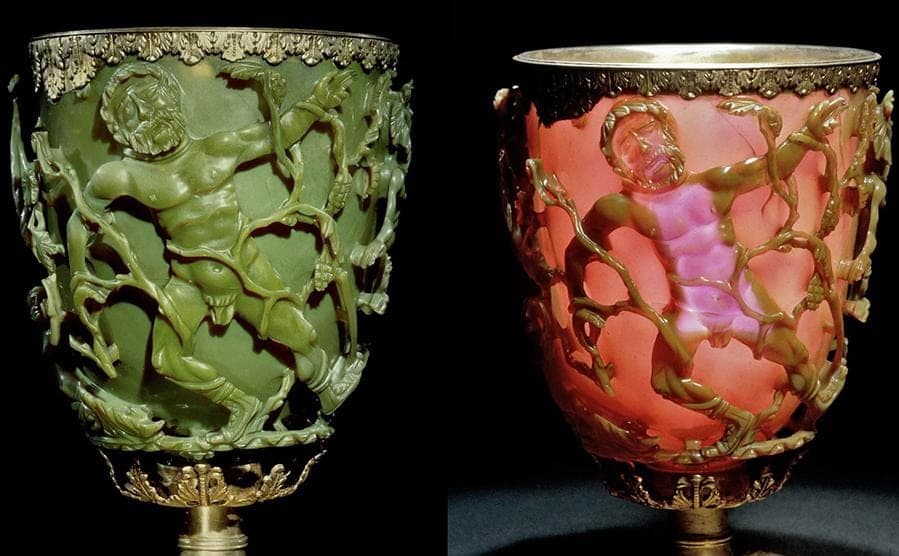
Scientists from the University of Sheffield (UK) were able to recreate ancient Roman glass, changing color, writes The Guardian.
The British Museum holds a glass Lycurgus Cup of the IV century, made of dichroic glass, which changes color depending on how light falls on it: in ordinary light, the vessel appears jade-green, and when illuminated from behind – ruby-red. It depicts the myth of King Lycurgus from the sixth song of Homer’s Iliad, who ventured against the gods. In 2022, the Lycurgus Cup was recognized as one of the seven wonders of the world, executed in glass.
According to researcher Lisa Hollands, gold and silver nanoparticles were introduced into the glass. A thick molten glass mass was obtained, as it cooled around the particles present in it, nanocrystals of gold and silver began to grow.
“White light is made up of many different colors, as can be seen when a rainbow appears in the sky. The nanoparticles are much smaller than the wavelengths of light, and under certain conditions they block some colors as light affects the electrons in the atoms, Hollands explained.
According to her, if you pass through the glass light, “particles of gold and silver will trap blue and green rays, passing only red and orange.”.
“If light reflects off the surface, these particles scatter it, creating the same opaque green color that we see,” she said.
If the Romans could see me doing experiments, they would probably laugh and ask, "Why doesn't she know how to do it?".
Ian Freestone, professor emeritus at University College London, noted that in the 1960s there were already attempts to reproduce ancient Roman glass.
“The colour was largely dependent on the conditions in the oven. If the glass was in another place of the furnace, then the color was different. The fact that the color is so sensitive to the location in the oven suggests that it was extremely difficult for the Romans to control it. It suggests that in the case of the Lycurgus Cup, they were just incredibly lucky, he said.


