
Bracelet with sapphire Romanovs sold at auction Sotheby’s for е411 million
Sapphire cushion shape weighing 197.80 carats dated to the XIX century. It is fixed in a bracelet of geometric design, on which are the stamps of the master Cartier. Around 2015, the brand rewired the stone into a product
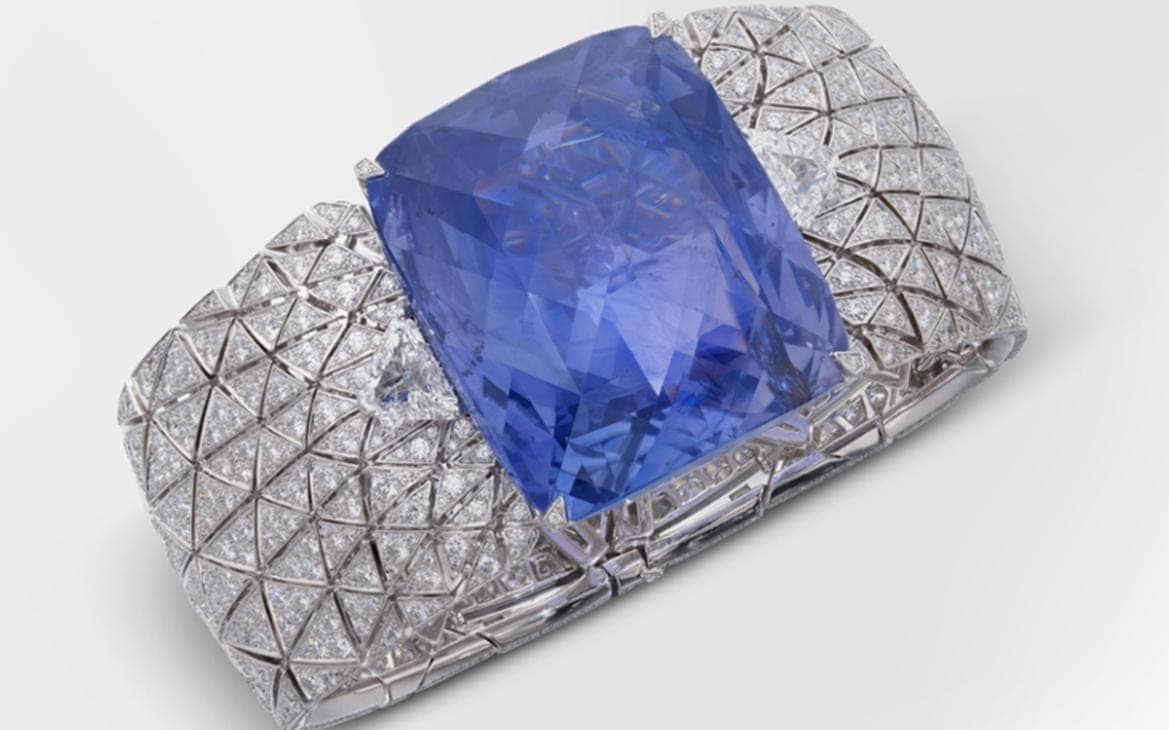
Ceylon sapphire from the collection of the Imperial House of Romanov, inlaid in a bracelet labeled Cartier, was sold at Sotheby’s Royal and Noble Jewels auction for 4.1 million Swiss francs (about 411.1 million rubles).
The auction house valued the lot at 850,000 – 1.7 million Swiss francs. The initial rate was announced at 600,000 Swiss francs, below the lower limit. As a result, the lot was sold more than 2.4 times more expensive than the upper limit of the preliminary estimate.
According to the description on the website of the auction house, the cushion-shaped sapphire weighing 197.80 carats is dated to the XIX century. It is fixed in a bracelet of geometric design, decorated with round-cut diamonds and a modified thyroid stepped cut; in the center is a replaceable engraved insert of rock crystal with triangular diamonds.
It's the brand of the Cartier master. The bracelet is dated around 2015 - then the brand remounted the sapphire into a product.
This exceptional historical sapphire comes from the legendary collection of the Romanov family. The illustrious collection of Russian tsars was perhaps the most luxurious and valuable royal collection ever assembled, second only to the legendary treasures of the Mughal Empire. The exact date when this exceptional sapphire hit the Russian crown jewels has not been fixed, but its extremely unusual style of cutting points to the origin of the Mughal era.
According to the auction house, Fersman's catalog, compiled after the revolution in 1924-1926, fixes the sapphire in a diamond frame by Faberge - along with the second sapphire, weighing 249.25 carats, it was a pair of brooches or fasteners. Dowager Empress Maria Feodorovna wore them on the front of a skirt during a costume ball at the Winter Palace in 1883.
After the revolution, the Soviet government carried out an inventory of the crown jewels and divided the collection into three categories. Stones of no historical or artistic value were sold anonymously, including the sapphire. In 1927, it was purchased by socialite and amateur singer Ganna Walska at Cartier, where it was fixed as a central pendant on the sotoir. In 1929, she rewired it to another necklace along with a 256.60 carat carved Mughal emerald. Sotoir was redesigned several times: by 1971, the sapphire was the centerpiece of a short necklace made of sapphire beads, in 1992 it appeared at Sotheby’s auction in Geneva on a necklace-torcade made of emerald and sapphire beads.
In 2015, Cartier created the current bracelet around an Art Deco-style Romanov sapphire - a reference to how Cartier first set the stone for Gunna Walski.
Sotheby’s has announced that it will put up about 300 rare objects and works of art associated with the Russian imperial family at auction in New York. The total estimated value of the collection exceeds $15 million. It included objects of different eras and directions: jewelry by Carl Faberge, porcelain, silver, objects of painting.


