
The world after Trump and the “Ozempic” effect: what is the new cover of The Economist
The Economist magazine published the famous cover-rebus with a prediction for 2027. What are the main trends highlighted by the editors for the coming year and what are known past covers - in the review
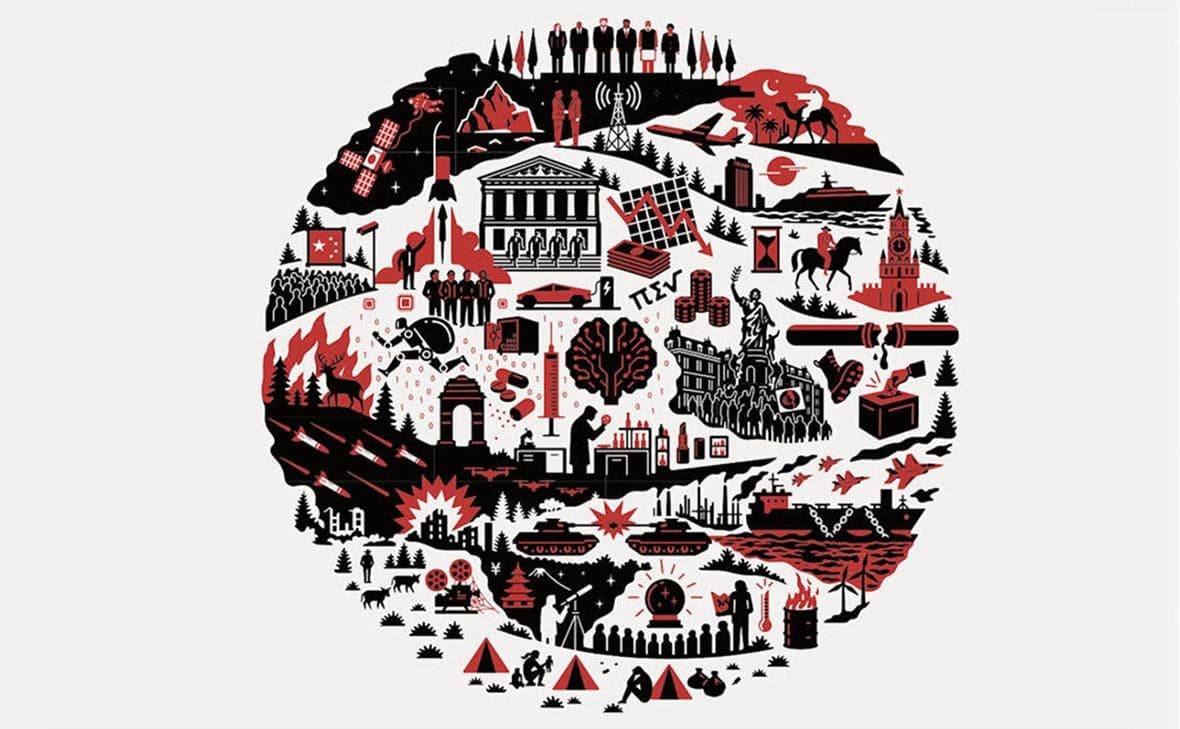
The British magazine The Economist presented the famous cover forecast for 2027. It depicts the ten main trends of the next year, according to the editorial board.
The cover of The World Ahead 2027 is in red, black and white. Cleon Peterson's illustration is a detailed collage in the shape of a ball. It depicts world leaders, military equipment, missiles and satellites, symbols of artificial intelligence, an exchange chart, money, the Spasskaya Tower, the Arc de Triomphe, tanks and tents with people.
Among the main political challenges identified by the editorial board is the race for the presidency of the United States after Donald Trump. The publication also describes the consequences of the war in the Middle East and the rise of right-wing populist forces in Europe. In addition, journalists predict increased public discontent with major technology companies, record heat, drought and wildfires.
What's the new cover
The Economist expects that in 2027 the world will face the consequences of a war with Iran, political uncertainty in the United States and Europe, increased risks from the introduction of artificial intelligence and economic restructuring. Ten trends to look out for in 2027, according to The Economist:
The post-Trump world. After the midterm elections in the United States, according to the publication, the struggle for the place of President Donald Trump’s successor will intensify. Trump will not be a lame duck, but rather a destructive angry bird. Consequences of the war with Iran. Changing energy routes, weakening Allied confidence in the United States, fertilizer shortages and threats to global food security. New temperature record. 2027 could be the hottest year on record. Growing discontent with artificial intelligence. The financial risks of AI companies, cyber threats and political consequences of using neural networks will come to the fore. Right-wing populist forces in Europe. Marine Le Pen’s possible victory in the French presidential election could change the balance of power in the European Union. Pressure on the bond market. Rising public debt levels could lead to financial turmoil in developed countries. Taiwan is under threat. China will continue to build up its military capabilities, aiming to ensure its armed forces are ready for a possible operation against Taiwan by 2027. The Ozempic effect. Weight loss drugs are changing consumer behavior, and pharmaceutical companies will invest more in life-prolonging developments. Cheaper space launches. Starship will continue to develop, private space stations and the prospect of building data centers in orbit. Hollywood reboot. Major film studios are trying to attract new audiences with reboots of well-known franchises, but the successes of independent authors and YouTube creators make you wonder whether viewers really need to continue familiar stories.
What are the predictions
The Economist has issued a special annual issue with forecasts for the next year every November since 1986. It used to be called The World in... then The World Ahead.
The issue of last year was an anniversary - the 40th in a row. The cover of 2026 depicted inscribed in the sphere (ball) important events. In the center then, as a year ago, was the figure of US President Donald Trump. Next to it is a huge cake with candles in the form of the number 250: this year the States celebrated the 250th anniversary of the adoption of the Declaration of Independence. Place on the cover found and the world Cup, which was held in the summer, as well as missiles, robots, melting ice, medicine and a glass of wine.
The magazine describes The World Ahead as an annual issue with an analysis of the main trends and events of the coming year. However, not all forecasts of the magazine are successful. In November 2025, the magazine published a retrospective, A look back over the first 40 years of The World Ahead. In it, the editors admitted that they could not predict the collapse of communist regimes in Eastern Europe and the collapse of Yugoslavia.
In July 2026, the magazine published an article titled Is The Economist Always Wrong? (The Economist is always wrong?) In it, the authors with the help of artificial intelligence analyzed about 7 thousand of their own editorial articles for 2000-2026 and compiled a list of mistakes. At the same time, the editorial staff often stressed that they did not set the task to achieve absolute accuracy: “We do not strive for impeccable accuracy of predictions — our main goal is to provide information and encourage reflection. Ideally, though, I wish we were right more often than wrong.”.


