
Diary of drawings and AI cardiologist: what other medical developments presented at ATOM GLOBAL AI EXPO
At the international forum of artificial intelligence ATOM GLOBAL AI EXPO on October 16 presented innovative medical developments.
At the international forum of artificial intelligence ATOM GLOBAL AI EXPO on October 16, innovative medical developments were presented - from rehabilitation equipment to diagnostics. Details - material of the correspondent of the agency "Minsk-Novosti".
A machine that helps you get up
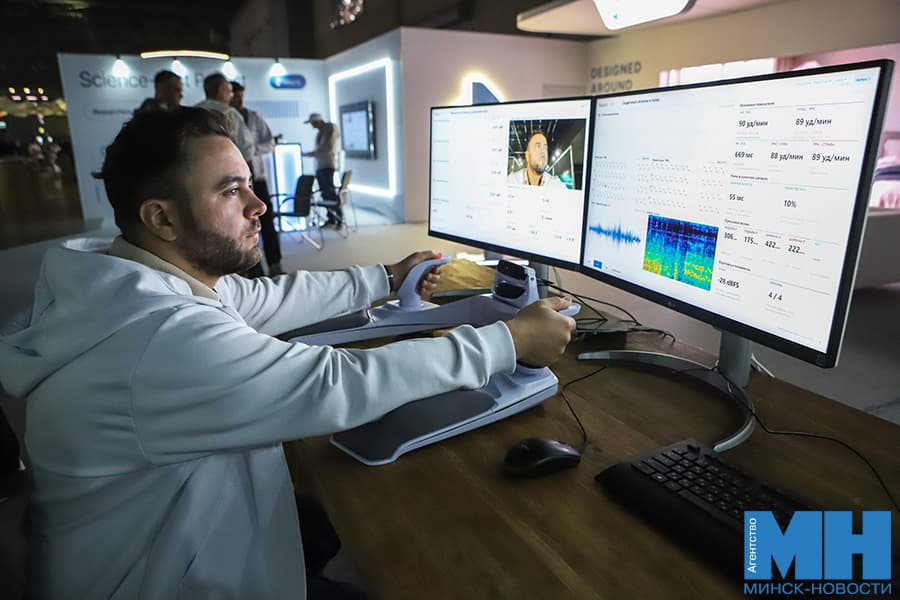
Innovative device Nearis for rehabilitation of people after operations, with problems of the musculoskeletal system, the elderly. A person has a kind of remote: one click - the device receives a signal, comes to the right room, finds the patient by the sensors and drives up to him. Armrests are lowered to a comfortable distance, the person puts his hands - and the device helps to get up.
- The idea is that a person himself strains his muscles and walks, and the device should only help him. That is, he “feels” the patient and follows his direction of movement. In joysticks, which you need to hold on to, there are special sensors and sensors, and the device predicts where a person wants to go. The sensors also read the electrocardiogram, pulse and other biometric parameters. On the camera, the device reads the face, facial expressions, blinking, muscle activity. Can predict future microstroke: say, if the corner of the mouth falls. Everything is collected in the database, and then the doctor can analyze it, said Dmitry, a programmer-developer of the startup.
While this is the first prototype, the device is about six months. It is positioned not for home, but for medical and rehabilitation centers, where there is a staff ready to respond urgently. If something goes wrong, the device gives a signal and the person comes to the rescue.
An unusual diary for silent children
It's an invention for children who don't talk much. A kind of diary in which a parent uploads a child's drawing. The application analyzes it and tells you what to pay attention to and what questions to ask. To have a warm and deep dialogue, not “how are you?” The model was taught by psychologists: about ten practitioners disassembled about a hundred drawings each - a total of a thousand.
- This site is designed for children from three to ten years. This is the period when the child already creates conscious drawings, but can not express the emotions that he feels in words. Therefore, for a parent, this is an important point - to learn more about how the child feels at a particular period. All the drawings are stored in the gallery: if there is a recurring trend - the same colors, elements, animals - this too is remembered and will be highlighted. But we must remember that this is not a medical examination, the diagnosis is not made here, said Ruslan Hajiyev, a startup developer.
According to him, the drawings are preserved, and after a year you can return, compare, connect with what happened in the family. So far this is a website, but plans to make a full application.
Diagnosis by cardiogram
This neural network will make a preliminary diagnosis according to the electrocardiogram. The application is available exclusively to the doctor - in order to avoid self-medication in the patient.
- The specialist downloads digital signals - data saved on the computer after taking the cardiogram, or scans or photos of documents with which the patient came to the appointment. Then choose the number of possible diagnoses you want to see. At the output, the system issues several options with probability percentages and explains why it chose a particular diagnosis. In addition to decoding, the formation of the patient’s cardiological history is provided: the doctor will be able to trace how the disease developed, said Nikita Larchenko, the author of the startup.
According to him, in parallel, the team is developing a kind of holter for round-the-clock monitoring: the device works up to 14 days without recharging, it can be used repeatedly - only the adhesive base needs to be changed. It is worn on the chest to detect rhythm disturbances, ischemia and hypertension at an early stage. The startup is two years old.
There are no direct customers yet – medical development requires certification and clinical validation. But on open data, the system has already been tested with doctors. In 90% of cases, the correct diagnosis was among the three most likely options proposed by the neural network, and its conclusions coincided with the opinion of a specialist.
AI for teeth
According to the project, you can take pictures of your teeth. The application will analyze and diagnose the presence of caries. You can upload a 3D image to determine which tooth is sealed, where the implant is and what other problems are there. The neural network stores the entire history of the oral cavity and can remind you when to check a particular tooth.
Photo by Sergei Pozhi


