Go down to a real dungeon and find the grave of Munchausen: how to spend time in Glubok for 100 rubles
We are used to the fact that you can have a good rest mainly in large cities, they say, there is really something to see. Small towns, however, do not...
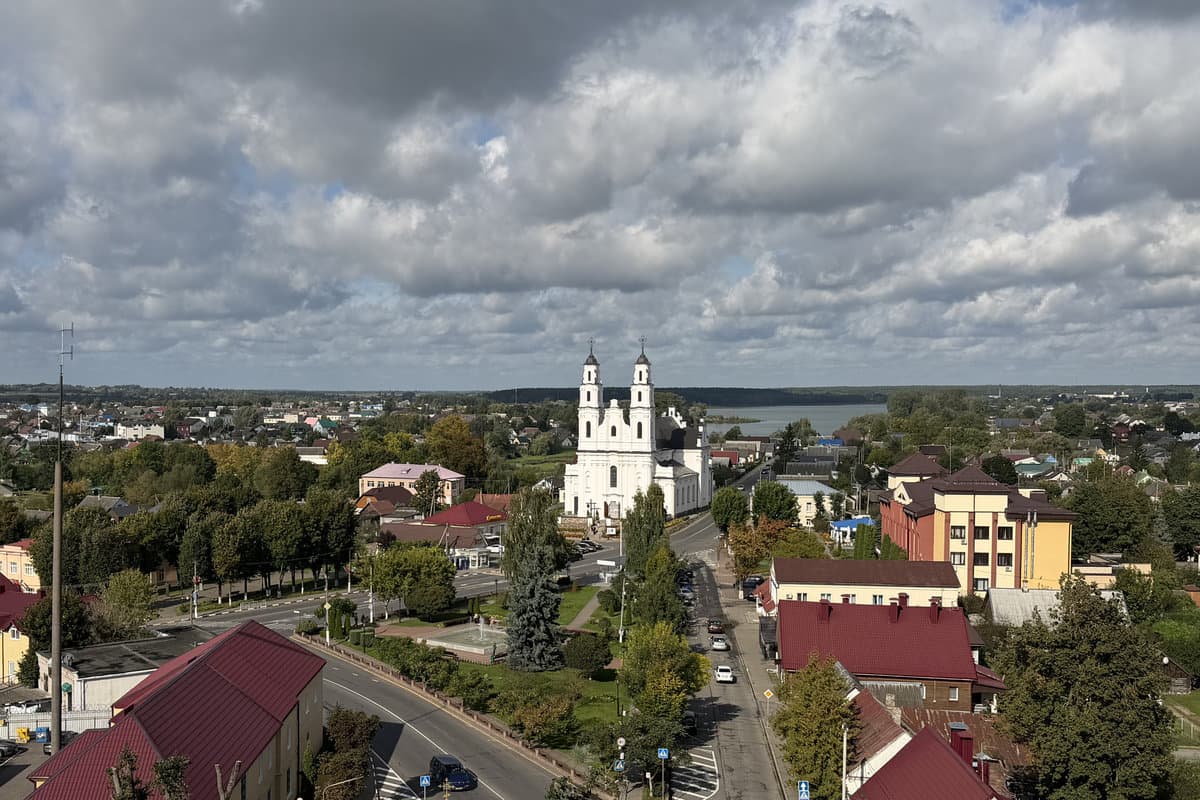
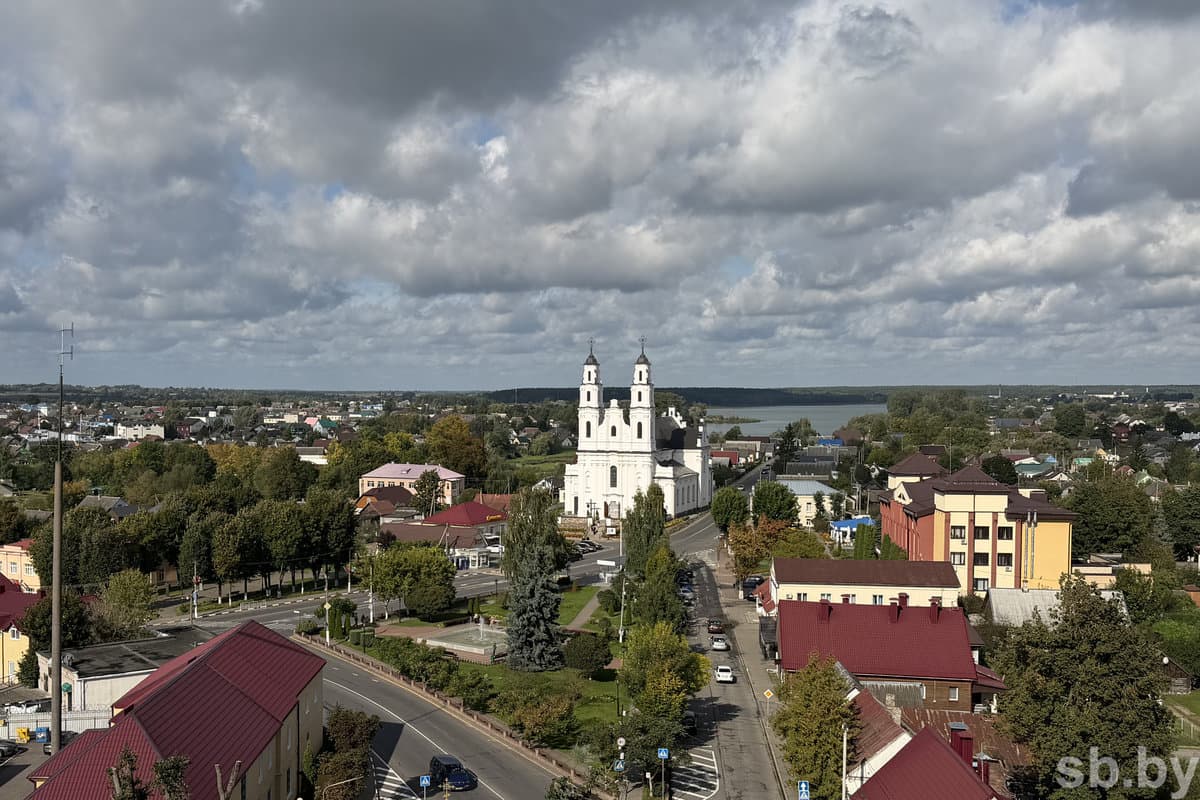
We are used to the fact that you can have a good rest mainly in large cities, they say, there is really something to see. However, small towns keep no less interesting history, and in terms of the number of attractions, some of them can even compete with regional centers. This time, within the framework of the project “Rest for 100”, the correspondent “R” went to the north of the country, to the city, which is rightly called the Belarusian Venice, because five reservoirs are located within its borders. Here is the grave of Baron Munchausen, the second largest arboretum in Belarus is located, and the cherry aroma hovers on the streets of the city even in autumn. Welcome to the Deep!
Keep up! Preparing for a small trip starts with exploring options for how to get there. Deep has good transport accessibility: you can get there by bus, bus or train. Having studied the question in more detail, I immediately dismiss the last option. The train will be on the way for more than 4 hours and will arrive at the station around half past four in the morning. I think that after such an early rise, no walk will be desired. Buses and minibuses run more often. I'm taking the bus. 30 rubles for a ticket, two and a half hours drive one way - and I'm there.
Even at the entrance to the city I notice a large aircraft-monument, which is dedicated to the famous aircraft designer Pavel Sukhoi. He designed more than 50 models of Su aircraft and was twice awarded the title of Hero of the Soviet Union. One of its "drying" (as these aircraft were called in the aviation environment) meets guests of the city. Spoiler: during the tour you will see more than once the aircraft of the famous line.
Having safely reached the bus station, I move towards the central street of Lenin. At first, out of habit, I walk quickly, but in time I remember the advice of my friend - an avid traveler: in any new city walk slowly and look around, then you will definitely see something interesting.
Indeed, slowing down, I immediately note for myself the first local feature. Here, modern buildings are harmoniously combined with two-storey houses with narrow windows, the so-called stonewalls. Before the Revolution, most of these houses were owned by Jewish merchants and artisans. The first floor was reserved for shops, pharmacies, bakeries, workshops, on the second lived the owners. The next location is the embankment along Lake Kagalnoe. But before we go there, we will take a short break for a snack. During a short walk along the way, I managed to meet a bakery, a cafe, a bar, as well as several coffee shops. So if you want to eat fully and slowly, I’m sure there will be a suitable place without problems. I look at one of the coffee shops, take a glass of fragrant cappuccino for 7 rubles, and at a point nearby a standard shawarma for 10 rubles. As they say, cheap and angry, but most importantly – hearty.
The waterfront really deserves special attention. Here you can not only admire the beautiful view of the lake, but also take good photos. By the way, on the other side of the reservoir you can see another model of the aircraft of the Su line. There are several interesting statues along the waterfront. Among them are a firebird, a goldfish, a money horseshoe, and a deep-bodied grandfather. His prototype was the local teacher and local historian Alexander Sobolevsky, who wrote books about Glubok. The locals say that if you rub his boots, you will be happy. A hot bird and goldfish will fulfill all your cherished desires. Well, we'll check. Fragrant, tasty, Glubok Having entrusted your most secret dreams to fairy-tale figures, we move on to an equally interesting monument - Glubok cherry. Here this berry is in special honor, because cherry is one of the symbols of the city. In the 1920-1930s, local breeder Boleslav Lapyr bred a winter-resistant variety that is resistant to the cool weather of the northern part of Belarus. To do this, he crossed cherries and cherries. The resulting form was called - Glubok.
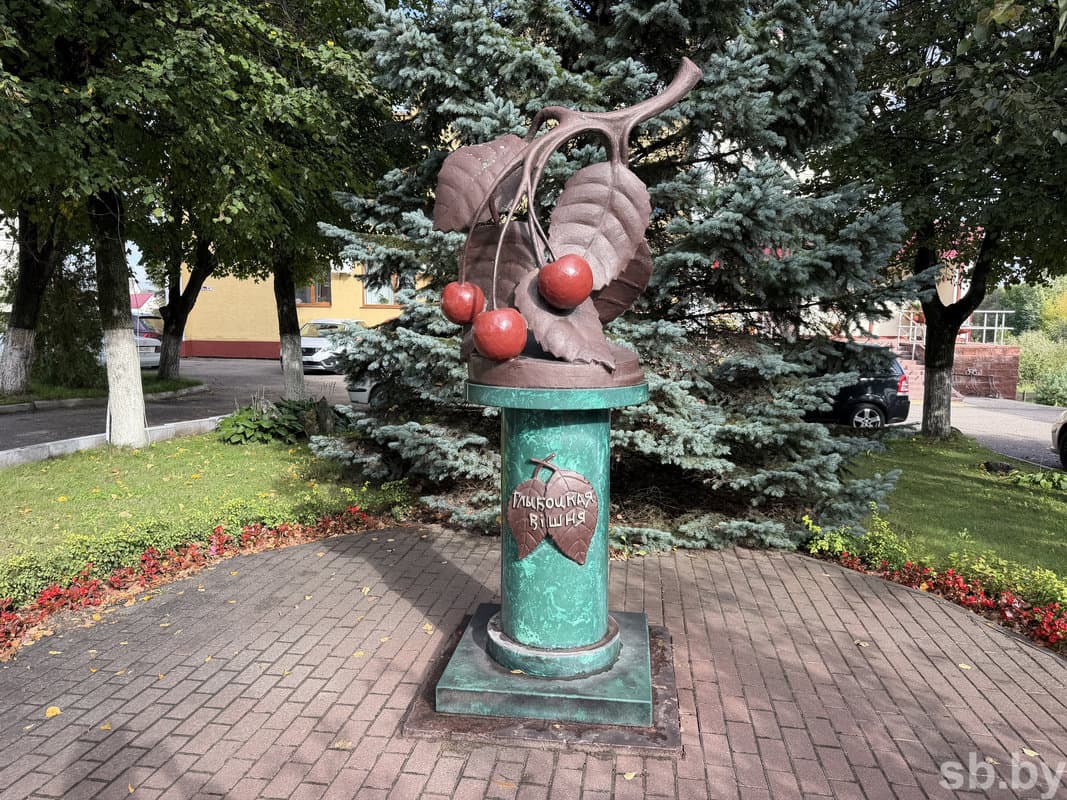
By the way, the two-meter statue is not the only thing that refers to the local brand. In almost every yard grows one or even several cherry trees. Throughout the city you can find images of sour and sweet beauty, even on the windows of buildings and road hatches. And in July, in honor of this berry, the international Cherry Festival is held, which is known not only in our country, but also abroad.
Across the street from the statue is Victory Park, where there is also something to see. There is an exposition of military equipment, a memorial to the soldiers of the Great Patriotic War and, of course, another aircraft - the Su-27 fighter. Nearby extends the already familiar Lake Kagalnoe. The ripples from the wind on the water and the frozen monuments create an amazing contrast, from which the soul becomes calm and peaceful.
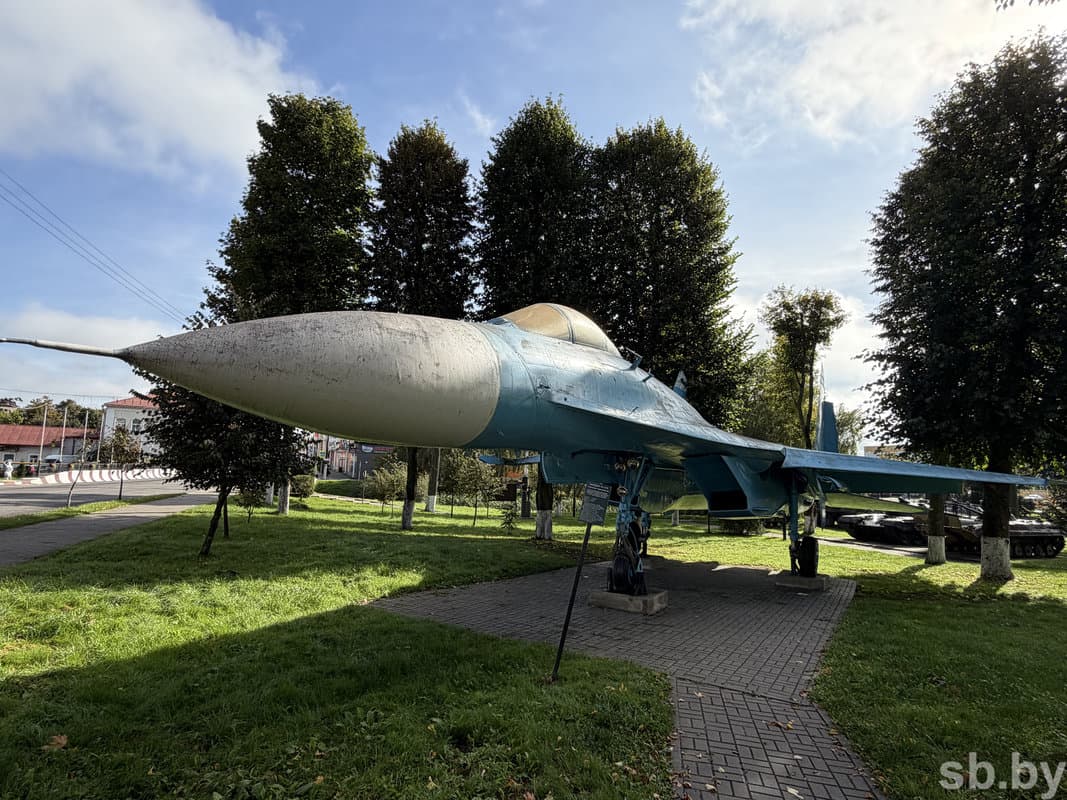
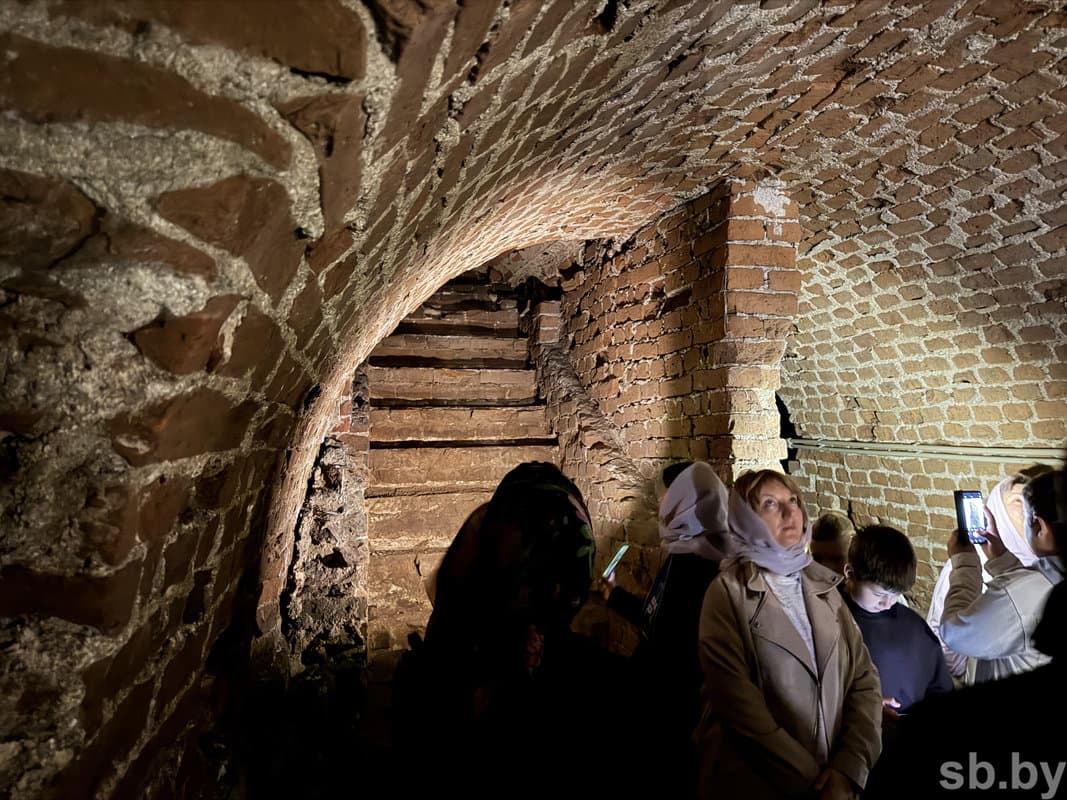
Su-27 fighter designed by Pavel Sukhim. We move towards the square of September 17, where two main sights rise majestically - the Church of the Holy Trinity and the Cathedral of the Nativity of the Blessed Virgin. The latter is also interesting because there is a large dungeon under it, which probably once connected the two temples with each other. And from the bell tower there is a great view of the city and you can see the Deep as in the palm of your hand.
The appearance of the cathedral does not leave indifferent. The shrine is built in Baroque style with elements of classicism and really looks impressive. What is the carved door of the XVIII century! By the way, Napoleon appreciated the decoration of the cathedral. According to legend, during the war of 1812, he passed the Deep and sincerely regretted that he could not take the temple with him to Paris.
An important remark: you can go down to the dungeon and climb the bell tower only in the presence of a guide who will tell about the history of the church and make sure that no one gets lost and everyone returns safely to the surface. The cost of the tour is 34 rubles from a group of up to 40 people. But even before I arrived in the city, I called the local historical and ethnographic museum, and I was added to a tourist group from Polotsk. This time, learning about the temple was free.
I go down to the dungeon, the cellars of which were the last tomb for the monks of the Order of the Carmelites. The air here is saturated with dampness and the smell of wax. At the corners in some places lie decaying boards of coffins, and in some places you can see human bones. Complementing the atmosphere is the small number of things found here, as well as the vaults themselves, made of red brick. For example, one of them has fingerprints. In the twilight, these traces of the past are felt especially acutely: it seems that time has frozen here, and involuntarily I want to go to the whisper.
The climb to the bell tower was not so easy. The spiral staircase winds in the twilight, under the feet seemingly endless steep steps. But when you get upstairs, it's like the city rewards you with a panorama that's breathtaking.
I come out of the temple under a strong impression. But the route is not finished yet, so I am heading to its next point - the alley of famous countrymen. This is a tribute to the people who made the area famous. Here are busts of the artist, ethnographer and writer Yazep Drozdovich, the father of modern Hebrew Eliezer Ben-Yehuda. Nearby is the founder of the professional Belarusian theater Ignat Buynitsky, the aircraft designer Pavel Sukhoi, public and political figure, writer Vaclav Lastovsky and others. Yes, the deep earth is rich in talent. After the dungeon, I have nothing to do with everything, so I go to one of the oldest cemeteries of Golubokoy - Koptevka. Interest among tourists here is the family tomb - the Catholic chapel of St. Elijah of the early XIX century in the style of classicism, to which a narrow stone staircase leads.
A memorial column is installed in the cemetery in honor of the adoption of the Constitution of the Commonwealth on May 3, 1791. It was chosen by storks: on the top they built a huge nest, where they return every year.
We see the tombstone, which indicates that Ferdinand and Wilhelmina von Munchausen are buried here. Of course, it is unlikely that this is the burial of the same literary character - a famous inventor, but who knows? By the way, in 2014 near the cemetery even appeared a monument to Munchausen, where he sits on horseback on a cannonball.
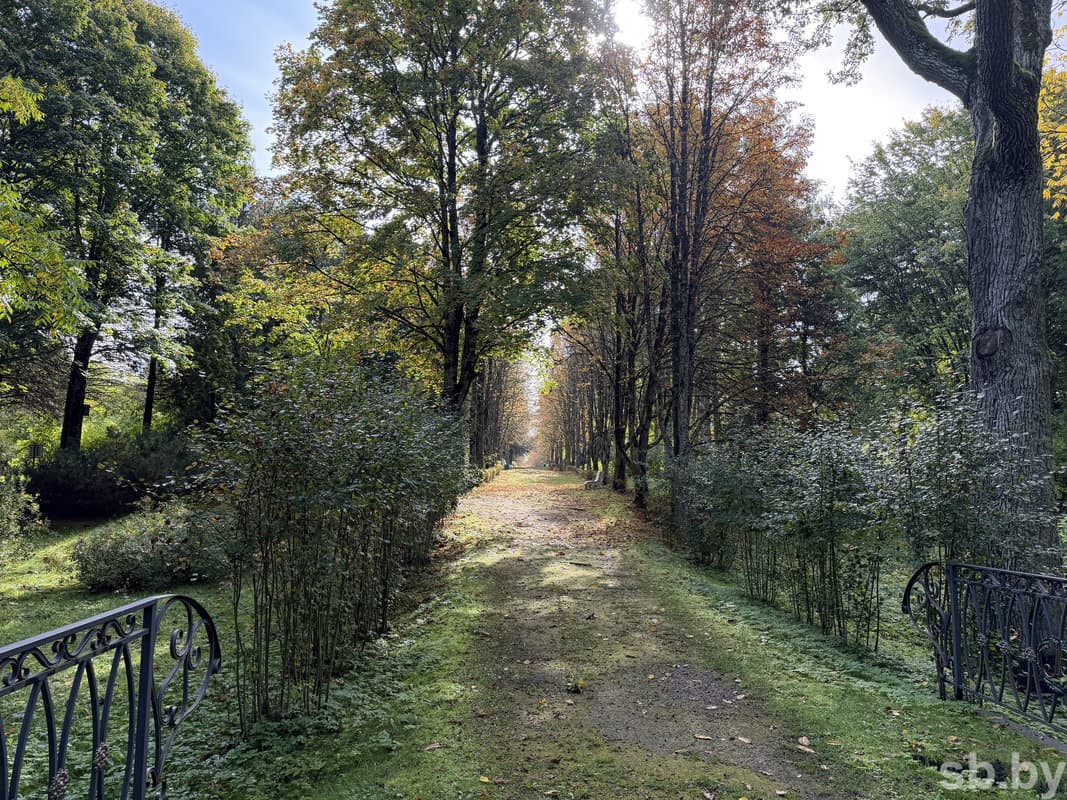
The final location of my trip is the dendrological garden, which the locals call an eight-hectare planet. It was founded in the early 1960s by forest crop engineer Victor Lomako and is the second largest and most diverse park in the country after the Central Botanical Garden of the National Academy of Sciences of Belarus. Nature lovers here definitely have something to see: sections, artificial reservoirs, well-groomed paths and bright alleys. Now it is really beautiful: the dendrological garden is gradually painted in gold and scarlet. The trees have not yet had time to shed the foliage, and it seems as if the air rings from this quiet beauty.
This brings my journey to an end. But how do you leave without souvenirs? At the risk of being late for the minibus, I run into a store where a product that has become another brand of the city is sold - Glubok condensed. I decide not to change things and take a set of three jars with different tastes - classic, boiled and cherry aroma. For this sweet pleasure I give 17 rubles 7 kopecks.
On the way to Minsk, I analyze my impressions: The deep turned out to be exactly what they say about it – cozy, warm and very real. Definitely put him like - bright, cherry, with a slight sourness, as well as the main berry of the city. On what spent 100 rubles in Deep Road in both directions - 60 rubles.
Shaurma, 10 rubles.
Coffee in a local coffee shop - 7 rubles.
Gift set condensed - 17 rubles 7 kopecks.
The balance is 5.93 rubles.
kurdo@sb.by