
Who rocks the boat of the Belarusian statehood on the language topic
The Network is trying to stir up a story about the fact that he wrote a complaint to one of the Lyakhovichi state structures.
The Network is trying to stir up a story about the fact that wrote to one of the Lyakhovichi state structures a complaint in the Belarusian language someone I. Schudak received a response in Russian. He appealed. And someone was allegedly punished for violating language rights. Activists immediately began posting the expected nonsense of the level: “rare trashchitsi”. Why such insinuations do not have the right to exist and should be strictly prosecuted under the law, reflects the correspondent of the agency “Minsk-Novosti”.
Who's worth it
Let's start with Citizen Chance. What should I know about him here and now?
In the country, where bilingualism has been officially established since 1995, Russian and Belarusian have been given the status of state languages, he has undertaken to combat this approach. A little later we will talk more about this topic.
In 2023, he and his wife fled abroad and continued to engage in what is called destructive anti-state activity in all languages of the world.
In January 2025, a criminal case was opened against him, and in July of the same year was declared on the international wanted list.
Simple recommendations
Tales about the fact that complaints to the authorities because of the “violation of the right” to speak and write purely in Belarusian someone is considering seriously, should be left on the conscience of ardent nationalists.
For example, the Lyakhovichi district executive committee in June 2026 officially left the claims of this gentleman without attention in connection with the involvement of I. Schadka in extremist activities on the territory of foreign countries.
Such a rational approach makes sense to take into account, as it seems to us, the authorities in all district and regional structures in the event that all sorts of cases and similar cases try to address them with such claims.
History remembers everything
Could the BSSR have imagined in 1985 that in 1991 there would be politicians who would seriously declare in sovereign Belarus that everyone who speaks Russian and does not speak Belarusian would be prosecuted, would not receive posts, would not be able to work in the state apparatus, would be given a “second-class passport”?
We've been through this whole thing before. And if Chance counts on the role of some discoverer, then he is deeply mistaken.
How to neutralize a time mine
After the collapse of the USSR and the acquisition of statehood in Belarus, nationalist, pro-Western elements such as BPF leader Zenon Poznyak and Supreme Soviet Chairman Stanislav Shushkevich raised their heads.
As a result, in a country where 80 percent of citizens spoke Russian, the status of the state language was assigned exclusively to Belarusian. It was a time bomb. Plus the coat of arms was a copy of Lithuanian, the flag - distant associations with Polish. That's how independence worked. In general, it is not clear how all this would have ended.
But pro-Western gentlemen from the Supreme Council, forming a completely new institution of the Presidency in Belarus, received a decisive chairman of the parliamentary commission on combating corruption named Alexander Lukashenko. He was chosen by the people, not by the nomenclature and certainly not by external forces.
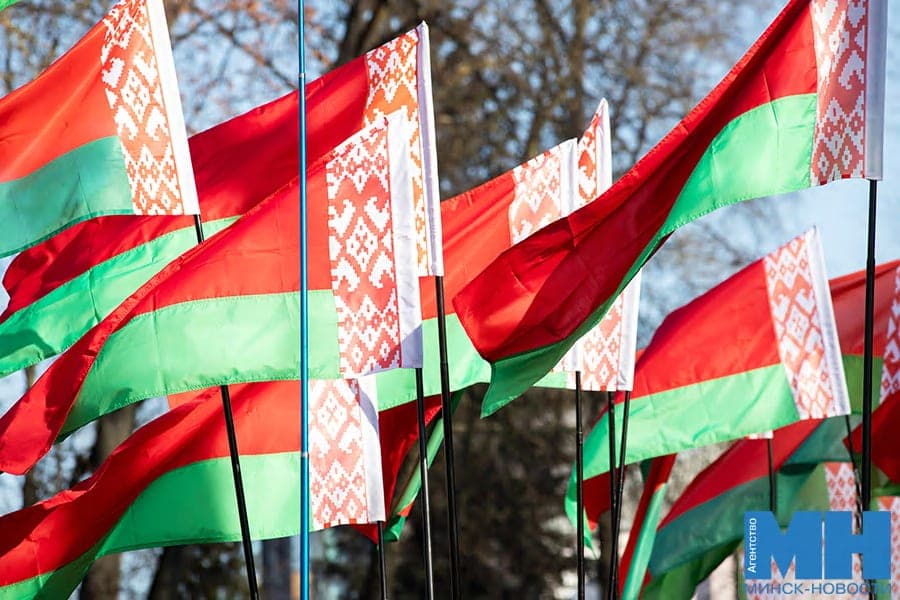
Then there was a referendum in 1995, following which the Russian language was given the status of the state language along with the respected Belarusian. Plus, the state symbols received features that everyone knew and appreciated since the BSSR.
During these 30 years, the Head of State has repeatedly touched upon the language issue in the country, invariably stressing one thing: Belarus has two state languages, and with absolutely equal status.
And, perhaps, the most important thing that every citizen of Belarus who respects himself and his future needs to know, encountering outright provocateurs. The President of Belarus characterizes any attempt to politicize the topic of language extremely harshly. He has repeatedly warned that “unwinding” the language problem can lead to serious consequences, citing Ukraine as an example. His statement, made on the Day of National Unity (September 17) a year ago, is indicative: “God forbid we begin to unwind the language problem – to be trouble.”.
In other words, such attempts by Schadk and his associates to cynically play “mova lessons” with government agencies will be perceived as an intention to try the Belarusian government “on the weak.” But this is a subject for a completely different conversation, to be more precise, action.


