
Glaciers on Earth soon predicted a sad fate
Scientists from the Swiss Higher Technical School of Zurich and the Free University of Brussels have created an interactive tool that allows you to know when a particular glacier may disappear under various scenarios of global warming.
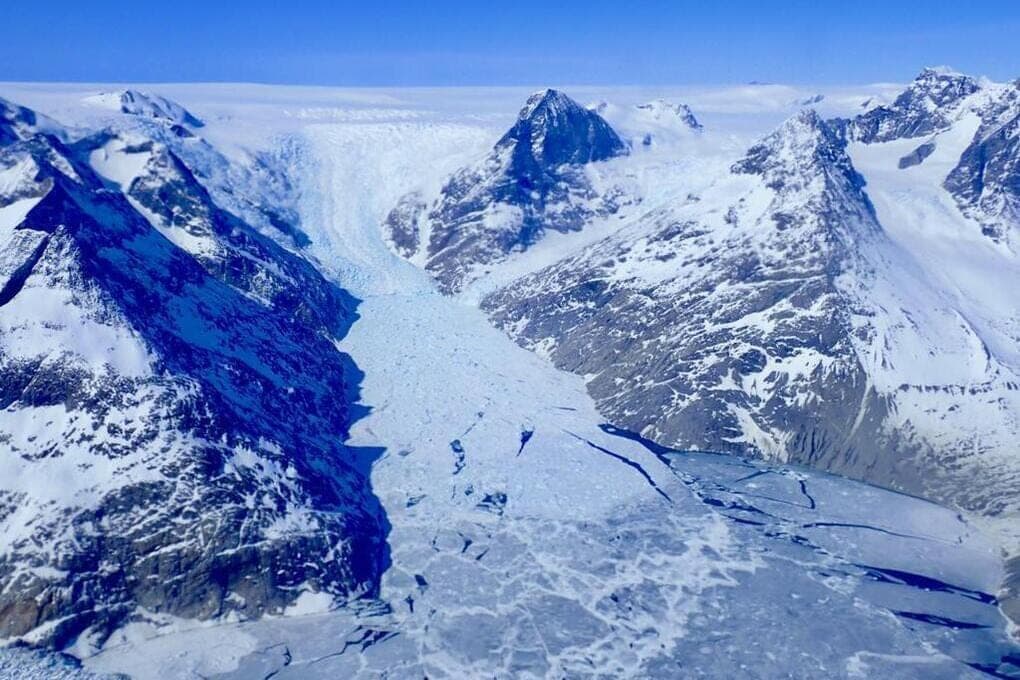
When creating this map, scientists found that almost half of modern glaciers could disappear by 2100 if global warming does not exceed +1.5 °C, writes the New York Post. The map allows you to switch between different warming scenarios — 1.5°C, 2°C, 2.7°C or 4°C — and the color of the dots on each glacier shows when it will disappear.
The dark red means that the glacier has already disappeared, orange that it will disappear between 2027 and 2041, and light blue that the glacier is expected to persist until 2100. The map was compiled on the basis of predictions made in 2024 by researchers from the Swiss Higher Technical School of Zurich. According to these projections, with global warming of 1.5°C each year, about 2,000 glaciers could disappear.
“Every fraction of a degree matters,” says Dr. Lander Van Tricht, who analyzed the findings.
With a warming of 1.5°C, almost 50% of all glaciers will disappear, the New York Post reports. At 2.7°C, only 20% of the glaciers will survive. And with 4°C warming, 90% of the world’s glaciers will disappear, leaving only 10%.
Although 2100 is still a long way off, a significant reduction in the area of glaciers was recorded in 2026, which is consistent with the results of the 2024 study. Due to the low amount of snow in winter and abnormal heat in the summer in the European Alps there is a "substantial" melting of glaciers.
Last month, the Bella Tola glacier near St. Luke in Switzerland was declared extinct, writes the New York Post.
The corresponding forecast was made in 2024 and coincided with the forecast of the disappearance of glaciers. This summer, another Swiss glacier, Urirotstok, was declared extinct. According to Dr. Van Tricht, these examples demonstrate that the melting of glaciers is not a myth.
In 2025, Swiss glaciers were melting at a tremendous rate, and their total volume decreased by 3%, according to the New York Post. Because of this, over the past decade, the mass of ice in Switzerland has decreased by a quarter.
According to Italian researchers from the University of Venice Ca Foscari, glaciers outside Greenland and Antarctica contain 150,000 cubic kilometers of ice, and if they melt, the sea level will rise by at least 30 centimeters.
Dr. Van Tricht noted that the glaciers, which according to the study should disappear, are melting now, and stressed that this problem “is not far from us” and “does not wait for us at the end of the century”, but is happening right now.


