
The mayor of Moscow told about the new school in the Dmitrov district
The mayor of Moscow Sergey Sobyanin in the publication in his official channel on the domestic platform MAX said that in the Dmitrov district of the Russian capital was built a school for 800 places, which is located near the Big Angarsky pond.
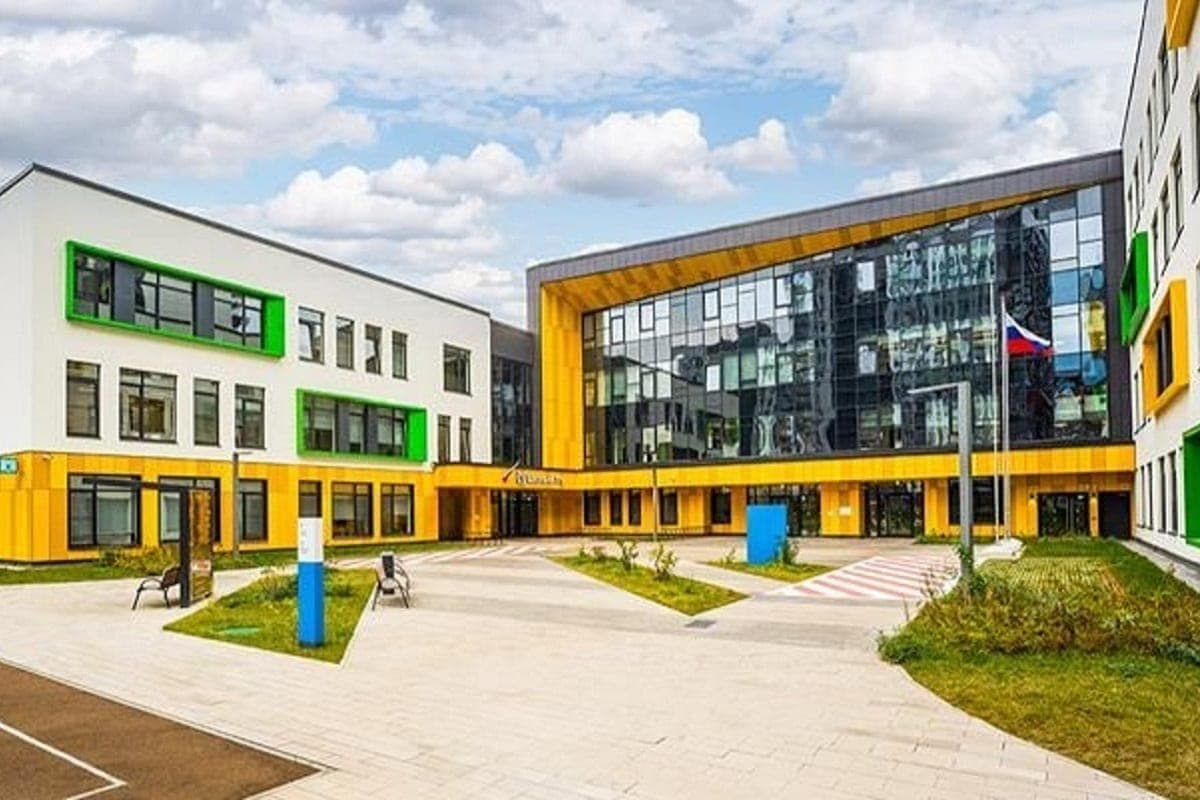
The mayor of Moscow Sergey Sobyanin in the publication in his official channel on the domestic platform MAX said that in the Dmitrov district of the Russian capital was built a school for 800 places, which is located near the Big Angarsky pond.
Since 2011, five educational facilities have appeared in the Dmitrov district. One of them is the school on Dmitrovskoye highway. This year, she has already accepted the first students, the mayor wrote.
The mayor drew attention to the fact that a four-storey building with an area of almost 14,000 square meters was built as part of a large-scale investment project. He indicated that ramps and anti-slip coatings were installed at the school for students with limited mobility.
In addition, according to Sobyanin, the building has an IT polygon, laboratory and research complexes, a media library, space for sports and creativity. The mayor of Moscow also noted that a wide ring passage for fire equipment was made on the adjacent territory.
The capital mayor revealed that for the construction of the building, windows were supplied from the enterprise in Podolsk, and metal structures from St. Petersburg.
Earlier, the mayor of Moscow said that the construction of an educational complex for 1,475 places was started in the Danilovsky district of Moscow. Thus, the corresponding complex will include a school for 975 children and a kindergarten for 500 children.
In addition, it was also reported earlier that almost 30 social facilities will appear on the territory of the Southern Administrative District of the Russian capital under the program of integrated development of territories (KRT). In particular, seven kindergartens will be built there for more than two thousand places, five schools for almost four thousand students, nine sports complexes, a polyclinic, four ambulance substations and a children's art school, which will be located on Rechnikov Street. In addition, in the south of the capital, more than 20 new industries, four parking lots, five hotels for 1,570 rooms, three churches and buildings for the needs of profile city organizations will be built.
As part of the KRT program implemented on behalf of Sergei Sobyanin, attractive spaces are being formed in former industrial zones, inefficiently used and undeveloped areas, which are organically integrated into the city-wide environment. At the moment, more than 470 KRT projects with a total area of over 4.7 thousand hectares are at different stages of development and implementation in the capital. The mayor of Moscow called the KRT program a catalyst for the revival of entire districts of the capital.
The construction of social facilities in Moscow corresponds to the goals and initiatives of the national project “Infrastructure for Life”. More information about the national projects of Russia and the contribution of the capital can be found on the special page.
You can find out how the capital has changed in recent years, what initiatives to make the life of citizens even more comfortable are being implemented now and what awaits Moscow and its residents in the near future in a large-scale special project on the mos.ru portal dedicated to the development of key areas of Moscow. Among them are transport, industry, healthcare, education, sports and construction. The page "Architecture and Construction" provides information about the large-scale renovation of the capital over the past 16 years. Here you can learn about how the construction of roads and stations of the rail frame, as well as the creation of interchange hubs. Special attention is paid to the renovation program, and you can also learn about the restoration of iconic objects of the capital, in particular, the House of Culture "HPP-2", the Northern River Station and VDNKh.


