
Unusual colony of living organisms resembling algae found in Karelia
This was reported by representatives of the environmental zone “Kivach”, specifying that the authors of the discovery were volunteers Pavel Demidov, Sophia Eremeeva, Elena Savinykh and Lilia Gubaidulina
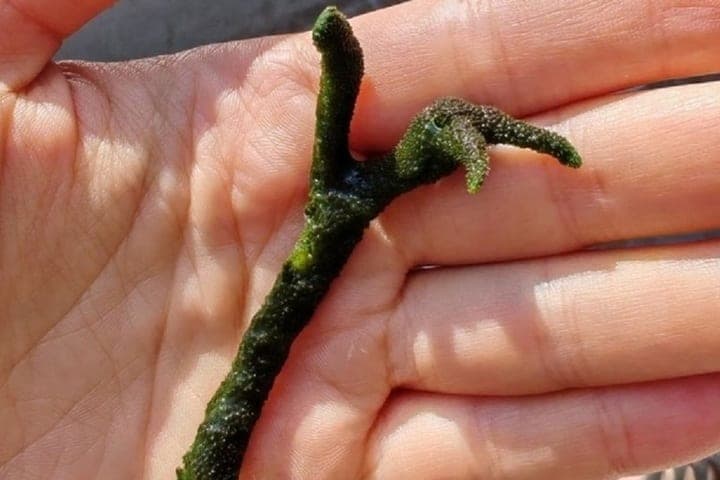
In the Sun River on the territory of the reserve "Kivach" volunteers discovered a large settlement of freshwater sponge - badagi (Spongilla lacustris). At first glance, it looks like twigs or algae, but in fact it is an animal.
This was reported by representatives of the environmental zone “Kivach”, specifying that the authors of the discovery were volunteers Pavel Demidov, Sophia Eremeeva, Elena Savinykh and Lilia Gubaidulina.
They sailed on a boat on a reserved river and less than a kilometer from the waterfall Kivach noticed unusual growths on the sunken tree. It is noteworthy that the location is less than a thousand meters from the famous waterfall Kivach. A member of the expedition, Lilia Gubaidullina, who has a specialized biological education, identified a freshwater sponge known as a badagu in the find.
Many people mistakenly take the Badyaga for algae, since this organism leads a sedentary lifestyle and is absolutely motionless externally. However, inside the porous structure, continuous biological activity boils: cells constantly move at the microscopic level, thanks to which fluid filtration and food extraction are carried out. It is impossible to see this process with the naked eye, which creates a deceptive impression of complete staticity.
Discovered “grooves” spread over an area of about 150 square meters (10x15 m). On the trunks of birch trees and other tree species immersed in the aquatic environment, researchers counted about three dozen large colonial formations (their dimensions vary from 30 centimeters to a meter), as well as about two dozen smaller specimens. To the touch, these branching structures are soft and springy, and their characteristic greenish hue is explained by the presence of unicellular algae-symbionts - zoochlorella.
Biologically, the Badyaga is a colonial organism. Fused individuals are nevertheless autonomous and have no internal connections. The bulk of such a colony consists of dead tissue, while living biomass is concentrated outside. With the onset of cold weather, the active layer dies away, leaving behind only a frame of needle-like elements. However, before that, each individual produces special capsules - hemmules. This stage of rest allows you to survive adverse conditions in order to give birth to a new generation with the arrival of spring.
In addition, during the research work, the researcher of the reserve Alexander Sukhov studied the contents of the stomachs of river perch caught in the Suna River. Inside were found larvae of sisira - rare representatives of the order of retinoptera insects. They parasitize the colonies of the Badyaga, sucking out its contents.


