
From Team Games to Life Resilience: How Sport Shapes Character
Adolescent anxiety has long ceased to be a topic only for psychologists and family counseling
Teenager anxiety has long ceased to be a topic only for psychologists and family counseling. Fear of the test, the race for likes, the pressure to “be like everyone else” – all this is carried by schoolchildren in an invisible backpack to the classroom, and to the sports field, and in the company of friends. Educators are increasingly noticing that the usual reactions – isolation, irritability, going to the phone – become the background of everyday school life. And then the question arises: does the school have a resource that works not for “warning”, but for “building”? A resource that does not forbid, but gives support?
The answer was known even before the word “bullying” appeared in the parents’ dictionary. This physical education is the most underrated lesson in the school schedule.
The problem is bigger than it seems
Let's start with the numbers. According to the World Health Organization, about 80% of adolescents in the world do not follow physical activity guidelines, and girls are less active than boys: 85% of girls and 78% of boys aged 11-17 are below the norm. Russian studies in regional schools give a similar picture: up to 37% of schoolchildren, in addition to physical education classes, do not engage in any motor activity at all, and only a few do exercises in the morning. At the same time, the WHO recommends that adolescents move for at least 60 minutes a day, and three times a week with a load that strengthens muscles and bones.
The paradox is that it’s not just about muscles and endurance. Physical activity is directly related to mental health: it reduces symptoms of anxiety and depression, improves sleep quality and cognitive function – that is, the same academic performance for which parents most often “sacrifice” walking. International studies show that the higher the level of physical activity of a teenager, the higher his self-esteem - and through self-esteem, psychological stress decreases, and the effect is retained in the long term. It turns out that the vicious circle is the opposite: not “sport is a reward for mental health”, but “sport is its building material”.
Three mechanisms: stress, self-esteem, team
How exactly does physical education “retest” a teenager? Psychologists identify three interrelated mechanisms.
One is biochemical. During the load in the body, the release of endorphins, serotonin and dopamine increases, the level of cortisol - the stress hormone - decreases. Regular exercise improves sleep patterns and even increases the volume of the hippocampus, the area of the brain responsible for memory and learning. Physical education is, in fact, a natural “reset” of the nervous system, free and without side effects.
The second is self-assessment. Sport gives a teenager something that the school system almost fails to provide: an objective, measurable result of their efforts. We ran faster than we did in September, that’s a fact, not an opinion. The domestic study showed that among students actively participating in sports and mass events, almost 90% of respondents had adequate self-esteem, while in the group of non-exercising - only about 80%. The nuance that scientists note is also important: sports form a realistic self-esteem - young athletes differ from their peers by less fear of failure and lower anxiety. And stable, based on real achievements, self-esteem is, as our interlocutor will show, also a shield against pressure "for the company.".
The third is social. Team games - relays, football, volleyball, basketball - create a unique environment: here you need to simultaneously control your emotions, hear your partner, follow the rules and take responsibility for the overall result. Studies show that teenagers involved in team sports are less likely to face social isolation, are more actively involved in the learning process and less likely to become participants in deviant behavior. For introverted teenagers, team games generally work as “soft socialization”: through the common goal and support of the team, they gain confidence and communication skills, which are then transferred to the classroom and to friendship.
Finally, there is a strong-willed aspect: surveys show that teenagers involved in team sports have higher internal discipline and the ability to finish things, and their self-esteem is more adequate than that of non-engaged. These are the very “inner pillars” that so much is being talked about in the context of risk prevention.
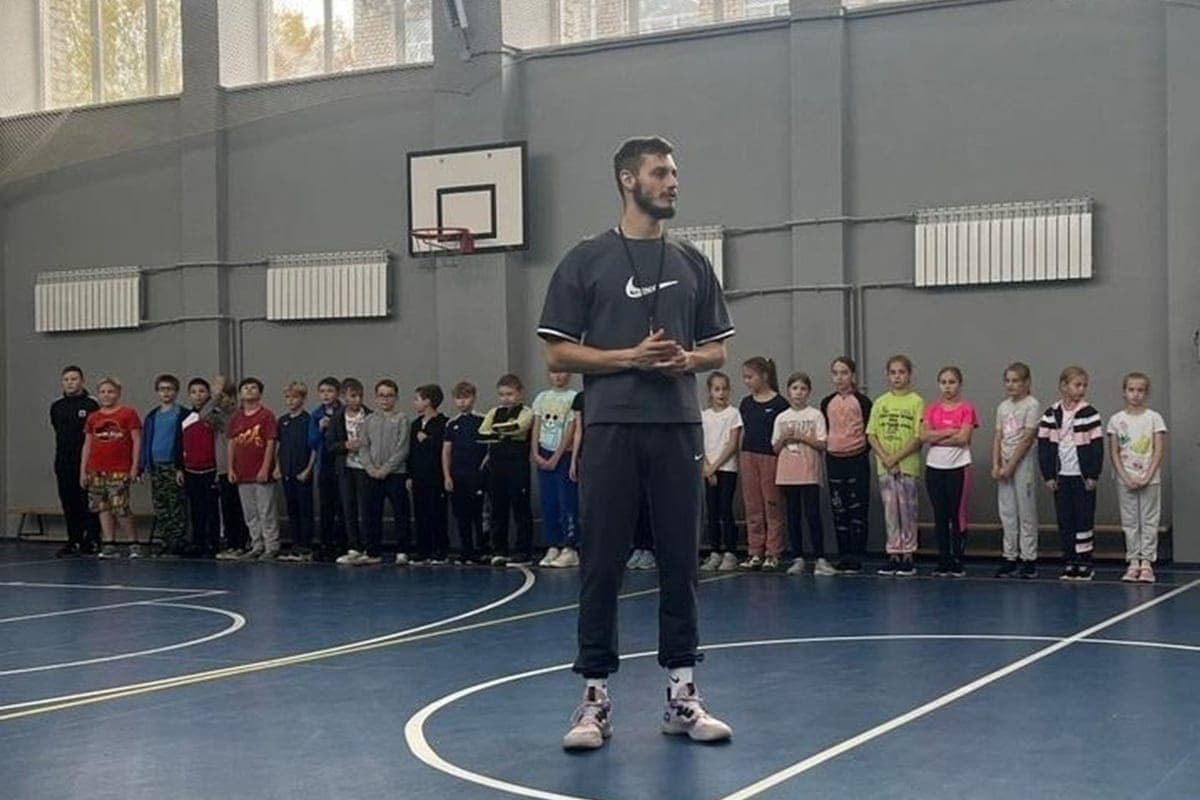
How it looks in a real school, the correspondent of "MK in Pskov" told the teacher of physical culture MAOU "Face of Economics and Entrepreneurship No. 10" Maxim Ryabov.
Maxim, do you notice that today’s teenagers have become more anxious or tense? What does that mean?
- Yes, the anxiety really became more noticeable. Manifestations are different: a teenager can walk thoughtful, he may have insomnia or, conversely, increased irritability. Often anxiety results in aggression. In the classroom, it looks like this: someone avoids answering at the board, is constantly distracted, shows anxiety in front of the test or during the response of a friend. Often the root is social pressure: anxiety about grades, class relationships, peer expectations, or the endless race for approval on social media.
What, in your experience, does regular physical activity give a teenager that nothing else does?
- It has a complex effect. First, exercise naturally reduces stress and tension. Secondly, sports give a clear, measurable result: improving physical fitness, mastering new skills, winning competitions. This creates a sense of competence and confidence in the adolescent. Thirdly, in team activities – football, relays, group exercises – the skill of self-control develops: you need to restrain impulses, follow the actions of your partner, follow the rules, even when you want to distract yourself.
How do team games help teenagers learn self-control?
- In team games, each participant is required to control their emotions and actions. For example, during the relay, one participant was distracted by the phone - the team loses pace. A teenager needs to force himself to focus, not to break down, perhaps ask a friend to help. Here he learns to track his condition and manage it in the moment.
How do achievements in physical education affect the self-esteem of a teenager? Have you ever had a sport that helped you believe in yourself?
- Sport provides objective points of support for self-esteem. When a teenager achieves success – a good run, a difficult exercise, helped the team – he sees the result of his efforts. It strengthens self-confidence. I remember one case: a boy who used to be embarrassed to go to the board, consistently showed good results in physical education classes. He became more involved in discussions, taking on the role of a leader in group assignments, a major step toward greater confidence.
Does sports self-esteem help a teenager resist peer pressure? How does it work?
- Yes, it does. When a teenager has a steady, realistic self-esteem based on real achievement and development, it is harder for them to succumb to the pressure of being like everyone else or doing something risky for the company. He relies on his own strengths, values and understanding of his strengths, not on the immediate approval of the group.
The practice of Maxim Ryabov once again confirms the picture that science draws. Physical education is not about running 40 minutes between math and lunch, but a compact model of life situations: there is a victory that must be accepted with dignity, a defeat that cannot be discounted, a team that does not expect excuses, and rules that apply even when you really want to break. A teenager who has learned to lose the baton without disaster and ask for help from a teammate is more likely to cope with failure on the test and will not go “for company” where you should not go.
It is also important that physical education is the only school subject where self-esteem is formed not by third-party subjective assessments, but by real objective facts. It is impossible to “seem” here: either ran or did not, or helped the team or failed.
Knowledge gained in school is outdated, formulas are forgotten. And the ability to get up after a fall, lose without rage and work as a team remains for life.
And if a teenager doesn’t get that experience in school — from not having lessons, from being released “by reference” or choosing “I’d rather sit on the phone” — that gap isn’t automatically filled. It then has to be closed as an adult, which is much more difficult. Therefore, the shortest answer to the question “why does a teenager exercise” is this: so that one day in adulthood you do not learn to cope with stress, failures and people from scratch.


