
From Orthorent brush to stable platform: what was presented at the exhibition "Medicine and Health - 2026"
Rehabilitation equipment, which helps patients to learn to move again, was presented at the International Specialized Exhibition "Medicine and Health...".
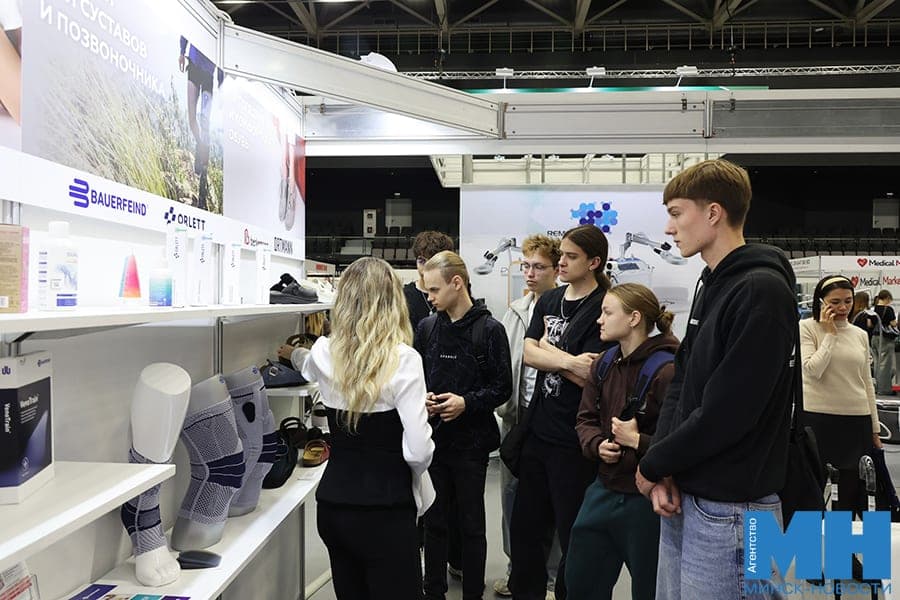
Rehabilitation equipment that helps patients to learn to move again was presented at the International specialized exhibition "Medicine and Health - 2026". Details - in the material of the correspondent of the agency "Minsk-Novosti".
"Orthorent-hand": accurate work with fingers
This device is among the innovative technologies, designed for prolonged passive mobilization of the joints of the hand and fingers. It is relevant for patients who have undergone surgery or injury, when it is important to prevent immobility of the joints. The device works with both individual fingers and the brush as a whole with individual adjustment of the angle, speed and time of therapy.
- This device allows you to stretch your fingers with effort, explained the leading specialist in the sale of medical equipment Natalia. There are quite a lot of devices with pneumatic drive, but for patients with spastic fingers they are not suitable, because the fingers do not stretch. This model is designed specifically for these patients.


Children's exoskeleton: rehabilitation from the first years
Among the presented developments, the children's exoskeleton attracts special attention. It was created specifically for the rehabilitation of children with motor impairments and has been demonstrated in several models, including the smallest for patients of early age - up to 2 years. As noted at the exhibition, with cerebral palsy, rehabilitation is most effective when it begins from the earliest years, while the body is still plastic and susceptible to therapy.
According to Natalia, the design of the exoskeleton takes into account the physiology of movement: it has a roll of the foot, simulating a natural step, and a system of adjustments that is adjusted for a particular patient - not by abstract scales, but by actual body parameters. This allows you to use the device in children with different anthropometric data and choose a comfortable training regime.
Classes with the child is conducted by a specialist pilot who is behind the device, holds handrails and sets movement parameters. He can walk on his own, too, but this is not done for safety reasons with young patients. A person should always be safe in such an exoskeleton.


Stable platform: a proven solution
Along with innovative developments, the exhibition presents equipment that has long been widely used in rehabilitation institutions. As Natalia noted, the stable platform is designed to verticalize patients with disorders of the vestibular apparatus - after injuries, strokes, heart attacks. Even people with multiple sclerosis work on it.
Handrails for the platform are designed specifically: engineers make them on an individual order, for a specific person. The decision comes after users noticed that people sometimes lose coordination during classes. So the design has become an additional insurance and ensures the safety of the patient.
- The platform works as a biofeedback device. On the screen, a test, diagnostic or training program is set, and the patient, standing on the platform, performs exercises, looking at the screen, where there is a video sequence and instructions. This is how the vestibular apparatus is trained and verticalization occurs, Natalia explained.


Photo by Elizaveta Davidovskaya


