From Rostov to Kazan: what are the main streets of five million-plus cities
Each large city has its own special places, where not only tourists, but also residents aspire – for walks, meetings with friends or just relax
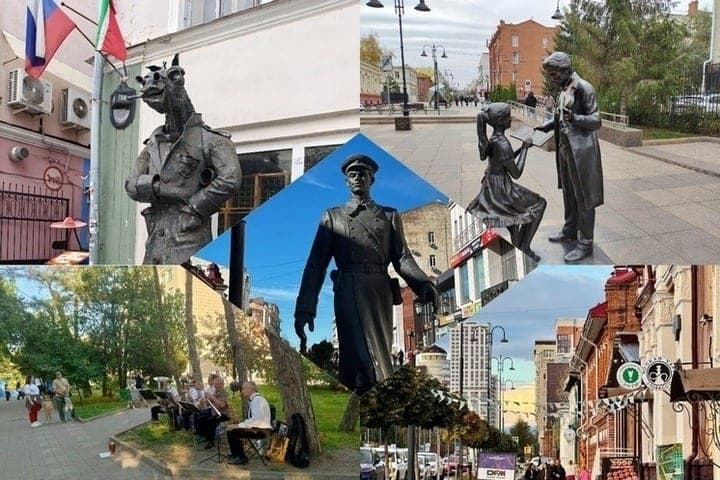
Each major city has its own special places, where not only tourists, but also residents aspire – for walks, meetings with friends or just relax. Often such centers of attraction are pedestrian streets: with their historical atmosphere, cozy cafes, interesting monuments and lively public spaces. Each city has its own unique “Arbat”, reflecting its unique history and spirit. Omsk, Samara, Kazan, Ufa and Rostov-on-Don – these five million-plus cities are no exception.
"Moskovsky Komsomolets on the Don" invites you to a virtual journey through the main pedestrian streets to find out what they look like in the autumn of 2026, what attracts and what stories they keep.
Rostov-on-Don: Pushkin Street
Pushkinskaya Street is one of the most recognizable streets of Rostov-on-Don. It stretches for 3.5 kilometers through the historical center. Here old mansions coexist with modern buildings, and the green boulevard, despite the approaching cold months, remains a favorite place for walking.
Today, the street is being prepared for another renovation. A new concept for the reconstruction of the site from Dolomanovsky Lane to Theatre Avenue is planned to be developed by January 2027. At the same time, Pushkinskaya already has a rich history, numbering more than a century and a half.
The history of Pushkin has more than a century and a half. The street appeared on the city map in 1870 as Kuznetskaya, presumably due to the nearby blacksmith workshops. Initially, it passed through the territory of former fortifications. In the second half of the XIX century, active development began, in which the tobacco manufacturer Yakov Kushnaryov played a significant role. In 1885, the street was renamed Pushkinskaya in honor of the visit of Alexander Pushkin to Rostov in 1820. By the beginning of the XX century, the street became one of the main places for festivities, and in 1904 the first electric lights were lit here.
Among the architectural gems are the mansions of Pavel Kramer, Petrov and the famous Paramonov House, designed by Lev Eberg, where the Zone Scientific Library of the Southern Federal University is located today. Pushkinskaya is also associated with the childhood of the outstanding psychoanalyst Sabina Spielrein. The street is decorated with the Don State Public Library, which opened its doors in 1994 and became the center of cultural life.
Despite serious damage during the Great Patriotic War and subsequent restoration, Pushkinskaya regained its popularity.
Today Pushkinskaya combines tourist routes and everyday life of citizens. Here are houses, shops and cultural institutions, and green alleys remain a place of rest. However, the infrastructure needs updating.
The new concept of reconstruction should determine what the recreational areas and green areas will look like in the future. The main task is to make Pushkin more modern, preserving its historical appearance.
Omsk: Chokan Valikhanov Street
Chokan Valikhanov Street, located in the heart of Omsk, today is considered one of the hallmarks of the city. However, its current appearance and unofficial name "Omsk Arbat" it received relatively recently.
Until 1985, this site was called the street 20 years of the Red Army, and before that, in the pre-revolutionary period, Plotnikovskaya, in honor of one of the atamans of the Siberian Cossack army. On October 17, 1985, the site from the Irtysh embankment to Kuibyshev Street was renamed in honor of the outstanding Kazakh scientist, traveler and educator Chokan Valikhanov, who once studied in the Omsk Cadet Corps. It was here, in Omsk, in 1854, that Valikhanov first met Fyodor Dostoevsky, whose acquaintance grew into a close friendship.
In 1988, about 400 meters of the street became pedestrian, and in 2013-2014 there was a large-scale reconstruction. There were impressive glass art objects "Crystals" and a fountain crystal in front of the observation deck overlooking the Irtysh. There is a monument to Chokan Valikhanov on the street, and the Consulate General of Kazakhstan is also located. In September 2026, a new sculpture “Music” appeared here, symbolizing the awarding of the title “Cultural Capital of Russia – 2026” to Omsk.
It is worth mentioning the project “Pedestrian Lyubinsky”, launched in 2025. On weekends, part of Lenin Street turns into a pedestrian zone, where concerts, master classes and other cultural events take place.
Samara: Leningradskaya Street
Leningradskaya Street is one of the most iconic in Samara, which is the main pedestrian zone of the historical center. Its appearance has been formed over the centuries, and the names have changed many times, reflecting the stages of development of the city.
The first mention of the street on the map dates back to 1792. It was originally called Prolomna because of the ravine that descended to the Volga. Then, in the 1840s, it became Senna because of the nearby bazaar, later - Moskalnoye, and then - Bread. At the end of the XIX century, the street was called Panskaya - in honor of merchant mansions, shops and apartment houses. In 1918 it became Petrograd, and in 1924 – Leningrad.
For a long time there was public transport, but traffic restrictions were introduced only in 1986. Today, a pedestrian stretch of about 620 meters connects Kuibyshev and Galaktionovskaya streets.
In the 1990s, Leningrad turned into a spontaneous clothing market. After its liquidation, in the early 2010s, the street was extensively reconstructed: comfortable pedestrian zones, benches, fountains and small architectural forms appeared.
Now Leningradskaya is a popular place for meetings and walks. There are numerous cafes, restaurants and pastry shops. Among the attractions are the column in honor of the 150th anniversary of the Samara province and the bronze statue of the policeman Uncle Styopa.
Kazan: Bauman Street
Bauman Street is one of the oldest and most popular walking areas of Kazan, passing through the historical center of the city and connecting the Kazan Kremlin with Tukay Square. The length of the pedestrian section is more than one and a half kilometers.
Today, Bauman is an integral part of the tourist life of the capital of Tatarstan. Here are historical buildings, temples, museums and sculptures. Along the street is full of life: there are cafes, restaurants, shops and souvenir shops where you can try dishes of national Tatar cuisine and buy colorful gifts.
In the warm season, the street comes to life thanks to performances of musicians, street artists and theatrical performances. In winter it is transformed under the festive illumination.
The history of the street goes back to the times of the Kazan Khanate. After the capture of the city by the troops of Ivan the Terrible, the territory began to recover. Initially, the street was called Prolomnaya, then Big Prolomnaya. After the foundation of the Bogoroditsky monastery, the name Bogoroditskaya was fixed. In 1930, the street was renamed in honor of Nikolai Bauman, a native of Kazan and a revolutionary.
Modern architectural appearance was formed mainly in the XIX-XX centuries, when wooden buildings gave way to stone houses, which housed merchant shops, hotels and financial institutions. The street became pedestrianized in the mid-1980s. To celebrate the millennium of Kazan in 2005, a large-scale improvement was carried out here, the covering, facades of buildings were updated and new sculptural compositions were installed. Bauman Street remains one of the main places of attraction for both tourists and residents of Kazan, representing a concentration of iconic sights, architectural monuments and original small architectural forms.
The editorial staff of MK on the Don thanks colleagues from MK in Kazan, MK in Omsk and MK in Samara for their participation in the project!