
Full Moon in October 2026: what date will the Hunter's Moon rise and how it is unique
The full moon in October 2026 will come on October 26 at 07:12 Moscow time, but the full moon can be observed for three nights in a row: from 24 to 27 October
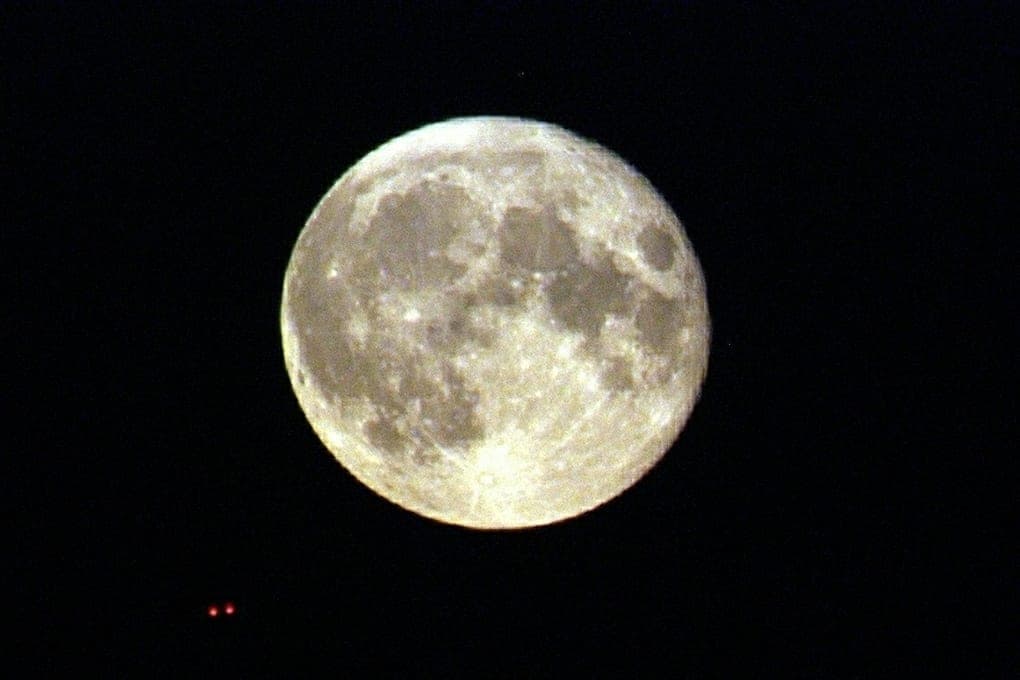
Date: October 26, 2026
Time: 07:12 Moscow time
Title: Hunter's Moon
The full moon in October 2026 will come on Monday, October 26, at 07:12 Moscow time (04:12 UTC). This is the moment when the Sun, Earth and Moon line up so that the observer sees the fully illuminated lunar disk.
It is important to understand that a full moon is a point in time, not a whole day. But it is almost impossible to distinguish the full moon from the full, so the round disk can be observed for three nights in a row - from 24 to 25, from 25 to 26 and from 26 to 27 October. The most “full” will be the nights from 25 to 26 and from 26 to 27 October, when more than 99% of the lunar disk is illuminated.
In different sources, the time and even the date of the October full moon may vary. Don't be surprised! The reason is the difference in time zones. In addition, on the night of October 25, European countries switch to winter time, so in European sources the difference with Moscow time will change by an hour. If Russia will change the clock again, read here.
In the Far East, the moment of the full moon falls on a day - in Vladivostok it is 14:12. And in some sources, the date is October 25: in the Western Hemisphere, for example, in the United States, the full moon occurs the night before.
At the time of the October full moon of 2026, the distance from the Earth to the moon will be about 368,872 kilometers. The moon’s apparent angular diameter will be about 32.4 arc minutes, and its apparent magnitude will be about −12.69.
Supermoon or not?
The October full moon of 2026 will not be a supermoon.
As the astronomer Elizaveta Parfenova told mk.ru, a supermoon occurs when the full moon (or new moon) coincides with the perigee, that is, the moment when the moon is as close as possible to the Earth. This time, perigee will happen later – on October 28 (about 21:01 Moscow time). That is, between the exact phase of the full moon and the moment of closest approach will take more than two days. Therefore, although the moon will be quite close, formally calling the October full moon a supermoon is incorrect.
When are we going to have a really big full moon?
Two supermoons are expected by the end of 2026:
November 24 (Beaver Moon);
December 24 (Cold Moon).
The most significant rapprochement of the moon with the Earth will occur on December 24 – the full moon will be the closest to the Earth since 2016. The distance between the planet and the satellite will be 356,740 kilometers. The next such convergences are expected only in 2028 and 2029.
The tradition of giving full moons names appeared long before the modern calendar, told mk.ru Larisa Mikallef, Candidate of Philology, Associate Professor of the Department of Foreign Languages and Intercultural Communication of the Financial University under the Government of the Russian Federation. Changing the phases of the moon was a convenient way to count time, and the names reflected what was happening in nature. Many of the names known today - Wolf, Snow, Strawberry, Harvest Moon - came from the traditions of the indigenous peoples of North America and spread through calendars and almanacs. These are not astronomical terms, but seasonal and cultural names.
The moon of the hunter is called the full moon, which follows the Harvest Moon. Most often it falls in October, less often in November. By this time, the harvest has already been harvested, the fields are empty, and the animals fattened before the winter are easier to notice, so it was time to hunt and harvest meat. The bright full moon allowed hunting after sunset.
Connection with the Harvest Moon and the Autumn Equinox
The harvest moon is the full moon closest to the autumn equinox. According to Larisa Mikallef, the Harvest Moon and the Hunter Moon were perceived as two consecutive autumn landmarks.
“The link between the Harvest Moon and the autumn works has an astronomical basis. At this time of year in the Northern Hemisphere, for several consecutive evenings, the Moon rises relatively quickly after sunset. Before the advent of artificial lighting, this extra evening light did have practical value: it allowed for longer work in the field during the harvest season. After about one lunar cycle, the next full moon occurs. By this time, the harvest has mostly been harvested, and the traditional economic cycle moves to the next stage - hunting and preparing for winter, explains Larisa Mikallef.
Other names for the October full moon
The moon of falling leaves - at the Celts;
Blood Moon in Europeans (for slaughter of cattle before winter);
The Moon is the Moon of the Slavs;
Friendly Moon - the Chinese (time of good relations and family meetings).
Time for observation
The best time to observe the full moon is just after sunset, when the moon is low above the horizon. At this time, it appears larger and acquires a beautiful orange hue due to the scattering of light in the atmosphere. For observation, choose open spaces away from high-rise buildings and light sources.
The main thing that can prevent you from seeing the moon of the hunter is the weather: in late October, the sky is often covered with clouds, and in some regions the first snow falls.
The Big Moon Illusion at the Horizon
As Elizaveta Parfenova noted, when the moon is low above the horizon, it appears larger because of the lunar illusion – a special optical effect. He has several key explanations:
Ponzo illusion. The brain perceives objects with perspective in mind: if two objects have the same apparent size, but one seems farther away, the brain makes it larger. At the horizon, the moon is “built into” the landscape – there are trees, houses, mountains. The brain decides that it is far away and compensates by increasing its perception. This is similar to the classic illusion with rails: two identical lines against the background of converging lines seem different lengths.
The Ebbinghaus illusion. The size of the object is estimated relative to the neighbors. At the horizon, the moon is surrounded by relatively small objects (pillars, roofs), and against their background it looks large. When the moon is high, there are no landmarks nearby, and it seems small against the backdrop of the endless sky.
None of these explanations are considered proven, scientists are still arguing about it.
What to see in binoculars and amateur telescope
The astronomer said that when observing the full moon through a telescope or binoculars, you can see:
Moon seas. These are dark, relatively flat areas of the surface – in fact, ancient basaltic plains flooded with lava. On a full moon, they are clearly visible as large dark spots.
Large craters. Even in a small device visible craters - for example, Tycho (famous for the bright system of rays, which are also visible in the full moon), Copernicus, Plato.
Mountain ranges and other forms of relief. You can see the outlines of the mountain ranges.
At the same time, according to Elizabeth Parfenova, the full moon is not the best time to study the terrain of the moon. The sun’s rays illuminate the surface almost directly, so the shadows become shorter and the craters appear flatter. Much more expressive relief looks in other phases, when the surface of the moon passes the boundary of light and shadow.
To get a high-quality picture of the moon on a smartphone, you need to meet several conditions.
Preparation. Check the weather, choose a place away from heat sources (roofs, roads). Use a tripod or phone holder.
Settings. Turn off the flash, set the minimum brightness of the screen. Use manual focusing on the moon. Turn off the night mode - it blurs the details.
Shooting. Make the most of optical zoom. Reduce the exposure so that craters appear.
When is the full moon in October 2026?
october 26, 2026 at 07:12 moscow time.
What is the full moon in October 2026?
october 26th.
When was the New Moon in October 2026?
october 10 at 18:50 moscow time.
Why is the October Moon called the Hunter's Moon?
It is a traditional name associated with the autumn hunting period after harvest.
Will the October Full Moon be a Supermoon?
No, the moon is far from perigee. Supermoons are expected on November 24 and December 24, 2026.
What is the best way to watch the full moon?
Immediately after sunset at the horizon - at this time the moon appears larger and acquires an orange hue.


