
Gardeners told about four plants that bloom in the suburbs to the frost
The garden can now either dullly prepare for winter, or flash the last bright colors
Timeless: the flower that was late for spring
Let's start with the most paradoxical character of the autumn garden. A timeless, or colhicum, is a plant that blooms when it has no leaves. In spring, it grows a lush green mass, by June the leaves dry up, and the existence of a tuber bulb in the ground can be forgotten until autumn. And in September – suddenly – large purple-pink or snow-white flowers break out of the ground, which last until the end of October.
“Timeless is a classic of the autumn garden,” says Alexei Volodikhin, a gardener near Moscow with many years of experience. Its main advantage is that it blooms at the moment when most perennials have already finished the season. But there is a nuance: the plant is poisonous, so you need to work with it in gloves and not plant next to garden crops.
Practical tips for growing a timeless:
Place. Timeless people prefer open solar areas, but also tolerate partial shading. The only thing that is detrimental to them is overwatered, poorly drained soil and thick shadow.
Soil. Optimal loose, light, well-fertilized soups.
Landing. Tuber bulbs are planted in August to a depth of 8-15 cm, depending on the size. For the winter of planting, it is recommended to cover with peat or a fallen foliage layer of about 10 cm.
• Care. Watering is necessary in dry autumn. Transplant timeless is every 3-4 years, otherwise the flowering weakens.
Special attention deserves timeless autumn terry - a form with numerous petals, which blooms later than all, from late October to early November. With thaws, flowering can continue, and in the spring the plant still pleases the eye for about a week.
Korean chrysanthemums: the last salute of the season
If the timeless is the quiet intellectual of the autumn garden, then the Korean chrysanthemum is its loud triumphant. It is the late varieties of this group that can bloom from August to October, and in favorable weather until the first snow.
“Korean chrysanthemums are not the fragile greenhouse plants we are used to seeing in bouquets,” explains Olga Petina, a chrysanthemum collector from the Moscow region. These are real garden perennials, which, with proper shelter, winter in the open ground even in the middle lane. Among them there are varieties with winter resistance USDA 4-5, which means withstanding frosts to minus 30-35 degrees.
The best late varieties for the suburbs:
"Svetozar" - blooms from August to October, resistant to bad weather and diseases. With a light shelter winters in the open ground.
“Moscow Lights” is a compact bush 30-60 cm high with a warm red-orange range. It keeps its shape and blooms when the main flowerbed has already bloomed.
"Umka" - winter resistance USDA 4-5, likes the open sun, resistant to astral diseases.
"Pompon Ellow" - golden-yellow terry flowers that retain decorativeness until the first frost.
Practical tips for sheltering chrysanthemums for the winter:
“Chrysanthemums in the Moscow region die not so much from frost, but from soaking and bragging during thaws,” warns Alexandra Pasyutina, author of horticultural publications. Therefore, the shelter should not only be warm, but also dry. \
After the first frost, the bushes are cut to a height of 10-15 cm.
Then the plants are covered with a hill of earth 20-25 cm high, like roses.
• On top of it lay spruce lapnik. In early November, this procedure is carried out in dry weather with a slight frost.
An alternative option for the most valuable varieties is excavation and storage in a dry basement with a temperature not higher than + 5 ° C.
Sedum prominently: "I planted and forgot"
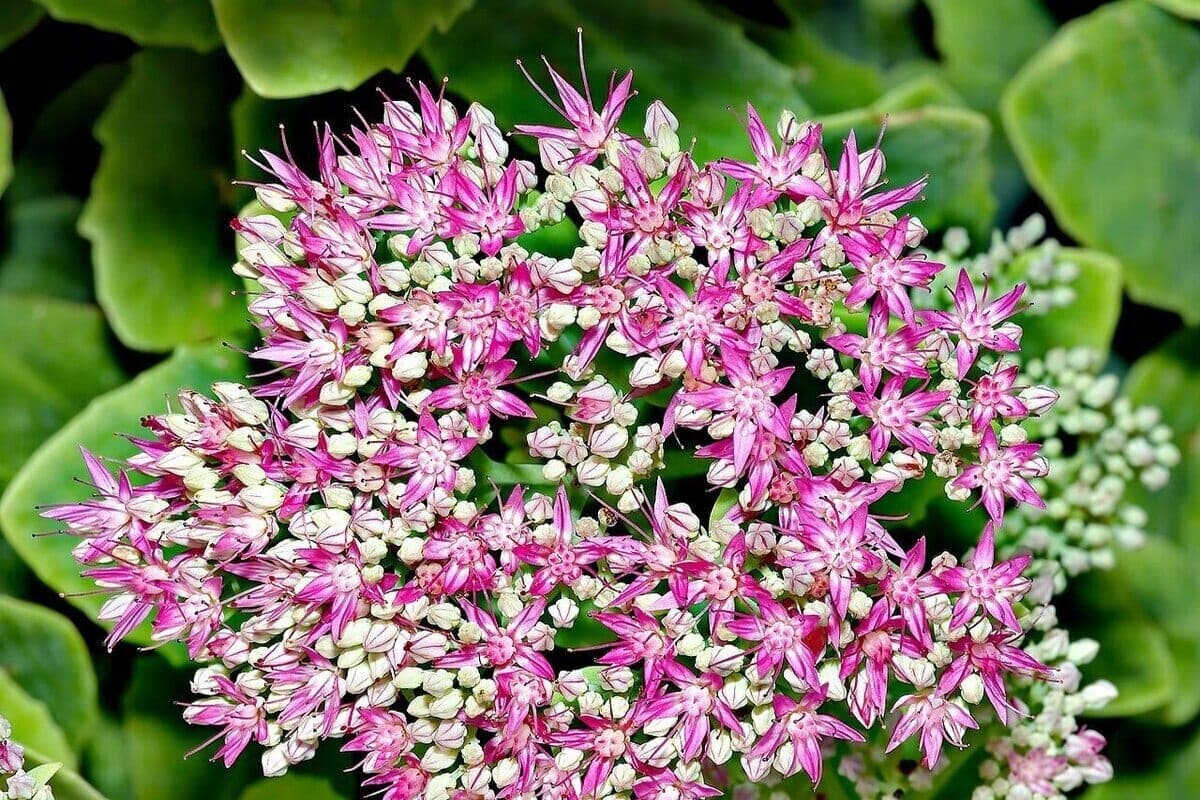
Prominent, or sedum, is that rare case when the plant not only survives without care, but literally blooms in the most spartan conditions. From August to October, it forms lush protective inflorescences of pink or purple color, which attract bees and butterflies.
“The eyewitness is prominent – the best choice for the cottage, where there is no opportunity to constantly care for plants,” says Alexei Volodikhin. He does not burn out, does not get sick, retains decorativeness and does not require participation in care. Thanks to the fleshy leaves, the plant stores moisture and easily tolerates drought.”.
Practical tips for growing sedum:
Place. Choose a sunny place where water does not accumulate. Stagnation of moisture is the only thing that is really dangerous for cleaning.
Soil. Absolutely undemanding. It grows even on rocky soil, where other plants do not take root.
Landing. Experts recommend planting and transplanting stones in autumn - in October, when it is already cool, but the ground is still warm for rooting.
Pruning. In early November, the stems are trimmed, leaving hemps 2-3 cm high above the ground level so that the plant does not break under the weight of snow. If you miss the autumn pruning, you can do it in the spring.
Feedback. No need. Moreover, from fertilizers, the stones “fat” and fall apart.
Astra of New England: a star named "Purple Dome"
Finishes our four astra New England, which is often called the September or October. This plant is able to bloom to deep frosts, and some varieties withstand a drop in temperature to minus 5 ° C.
One of the most reliable varieties for the suburbs is Purple Dome (“Purple Dome”). It is a compact bush about 60 cm high, completely strewn with purple-blue flowers that hide the thick green foliage. The variety is frost-resistant, suitable for growing in open ground in the Moscow region.
“Astra New England is a culture that is growing rapidly and requires transplantation every 3-4 years,” notes Olga Petina. If this is not done, the bush thickens, the flowering fades, and the center begins to die.
Practical tips for growing New England astra:
Place. The maximum sun so that the astra has time to blossom to the cold. In the penumbra, development slows down.
Soil. Drained, fertile, slightly acidic soils. On light soils additional watering is required.
A pinch. So that the bush was lower, thicker and did not fall apart, the tops are pinched in the first half of summer - in the middle lane no later than the beginning of July.
Pruning. In autumn, you can not cut: dried flowernoses in winter will create an original dry bouquet, powdered with snow. In spring, the stems are cut off from the ground.
• Division. The best time is early spring, when new shoots appear. Autumn division of the aster is often poorly tolerated.
What to plant so that the October garden is not empty
All four plants – a timeless, late Korean chrysanthemums, prominent sedum and New English astra – go well together. Astra and chrysanthemum can be used as a high background, sedum as a middle tier, and a timeless plant on the front edge, where its unusual flowers will be visible up close.
The main secret of the autumn garden in the suburbs is simple: do not be afraid to plant plants that bloom late. With the right selection of varieties and minimal shelter for the winter, your site will please with colors until the snow - and sometimes longer.


