The shrine of the Orthodox world
One of the greatest shrines of the Orthodox Church was delivered to Kazakhstan - the right hand of St. Spyridon of Trimifunt, one of the most revered saints of the Christian world
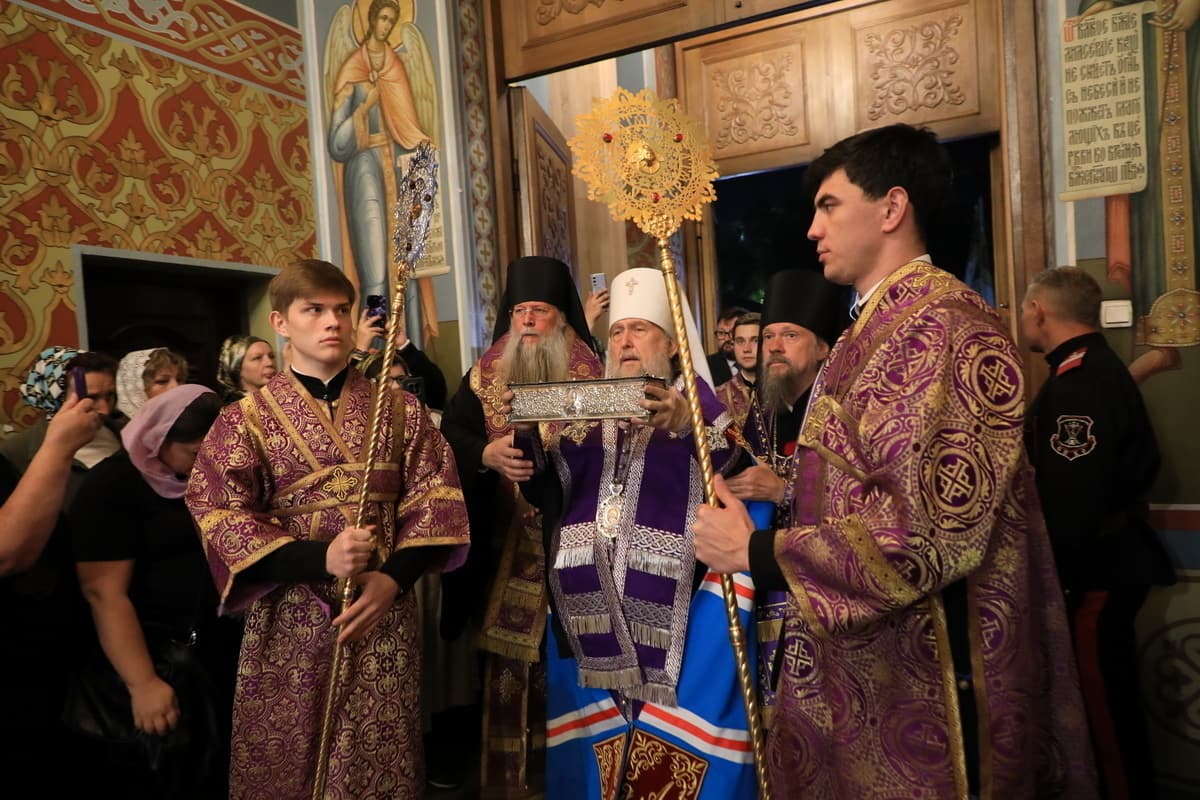
With the blessing of His Holiness Patriarch Kirill of Moscow and All Russia and with the good consent of Metropolitan of Kerkyr, Paxian and Diapontic Islands, Nektaria from September 21 visits the borders of the Kazakhstan Metropolitan District. The shrine has already been met in such cities as Karaganda, Uralsk, Ust-Kamenogorsk, Astana, Petropavlovsk, Kostanay.
With special reverence, the shrine and Almaty were received in the St. Sophia Cathedral of the Iversko-Seraphimovsky convent, where it was located from October 2 to 6. Further, the relics of Spiridon of Trimifunt meet in Baikonur - October 7. She will stay in Pavlodar on the 8th and 9th, in Shymkent in Nikolsky Cathedral on October 9th and 10th.
For Kazakhstan, this event has a truly historical and spiritual significance. For the first time, the faithful of our country have an opportunity to worship one of the greatest shrines of the Orthodox Church – the right hand of St. Spyridon of Trimifunt, one of the most revered saints of Christendom.
Saint Spyridon of Trimifunt has been revered by millions of Orthodox Christians for centuries as a great saint of God, known for his deep faith, humility, mercy and miracles. The arrival of his holy relics in Kazakhstan becomes an event that goes far beyond a single church celebration. This is a unique opportunity for thousands of people to touch the centuries-old spiritual tradition of Christianity and turn to the shrine with prayer and hope. The shrine unites people of different generations, gathering them in churches and cities of Kazakhstan around common prayer, faith and veneration of the Christian heritage.
The very fact of the presence of such a shrine on the Kazakh land gives this event a special scale, which has already entered the spiritual history of Kazakhstan and has become especially significant for the Orthodox community of the country.
Spiridon of Trimifunt lived in Cyprus in the III-IV centuries. Once a simple shepherd, elected bishop of the city of Trimifunt, participated in the First Ecumenical Council and remained in church memory as a man of rare simplicity and active charity. Even during his earthly life, the saint was known for his help in household and financial matters.
Currently, the relics of St. Spyridon are kept in the city of Kerkyra on the island of Corfu in Greece, in a temple built in his honor, and only his right hand is transferred to the world for worship. The holy relics of St. Spyridon are whole except for the right hand.
Church tradition for centuries keeps numerous testimonies about miracles performed through his prayers: about healing, help in the most difficult everyday circumstances and getting rid of disasters. There is evidence that Saint Spyridon continues to invisibly come to the aid of those who turn to him with sincere prayer. It is no coincidence that he is called the “travelling saint.” His shoes are changed periodically. It reveals signs of wear and tear, as if the saint continues his path, coming to those who need his intercession. The worn-out shoes of the saint are “spread” around the world in the form of such a shrine – a talisman, as a filahto. This is the name of a piece of shoes of Spiridon of Trimifunt – from the Greek word for amulet. It is a tiny piece of fabric of a velvet shoe or fabric that came into contact with the relics of a saint on the island of Corfu in Greece. Filahto is a tangible physical reminder of the constant miracle and mercy of the saint. This amulet has the value of a great shrine that protects a person in everyday life. It is carried in a bag, passport, car or sewn into clothes as a sign of God’s blessing. The shrine has no material value and cannot be sold for commercial gain. Pilgrims in Corfu are given free filahto as a blessing. Also, this envelope is given to everyone in Kazakhstan from among those who come to the temples to touch the shrine.
Many miracles of the saint are told by historical facts. During World War II, the Italians attacked Greece on Mussolini’s orders. Among the targets of the bombing was the island of Corfu. The attack began on November 1, 1940 and lasted several months. Corfu had no air defenses, so the island could be destroyed in a matter of hours. However, during the bombings, both pilots and those on the ground noticed that many bombs do not fall directly down, but at an angle go into the sea.
It was impossible to explain this phenomenon scientifically. And the thing is that the locals hid in the only refuge - in the church of St. Spyridon. All the buildings around this temple were badly damaged or destroyed, but not a single window in the church broke.
And always, and today, Saint Spyridon is addressed with prayers for health and healing, the well-being of relatives, overcoming material difficulties, reconciliation, help in work and in everyday life, preserving peace and harmony.
St. Spyridon does not leave believers in his prayers and helps those who turn to him for help.
Let today, during the stay of the right hand of the saint on the Kazakh land, people strengthen their spirit, find answers to their questions, become wiser, feel protected and healthy.