Secrets of the Castle Mountain: under Tolochin excavated a unique chapel-crypt of the XVII century
In the Tolochinsk district, archaeologists and volunteers discovered the ruins of a chapel of the XVII century with frescoes. Historians unravel the secrets of the tomb of the Drutsky princes.
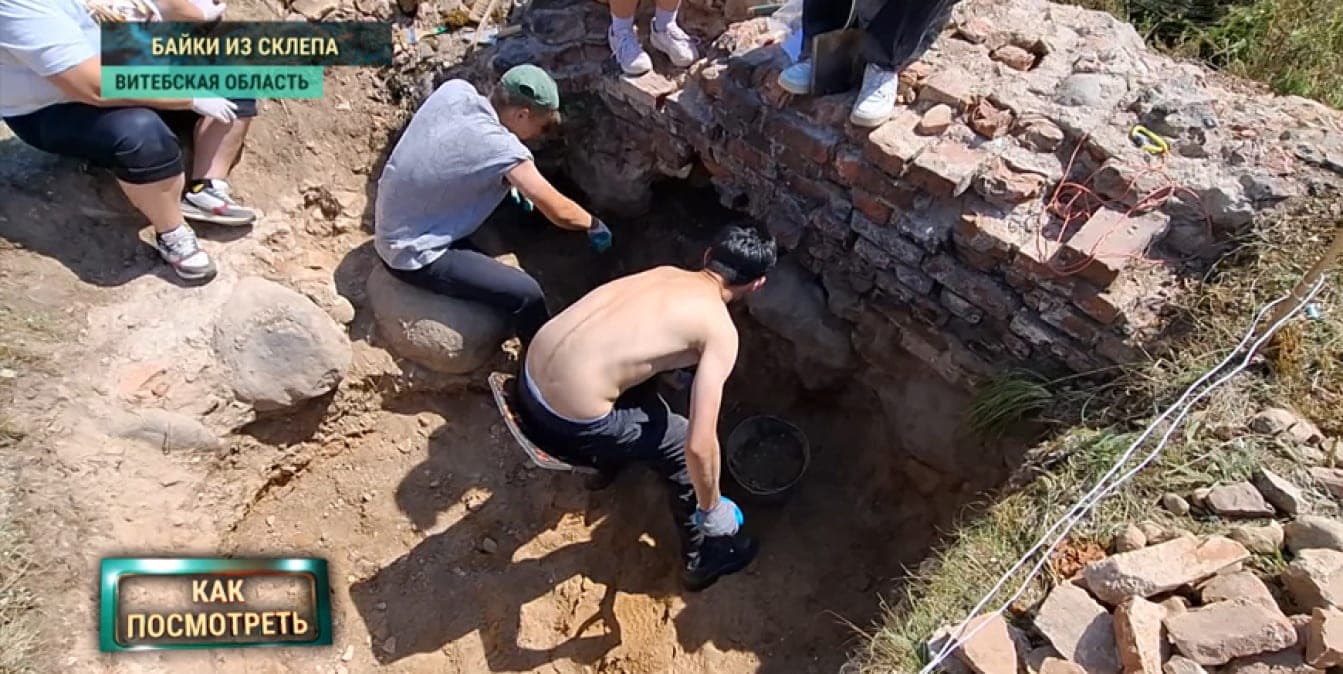
Everything secret, sooner or later, becomes clear. But sometimes you need to remove a few meters of land. Near Tolochin, archaeologists dug up a princely chapel of the XVII century. The building is small, but thorough and even fragments of the painting have survived. The sensation is that its description is not in any historical document. The deeper you dig, the more questions you have.
That's what Shurik could be talking about. "Caucasian Prisoner" was released in 1966. In the same years, the chapel in Sokolino went underground - almost completely. One of the local legends says that the full immersion of the tractor stopped... female skeleton. Someone must be to blame.
Dmitry Ivchenko, local historian: “Occasionally, on the old maps, the kryzhyk is important, there was a tsarva, tsі droplet. That's what I've seen before. I'm a peraglyadze, I'm not a bachy. Hatsya is the other less important yötsya, and Gatai is the nyama. I've been trying to get away with it. Well, what do you say, it's all covered with tseglai, stones, and a heavy fight, and on the right there is a creator.
You have to dig here. By this autumn, with archaeologists delved into the past volunteers from Tolochin, Kohanovo, Minsk. Two digs. And here is the first discovery - the length of the ghost building up to 10 meters. The walls are a meter and a half thick. The foundation of the crypt is wild boulders.
Snezhan Gvozdeva, teacher of the Belarusian language and literature of the secondary school No. 2 of Tolochin named after N. P. Lugovsky: “Small prykhodzil, walk here, all here would be still sluggish excavation, it was possible to have zaleztsy, and we were raised, that the gata is some sluggish, secret prastor. Piachora, nawat. Gavaryli, that's what you're looking for, that's what you're looking for, that's what you're looking for, that's what you're looking for.
So far there is no drawing, no photo of the memorial building – only legends. And what is remarkable is in every cherchez la femme. One of the popular versions is a chapel-tomb for the princess-drowned. My father remembered. Laying indicates the beginning of the XVII century.
Oleg Dernovich, a leading researcher at the Institute of History of the National Academy of Sciences of Belarus: “Sarod Usui Getai Standard Cegly we know adzym adzin asobnik – Kali weaska, zvarnitse vagu – geta palova cegly, ale fingertip jo diyaganal. So much for the Padkreslivaets! Then adbitak of the finger of the maistra - XVII stagodja, yaki rabi getya ceglu. I've got a sign on Advarots, I'm talking to Kalegami on the county, and I'm a vedic. Geta's got a little bit of squirrels. I'm the only one who's got a job.
Artifacts also said it was a building with Renaissance features. Stained glass fragment, probably. Remains of shingles such as "beaver tail" or flat, heavy - a steep roof. Construction ceramics were probably made on the spot. Sokolin fields are rich in clay.
Aleksandr Matyas: Crossing, crossing! The left bank, the right bank - the river Uswijka. There is Old Sokolino, here is New. It used to be one thing. Falcon: what was the court-residence of the princes Drutsky-Sokolinsky, today you can only imagine. Not every place is a noticeable point on the map of Tomasz Makovsky – the legendary “Radziwillivka” of 1613.
The people - Castle Mountain, overgrown with greenery, partially cut by a bulldozer (in the 70s, they say, took gravel on the next road). From the ancestral nest of the Drutsky-Sokolinskys - from the XVI century - only shafts and ditches remained from the tree now. "We're Rurikovichi!" - and this is not a joke!
Irina Pikulik, director of the Tolochinsk Museum of Local History: This is one of the branches of the Drutsky family. There were Drutsky-Sokolinsky, Drutsky-Tolochinsky, then one of the princes of Drutsky-Sokolinsky was founded in Ozertsi, began to be called Drutsky-Ozeretsky. Drutsky-Podberezsky, Drutsky-Prikhabsky. So the genus was very ramified. The book "Drutsk" was published in 2014, and there is a little literally said that in Sokolino in the XVII century Mikhail Mikhailovich Drutsky-Sokolinsky founded a Calvinist temple and there was a chapel, a stone chapel.
The dynastic crypt at that time was an attribute of royal power. 410 years ago, only the Radziwills in Nesvizh dared to encroach on the "holy". They have a Queen Barbara in their family. Who are you? Mikhail Drutsky-Sokolinsky since 1613 - Voivode Polotsk.
Oleg Dernovich, Leading Researcher at the Institute of History of the National Academy of Sciences of Belarus: “Adkryli taxama sluds nevyadomaga remembers manumentalnaga rospis. Well, I can say, what is fresco, hello here, hutchai for жнsho, geta al secco - murals on a dry tan. He didn't jump. It's a bit of a splashy mural, it's so chubby. You are so blessed to be so blessed with such a bright light. I'm a pagliadze, you know, you've got a black fragment. Well, you're a straitjacket, you're a big deal for the stagodzi prime. We're going to get the darawats of an imperfect zahavanast, pra da.
Scientists are now determining the age of the cult find - after 1612. Only in 1855, the Russian ethnographer Mikhail Bez-Kornilovych was the first to dryly write – or rather mention – about “the chapel in which the ancestors of the Sokolnitsky princes rest” (one of the variants of the surname).
Dmitry Ivchenko, local historian: “We have Aboltsykh kassel – adzin from the most first in Belarus. And there were perimeters, wakol, there were krypts. Yana's asleep. Well, I'm a yashche bachy, there's a lot of emptiness out there, and there's havali menavita on the perimeter of the temple. Magchyma and here, the fall of the gatymi valam, you're the only one. - Did you know the bones? - Fragments, chuck-chuck. “Nevadama, qi yang introduced, qi yang adsul.”.
The answer is expected from anthropologists from the Academy of Sciences. The material is in hand. According to papers, in Sokoln in the XVIII century, the Uniate Church of the Holy Spirit also towered. Are they connected? – that’s the question. Life on these hills became quiet, rustic two hundred years ago, as it is now.
Olga Gurskaya, Director of the Tourist Information Center of the Tolochinsky District: We offer only a visit to the church in the village of the Monastery. Other routes on the other side have not yet been created, we are still in development. You have to open up. There are 33 historical and cultural values on the territory of Tolochinsk district. But there are more objects that you can see. Such as Khomentovskikh in the village Krivoye chapel-tomb. The owners' tombstones have even been preserved there.”.
The guiding “star” in this region is the thousand-year-old Drutsk, a city-tradition, a monument of archaeology of international importance and the “cradle” of the ancestors of the author of our feudal, but still constitution – the Statute of 1588 – Lev Sapiega. His mother, Bogdan, is from Drutsky-Sokolinsky.
Elena Bomberova, Deputy Chairman of the Tolochinsky District Executive Committee: “So far, there have been no written reports on the need to give the status of historical and cultural value to the Tolochinsky District Executive Committee. This is required by the Culture Code of the Republic of Belarus. As soon as a written communication is received, we are of course ready to consider this proposal. This is the beginning. We are now canning for the winter, and as soon as spring comes, of course, we will begin to develop this idea.”.
Tolochin – there is such a version – from “tolok”. We dug it together and dug it together. A history lesson for schoolchildren. The native Sokolin land will preserve the newly identified object from bad weather. Then, on the ruins of the chapel... A place worthy of more than stories from the crypt.