
The horror of the “Titanic” repeated in the Mediterranean: lying at the bottom of the liner sold for $ 25,000
The sinking of the Titanic is perhaps the most epic and famous sea disaster
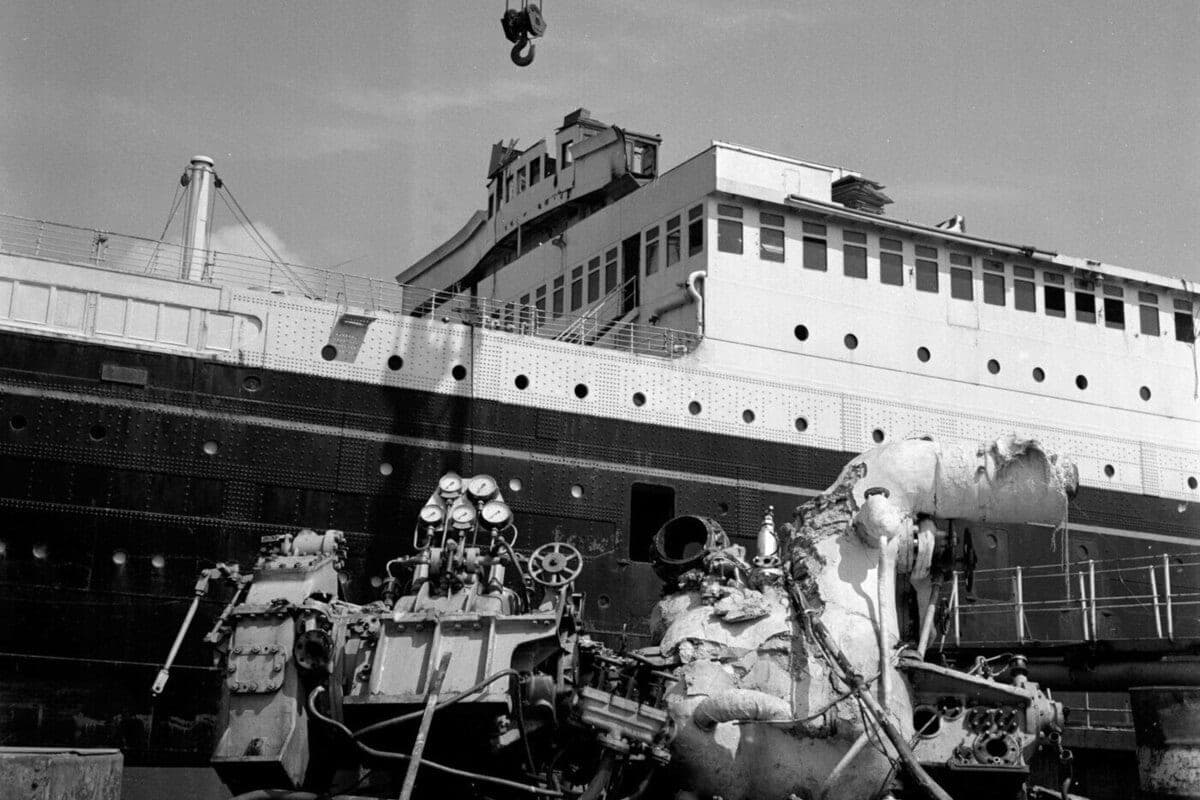
There's a cross on the miracle steamer. Red
The largest transport company "White Star Line" had three "trump cards" that cost a huge investment - three very similar to each other giant liners, designed, according to businessmen, for record-breaking fast passenger flights between Europe and the United States. The owners of the WSL christened them in honor of the heroes of Greek mythology - Olympians, Titans and giants.
Accordingly, the firstborn of this series was called “Olympics”. He without particularly serious incidents served, plowing the ocean expanses, a quarter of a century and was then cut for scrap.
The second ship was named Titanic. The story of his death is described in many books, shown in the famous film.
By the time of the catastrophe, the “middle brother” was already in full swing construction of the “younger” of this trinity – in accordance with the original idea, he was given the name “Giant”. However, when there was a sensational sea tragedy, the ship decided to rename: realized that in the original version laid a “logical mine”. After all, according to legends, as a result of battles, the Titans and giants were defeated. So the Giant became the Britannic.
The trouble that happened to the Titanic, made adjustments to the construction of liner No. 3. After learning about the problems and design flaws that the April night disaster revealed, the engineers made some important changes to the Britannica project. The ship increased the number of watertight bulkheads, and they reached the level of the upper deck. In addition, double sides were provided, additionally protecting compartments in case of meeting with the iceberg. The number of rescue equipment has increased. Even the problems that arose on the Titanic with the transmission of urgent information from the radio room to the captain's bridge were taken into account: a pneumomail line was provided on the new liner for greater reliability of communication between them.
Launched on February 26, 1914, the Britannic was declared the safest, most unsinkable ship in the world. Shipbuilders guaranteed: if in the ill-fated situation with the iceberg was instead of the “Titanic” this improved version, no tragedy would have happened, the ship would remain afloat.
It can also be noted that the ex-Giant is the largest of the "brothers" liners. Its body is several meters longer and wider than the Titanic.
The Britannic also wanted to make it the most comfortable and luxurious of all three super-liners. For the convenience of passengers, a restaurant and a smoking salon of the 1st class were expanded. In addition, they planned to equip a game room for children, a gym, 4 electric elevators on the ship. On the front staircase were even going to install an organ for concerts!
But before the implementation of these plans, things did not come to a halt: the 1st World War began. In the current military conditions, the completion of the Britannic slowed down. And in the autumn of 1915, a radical change took place in his fate. On November 13, the British Admiralty requisitioned a huge steamer to turn it into a hospital ship.
Very quickly the liner was converted into a floating hospital. The dining room, located in the center of the deck superstructure, turned into an operating room, a luxurious 1st class living room next door to it - the main room. Nearby cabins were given for accommodation of medical personnel. Other passenger rooms were adapted for wards for the wounded. Several holding rooms have now become medical warehouses, and one of them is even a morgue. The appearance of the Britannic has also changed. It was repainted in the internationally accepted colors of the hospital ship (which should guarantee immunity when encountering enemy warships): white boards, each of which has a green stripe along the entire hull and depicts three large red crosses.
In December 1915, the liner, now known as "His Majesty's Hospital Ship Britannic", was officially incorporated into the British Navy. It could carry more than 3,000 sick and wounded. The medical and maintenance staff consisted of almost 450 people, another 675 people – the ship’s crew. Charles Bartlett was appointed captain of the Britannic.
On 23 December, the steamer set off from Southampton on its maiden voyage. The final destination of the route was the Greek island of Lemnos to the Mediterranean Sea. There, the British established their transshipment hospital base, which was attended by soldiers and officers who suffered during operations against Germany and Turkey in the Mediterranean theater of operations. The ship arrived at its destination after 8 days, loaded a batch of wounded and sailed back to the British Isles.
Until the autumn of 1916, the Britannic made five exits to the sea to evacuate the wounded. On Sunday, November 12, a huge ship again left the port of Southhamton. This sixth trip proved fatal.
55 minutes of agony
The Greek archipelago "Britanic" reached quite safely. On the morning of November 21, 1916, the ship sailed through the strait between the mainland of Greece and the island of Kea at a speed of 20 knots (about 36 km / h). Suddenly, in the bow on the starboard side, an explosion thundered, noticeably shaking a giant, followed by another. The ship's chronometer showed 8.12.
Soon the ship began to tilt to starboard, sinking its nose into the sea (just like the Titanic!). Captain Bartlett's order to immediately finish off all watertight bulkheads did not help: the streams of water somehow continued to spread through the compartments. The holds reported to the bridge: a strong explosion not only destroyed the bulkhead in the bow, but also damaged the mine of the main fire highway. The water began to penetrate into other compartments, even in boiler rooms. The situation was aggravated by the fact that sealed doors, which are equipped with watertight bulkheads, for some reason were opened at the time of the explosion, and now, under the pressure of incoming water, they could not be scraped. As it turned out later, their contribution to the agony of the ship made on-board windows. Most of them were open: medical staff arranged morning airing of the cabins. When the "Britanic" noticeably sat down with its nose, through these round windows, the sea became easy to overwhelm the rooms on the lower decks of the starboard side.
The liner was 1134 people (according to other sources – 1066) – the crew, the administration of the floating hospital, medical and maintenance personnel. Realizing that the ship was sinking, Captain Bartlett ordered an SOS signal to be broadcast and an evacuation to begin before help arrived.
According to the recollections of the participants of the events, it was quite calm and clear, but there were several cases of panic after all. For example, a group of ship employees began to lower the boat without obtaining permission from the officers who commanded the rescue operation. At this time, the Britannic was still moving forward with decent speed and the ship, swamped by waves, almost immediately capsized. Fortunately, no one was killed.
Although without victims, alas, still did not do. The huge steamer plunged into the sea with its nose, increasingly tilting to the starboard side. At one point, the stern was so high that propellers appeared from the water (and again an analogy with the Titanic). They rotated as the liner's cars continued to work. Under these "mills" began to tighten two lifeboats with people. Both were crushed into pieces, more than 20 people died under the blades, others were wounded. Several other unfortunates never managed to get out of the inner compartments of the sinking ship.
It was over at 9:07. The Britannic capsized to starboard and then quickly went to the bottom. The "unsinkable" ship disappeared into the deep sea just 55 minutes after the explosion. But the Titanic stayed afloat for almost 2 hours and 40 minutes! Nevertheless, the fate of the British was much happier. Disaster signals from the hospital's radio operator were heard on several ships, which rushed to help. By 10 o'clock in the morning, the English "Scourge" arrived at the site of the shipwreck, followed by the auxiliary cruiser "Heroic".
Almost everyone on board the ship was rescued. The number of victims of this sea disaster was only 30 people. The British was the largest ship to die during World War 1. And the operation to rescue people from him was considered perhaps the most successful.
The cause of the crash of the “twin” of the legendary “Titanic” is disputed to this day. According to the official version, the killer of the British was an enemy submarine. A few days before the tragedy, the German submarine U-73, commanded by Captain Gustav Ziss, laid mines in the strait between Kea Island and the mainland. On one of these mines and came across a super liner.
For a long time sunk in the autumn of 1916, the giant ship remained invisible. Only in 1975, the exact place of his death was established by the expedition of the famous French explorer Jacques Yves Cousteau. The following year, divers managed to descend to the liner, lying at a depth of about 120 meters. What they saw on the one hand confirmed the official version: in the bow of the ship, lying on the starboard side, there is a hole from the explosion. But in addition, underwater scouts found on the “Britanic” and other damage.
Subsequently, members of the expedition put forward another assumption about the death of a huge steamer. It provides an explanation for the paradoxical fact that the “unsinkable” Britannic sank much faster than its less technically advanced “middle brother.” According to this version, on board the hospital ship, the British illegally transported weapons to Egypt. Carrying out the sixth (turned fatal) flight, the liner had to go to the port of Alexandria to unload military contraband. However, German intelligence learned about the secret operation of the “islanders”. During the intermediate parking of the Britannic in Naples, German agents managed to drag a cunning explosive device on board and hide it in one of the coal bunkers. Some time later, in the Kea Strait, a hellish machine worked, causing also detonation of coal dust accumulated in the ship’s bunkers that had already been noticeably empty by that time (this belated explosion was heard by many of those on board the Britannic). The detonation of the coal-air mixture led to serious damage to the watertight bulkheads and other systems in the holds of the ship, violated the tightness of the compartments, which led to their rapid flooding. However, many experts still reject this “spy” version.
Batyscaphe for the shipowner
A few years ago, several Russian divers were able to go to a meeting with the sunken Titanic No. 2. About the large-scale expedition project, conceived then, told “MK” organizer – Chairman of the Federation of water and rescue all-around Russia Yana Yaroshevskaya.
An international expedition was planned for 2016, the purpose of which was a thorough survey of the Britannic. It was prepared for several years, starting in 2011. Representatives of 16 countries were to participate in the dives. We received all the necessary permits and approvals, including from the Ministry of Historical Antiquities and the Ministry of Culture of Greece. The expedition was included in the program of the Cross Year of Culture of Russia and Greece. We managed to agree that our divers will penetrate some of the interior of the Britannic, conducting video and photo shooting. These materials were then used to create a virtual museum. Alas, at the very last moment we were told: sorry, but there is no money.
- After all, several dives to the sunken liner were made?
Yes. This was the preparatory stage, reconnaissance before the main expedition. In the summer of 2013, three groups made dives to the Britannic. And also managed to lower to this sunken steamer bathyscaphe, which was the owner of the "Britanic"
Here we should explain the story of Yana Yaroshevskaya.
The Englishman Simon Mills became the full owner of the ship resting at the bottom in 1996. Then high naval ranks in the UK, realizing that on the balance sheet of their department still have some ships involved in the 1st world war, among them – a giant floating hospital. To get rid of this "ballast" decided to arrange a sale of these rarities. Mills, who had long been interested in the history of the Titanic, learned about such an unusual trading action, applied for and purchased the Britannic. The new “shipowner” did not want to specify the financial side of this transaction, but the press mentioned the amount of 25 thousand dollars. This man was “rolled on a submersible” so that he could finally see his property.
Did Mills take the initiative to visit the Britannic?
- No, it came from us. We reached out to the owner of the Britannic, invited him to come to Greece when the trial dives take place
- Where did the submersible come from?
- We managed to use the bathyscaphe thanks to acquaintance. We have friends-divers who have the opportunity to use a similar technique – a boat with a bathyscaphe. They had just moved from Malta to Turkey for their next dives, and I asked them to make a short stop in Greece, where the Britannic was killed. They gladly agreed. Well, Simon Mills, actually seeing his liner in the window, was absolutely delighted.


