
In a year, Belarus Today will celebrate its 100th anniversary. Excursion into history through publications of past times
On August 2, 2027, Belarus Today will celebrate its 100th anniversary. We offer readers an excursion into history through newspaper publications of the past.

On August 2, 2027, Belarus Today will celebrate its 100th anniversary. We offer readers an excursion into history through newspaper publications of past times

Soviet Belarus, November 9, 1991 Even today we cannot fully appreciate the scale of the events of 1991. It was not only a difficult time, but also a terrible time. A great country once perished before the eyes of millions of Soviet people, abandoned to their fate.
In 1991 in the USSR for the first time (since 1918). — Editor’s note) did not celebrate the October Revolution Day at the official level. We offer you to familiarize yourself with fragments of the material “Red Day of the Calendar”, which tells how alarming it was on this day in Minsk.
Many Minsk residents I spoke with a day or two before November 7 expressed fears that holding two alternative rallies in the city at the same time could end sadly. The reason for the unrest really was, because the Executive Committee proposed for the place of collection parks named after Maxim Gorky and Yanka Kupala, which are shared only by Leninsky Prospekt. Fortunately, however, the concerns were not justified. On the eve, representatives of the Belarusian Popular Front withdrew an application submitted to the Executive Committee for a rally, offering their supporters to spend November 7 as a normal day off. And so on Thursday in the park named after Yanka Kupala gathered a hundred or two people who, as it turned out, did not know about the cancellation of the rally.
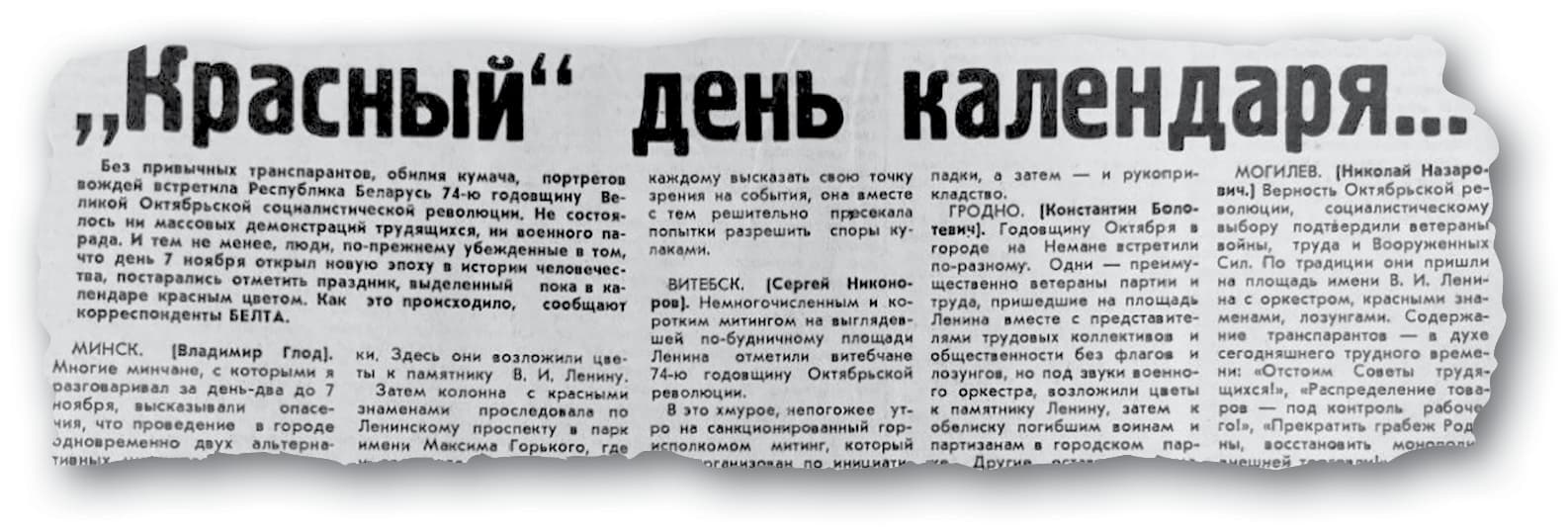
Then the column with red banners proceeded along Leninsky Prospekt to the Maxim Gorky Park, where the rally took place. The speakers said that the ideas of October were immortal and that they would defend Lenin’s ideals. We can only regret that civilized forms of communication are still given us with difficulty. And if you can still somehow understand the group of young people who climbed to the former government rostrum and greeted the protesters waving black scarves, then the youth who threw coins under the feet of veterans shouting “this is your last way” can hardly be justified.
It is worth adding that almost a month remained before the signing (December 8, 1991) of the criminal Belovezhsk agreements. Finally, the collapse of the Soviet Union ended on December 25, 1991, when Mikhail Gorbachev announced the termination of his activities as president of the USSR, and the Soviet flag was lowered over the Kremlin. “Worker”, November 10, 1927 The issue is dedicated to the celebration of the 10th anniversary of the Great October Revolution. The front page of the newspaper tells about the anniversary events in Moscow. But it turns out that things weren't going well, as evidenced by the title of one of the materials, "Shameful Failure."
During the demonstration in Moscow, the opposition tried to make themselves known by throwing out posters with the words: "Long live the leaders of the revolution - Trotsky and Zinoviev." The same slogans shouted from the balcony Preobrazhensky, Smilga and Alsky. Trotsky himself tried to speak somewhere. But everywhere, all these pathetic attempts ended in shameful ruin, arousing the indignation of the masses. Demonstrators responded to opposition slogans with shouts of “Down, out,” threw rotten apples at the oppositionists, and drove Trotsky away with whistles and shouts of “traitor, traitor,” etc.
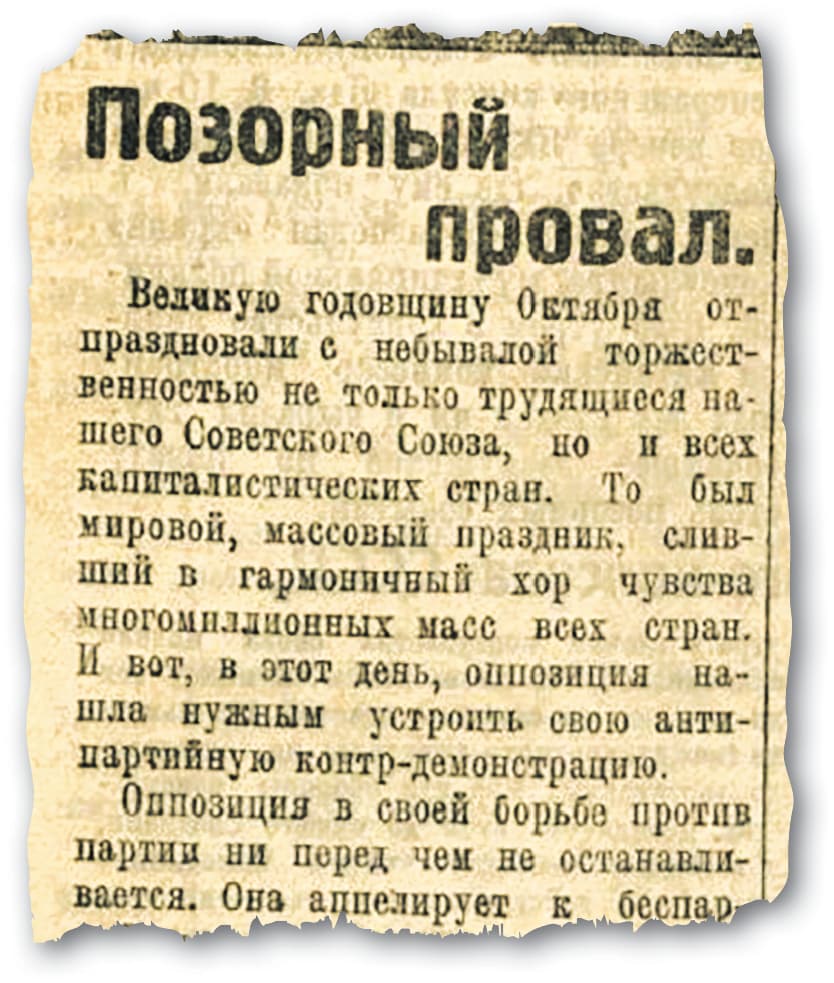
Yes, difficult times have come for Leon Trotsky and his associates, which is confirmed by another material “The Moscow Committee of the C.P.S.U.(B.) demands the expulsion of Trotsky, Kamenev and Smilga from the Party.”.
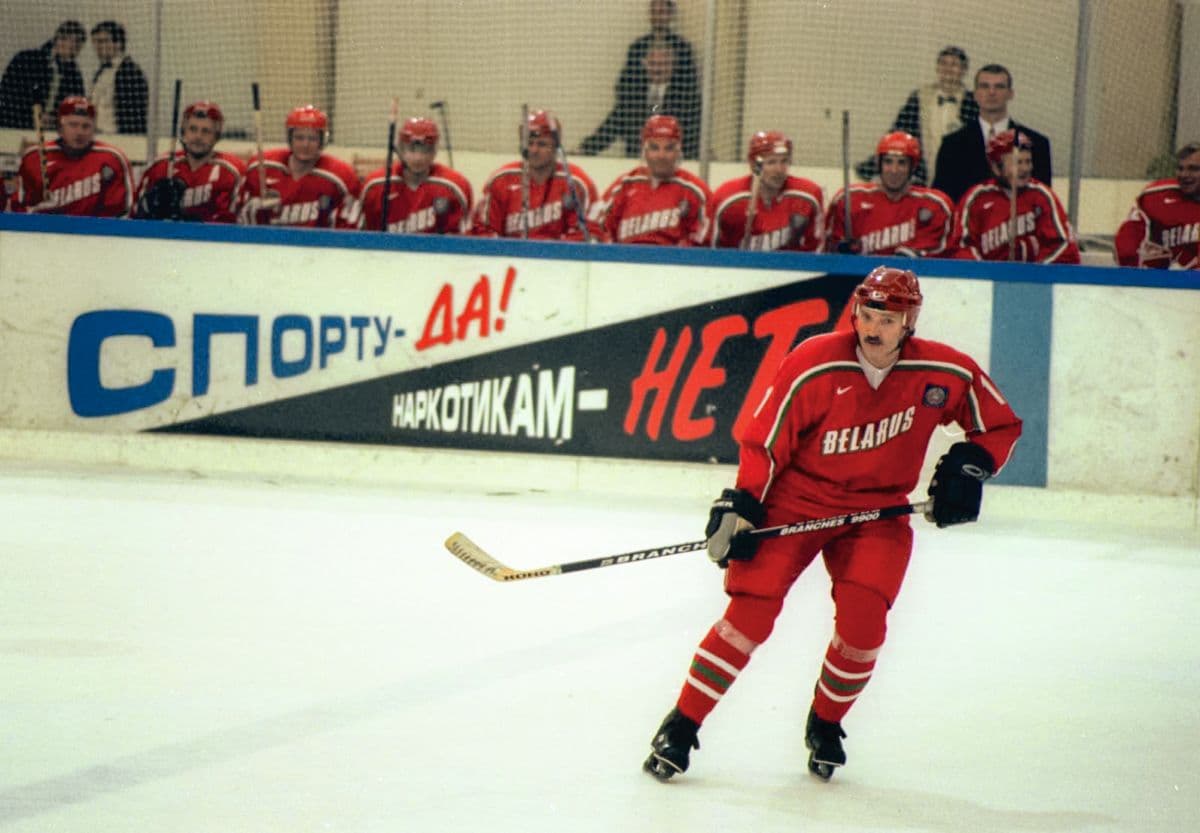
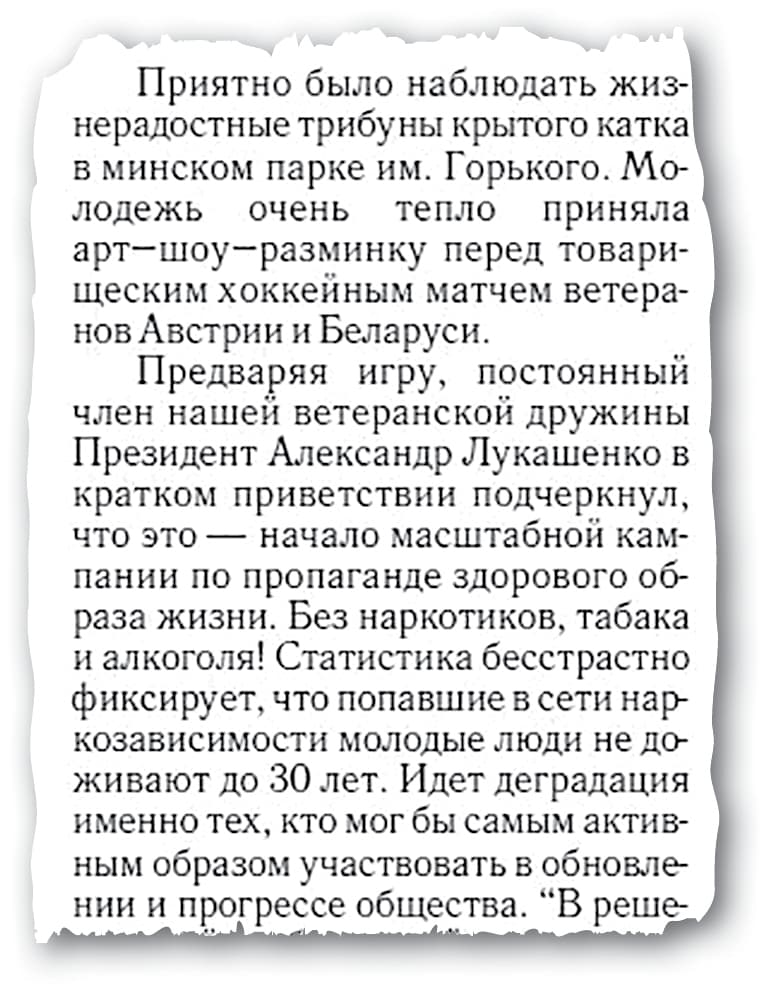
Two days after the publication, on November 12, the heroes of the material were expelled from the party. On January 31, 1929, Trotsky on the steamer Ilyich was deported from the Soviet Union to Turkey. By the way, only the latter agreed to accept a dangerous exile. On August 20, 1940, NKVD agent Ramon Mercader struck Trotsky with an ice pick in Mexico, and the next day he died. Thus ended the fate of one of the main leaders of the October Revolution of 1917 and the creator of the Red Army. “Soviet Belarus”, November 11, 2000 Everyone knows that President Alexander Lukashenko not only loves hockey, but also actively plays it. Thanks to the efforts of the Head of State, it was possible to make Belarus a hockey power. Therefore, it is no coincidence that the SB periodically publishes reports of friendly and official meetings on the ice. On the second page of the newspaper in the material “Sport – Yes!” tells about the friendly match of veterans of Austria and Belarus. The President played for our team:
“It was nice to watch the cheerful stands of the covered skating rink in the Gorky Minsk Park. The youth warmly received the warm-up art show before the friendly hockey match of veterans of Austria and Belarus. Before the game, a permanent member of our veteran squad, President Alexander Lukashenko, in a brief greeting, stressed that this is the beginning of a large-scale campaign to promote a healthy lifestyle. No drugs, tobacco and alcohol! Statistics dispassionately record that young people caught in the network of drug addiction do not live to 30 years. It is those who could most actively participate in the renewal and progress of society that are being degraded. “In solving this urgent problem for the whole world, there can be no indifferent,” the President said. — All active strata of society should participate in its solution – athletes, teachers, doctors, actors, journalists, scientists. The law enforcement agencies need to deal a decisive blow to drug distributors. Belarus must be free from the terrible potion.”.
Then the fans poured out their emotions, watching an extremely correct, meaningful and productive match of veterans, in which the advantage was on the side of the hosts of the court.
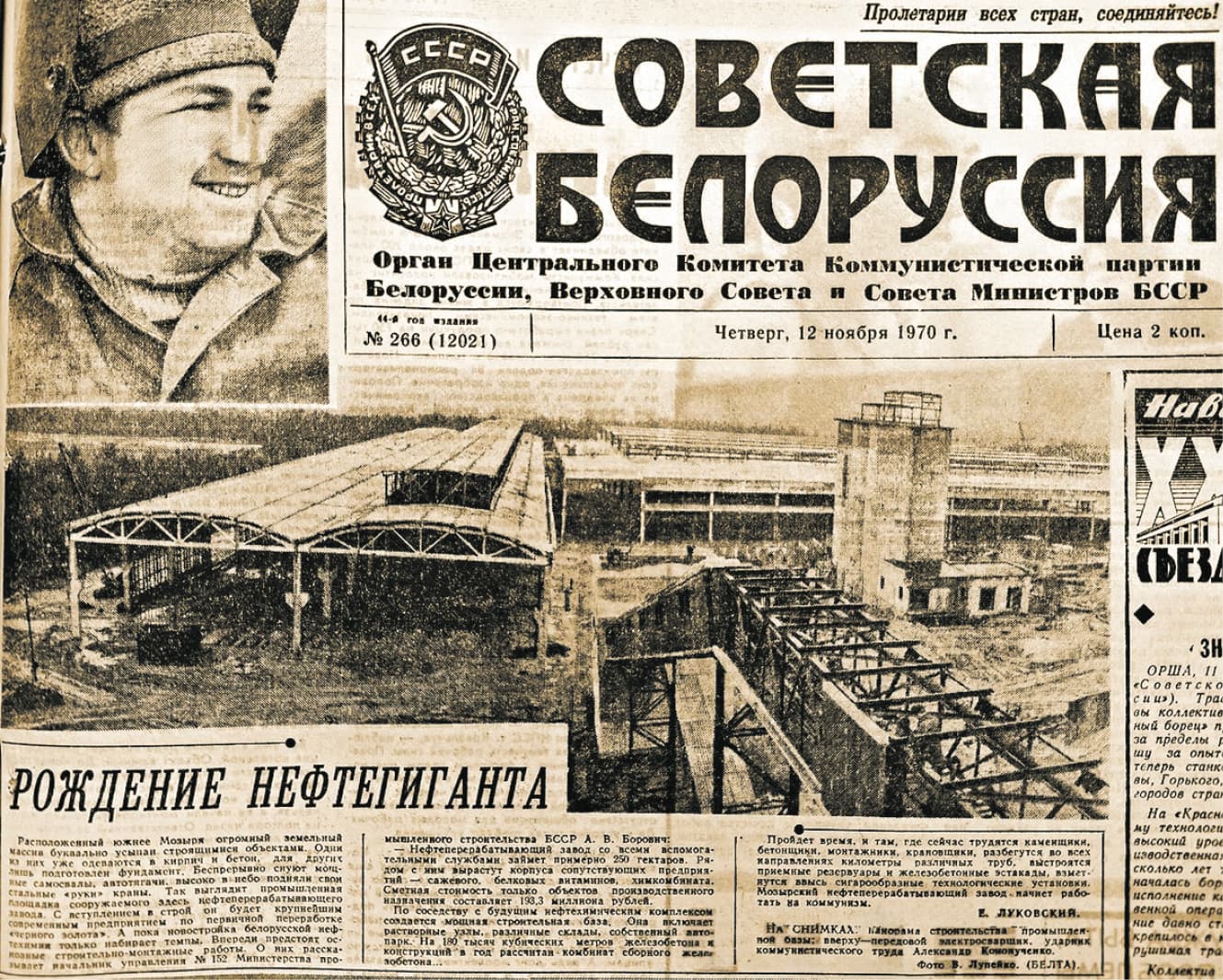
"Soviet Belarus", November 12, 1970 January 30, 1975 at the Mozyr oil refinery was launched the first unit LK-6U and received the first Polesie gasoline. About how the construction of the enterprise began and took place, "Soviet Belarus" tells on November 12, 1970 on the front page in the material "The birth of the oil giant" :
“Situated south of Mozyr, a huge land mass is literally strewn with objects under construction. Some of them are already dressed in brick and concrete, for others only the foundation is prepared. Continuously scurrying powerful dump trucks, tractors, high in the sky raised their steel hands cranes. This is the industrial site of the oil refinery being built here. When commissioned, it will be the largest modern enterprise for primary processing of black gold. Meanwhile, the new construction of the Belarusian petrochemical industry is only gaining momentum. The main construction and installation works are ahead. About them says the head of department No. 152 of the Ministry of Industrial Production of the BSSR A. V. Borovich:
- The refinery with all auxiliary services will occupy about 250 hectares. Next to it, the buildings of related enterprises will grow - soot, protein vitamins, a chemical plant. The estimated cost of only production facilities is 193.3 million rubles
Now it is difficult to understand why in 1952 the editorial office reported on the 25th anniversary of the newspaper "Soviet Belarus" not on August 2, but after almost 100 days - on November 13. The issue presents a number of materials dedicated to the anniversary event. Here are some of the fragments:
On August 2, 1927, the first issue of the newspaper Rabochiy was published in Russian, the organ of the Central Committee of the Communist Party (Bolsheviks) of Belarus. The newspaper “Rabochiy” began to appear at a time when Belarus was developing huge works on the industrialization of the republic, on the construction of new and reconstruction of existing industrial enterprises.
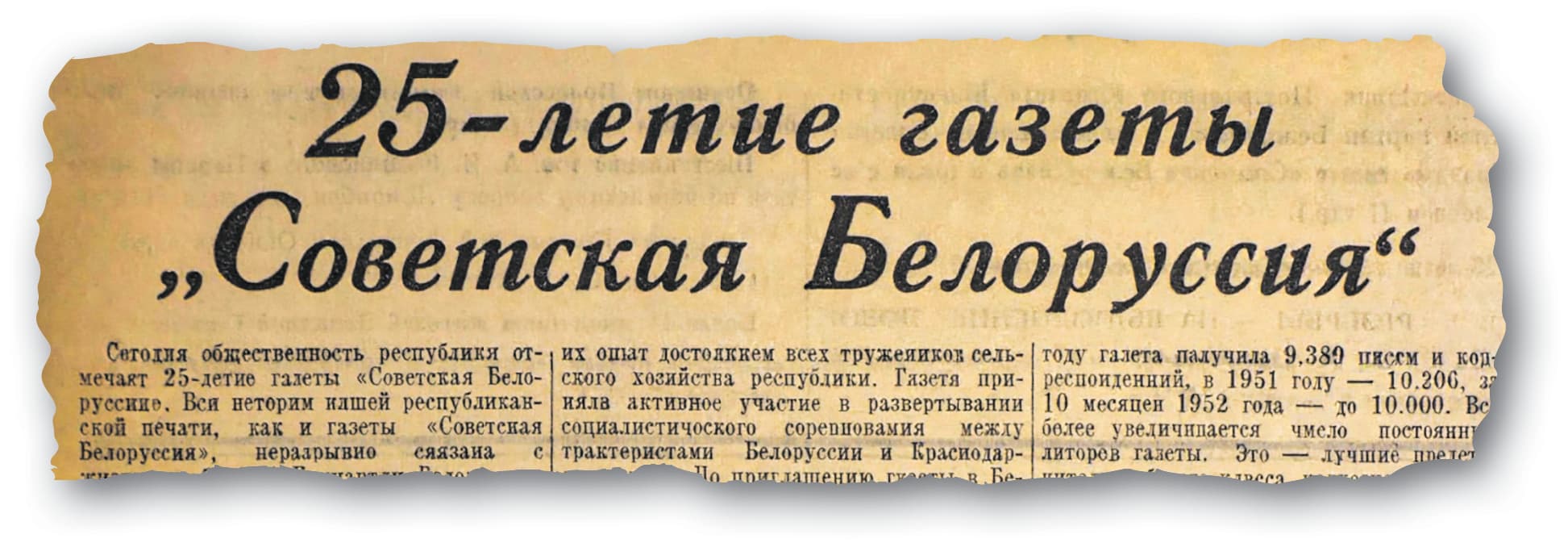
In 1937, the newspaper "Rabochiy" by the decision of the Central Committee of the Communist Party of Belarus was renamed "Soviet Belarus". The new name of the newspaper stemmed from the fact that new, broader tasks were set before it. The range of issues that the newspaper had to deal with increased.”.
“The newspaper published patriotic works by Y. Kupala, Y. Kolas, K. Chorny, M. Tank, A. Kuleshov, M. Lynkov, K. Krapiva and other writers.”.
It should be noted that during the Great Patriotic War, in the period from September 1941 to July 1944, our newspaper was called Sovetskaya Belarus. As soon as the capital was liberated, the editorial office moved from the suburb of Gomel Novobelitsa to Minsk and returned the former name - "Soviet Belarus".
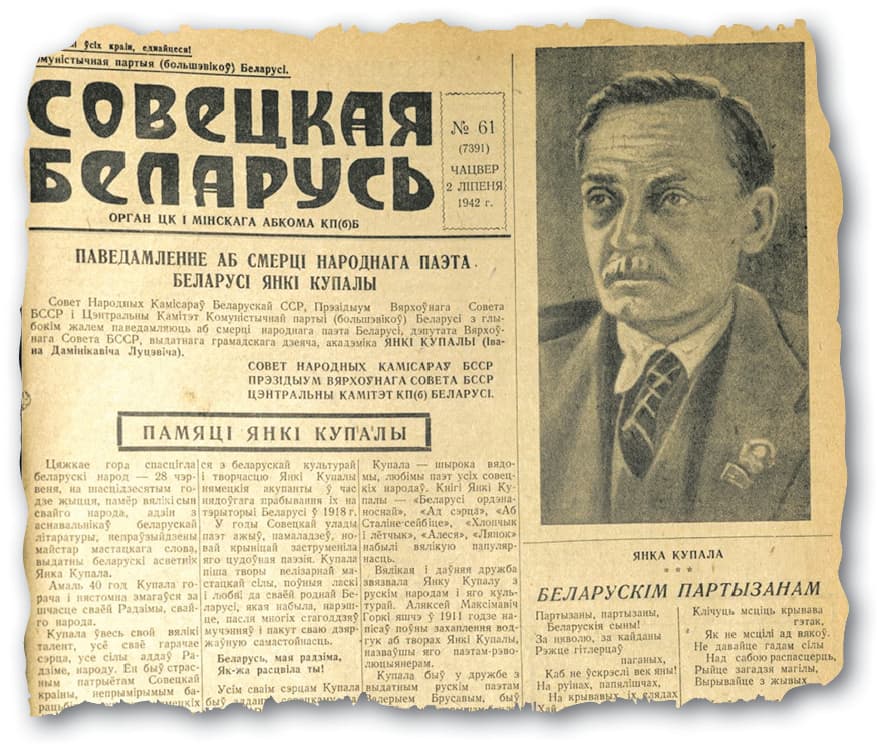
The poem “Belarusian Partisans” was published on the front page on July 2, 1942. Unfortunately, the same issue reported on the tragic death of Yanka Kupala. He did not live to see the publication in the “SB” for several days: he died in Moscow on June 28.
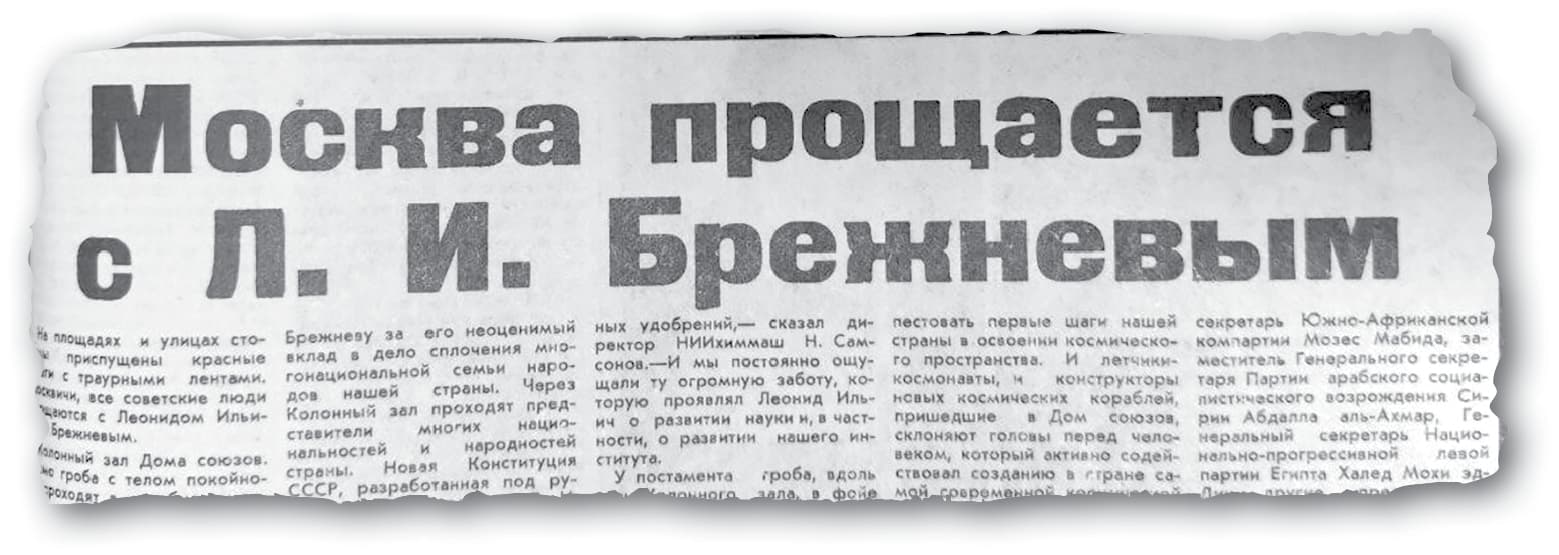
"Soviet Belarus", November 14, 1982 November 10, 1982 passed away General Secretary of the CPSU Central Committee Leonid Brezhnev. He headed the USSR for 18 years, from October 1964 to November 1982. Thus ended a whole era in the life of the Soviet people. On November 14, the SB published on the front page the article “Moscow says goodbye to L. I. Brezhnev”
" . Under the arch of the hall there are mourning melodies. The guard of honor changes every three minutes. The mourning watch at the coffin is carried by deputies of the Supreme Soviet of the USSR, deputies of the Supreme Soviets of the Union Republics, Heroes of Socialist Labor, advanced workers of production, party and Soviet workers, prominent figures of science and culture, pilots-cosmonauts of the USSR, representatives of the public, military personnel.
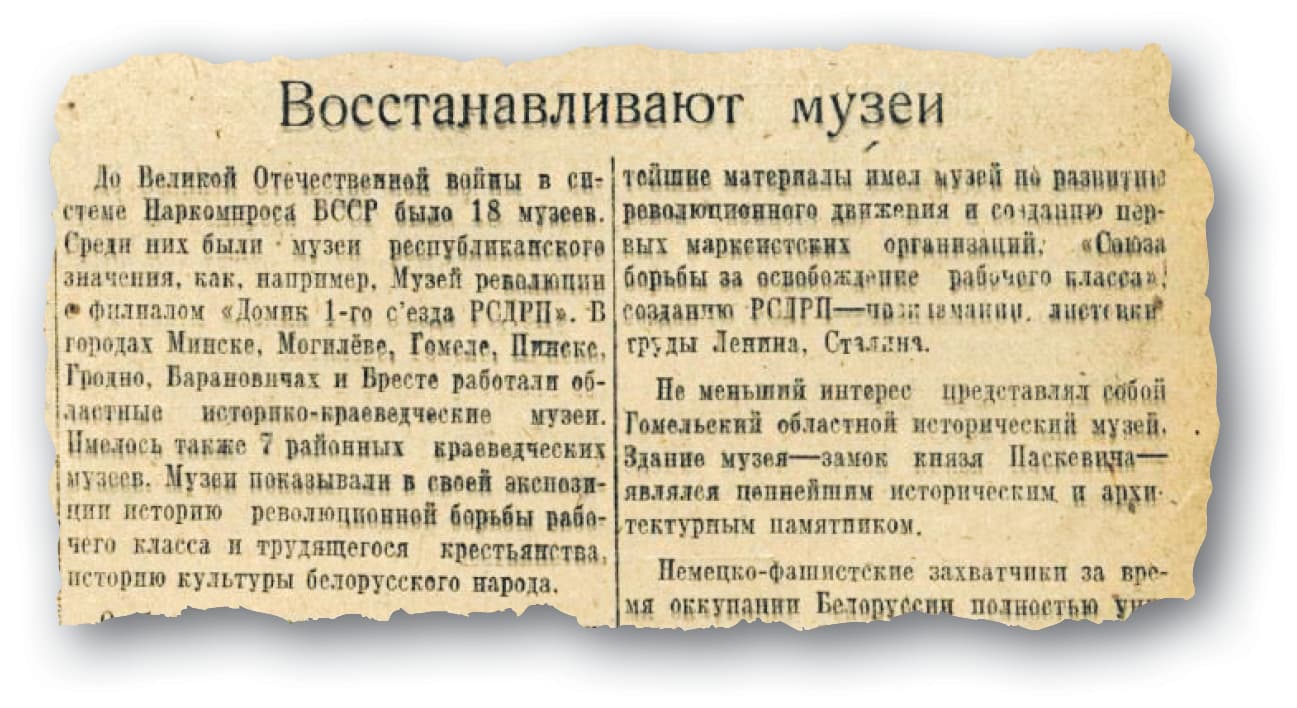
In the same issue it is reported that on November 12, 13, 14 and 15 mourning is declared in the USSR. "Soviet Belarus", November 15, 1944 and November 15, 2002 During the Great Patriotic War in the Soviet Union destroyed several thousand cultural institutions. More than 400 museums have been hit especially hard. Belarusians also lost part of their cultural heritage. With the end of hostilities, people began to reconstruct the lost. This was the subject of the article “Restore Museums”:
Before the Great Patriotic War, there were 18 museums in the system of the People's Commissariat for the BSSR. Among them are museums of republican significance. Minsk regional historical and local lore stood out for its special wealth. There were large archaeological collections, tools of primitive man, models of dwellings, weapons. During the occupation, the most valuable exhibits of many cultural institutions - the Minsk Historical Museum, the Republican Museum of the Revolution - were completely destroyed, the fascists burned down the House of the 1st Congress of the RSDLP, looted the Mogilev, Gomel and Vitebsk regional historical and local history museums. But the Soviet people will heal the wounds inflicted by the enemy.”.
* * * * * * *
The average depth of the Svisloch River in Minsk and in various areas is about 1.5 - 3.5 meters. The maximum depth in certain places and swirls reaches 8 meters. In 2002, "Soviet Belarus" told the story of how one young man almost drowned in the sands of Svisloch. Here are fragments of the material “River with character”:
The trouble happened with a guy who decided to take a picture of a pleasure ship that was left stranded in the area of Kommunskaya Street. He went down to the bottom and went to look for a suitable angle. However, the photographer was mistaken, believing that he was going to walk in the firmament. Taking another step, he fell into the dirty slime.
All attempts to get out led to the fact that the guy only went deeper into the quagmire. Soon a car from the rescue unit arrived at the scene. But the fighters were in a difficult situation - they had never before had to rescue people from the quagmire. Meanwhile, the problem of intelligence had to be solved in seconds. The rescuers did not save - they put a ladder on the silt and already reached the drowning man by it. A few more minutes - and dirty, but happy guy was already on his way to the police station.
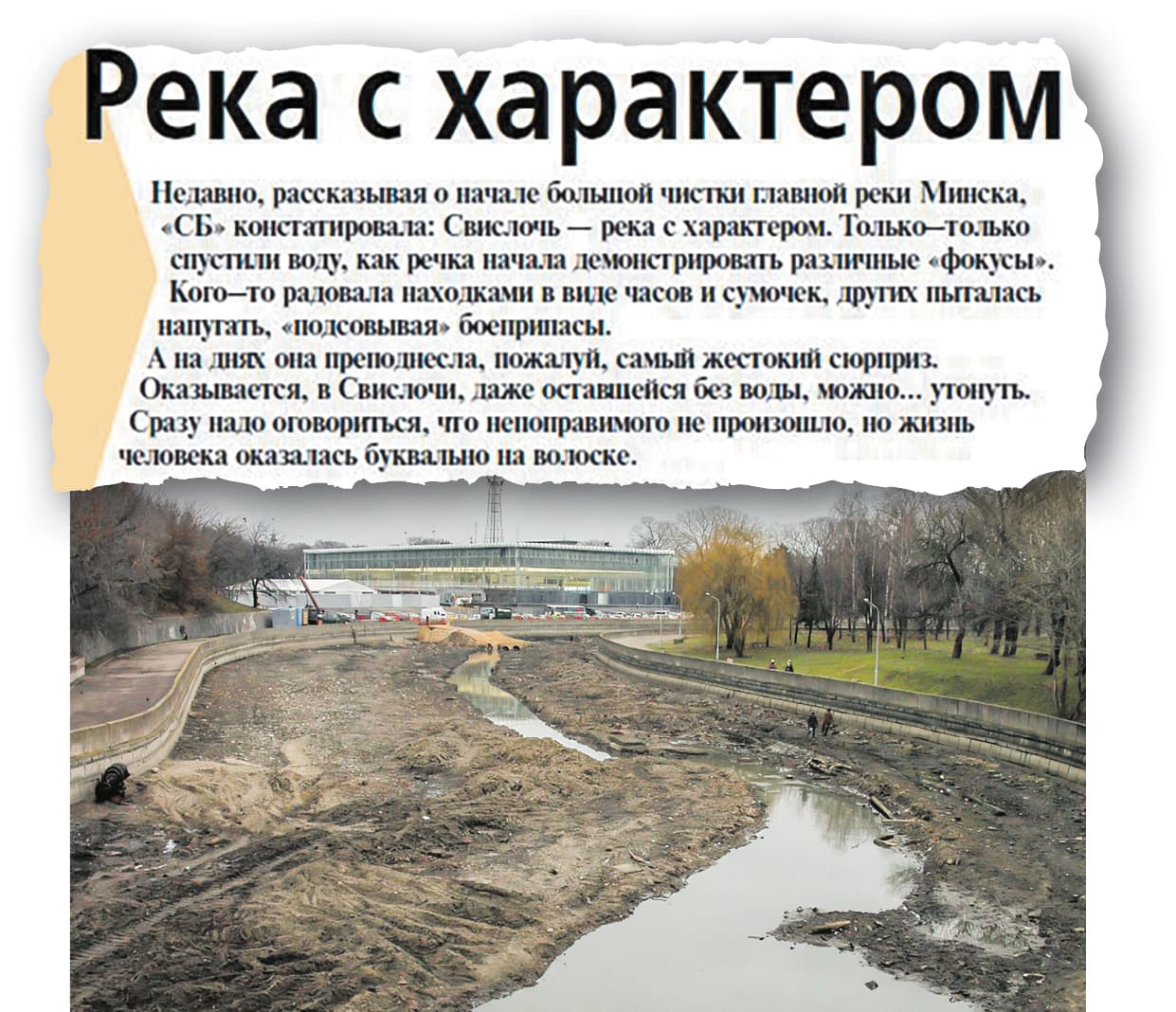
According to rescuers, the bottom of the river is covered with a viscous layer of mud, the thickness of which in places reaches one and a half meters. Therefore, people should not be under illusions about the apparent hardness of the bottom of the Svislocha.”.
It should be noted that large-scale cleaning of the Svislochi channel in Minsk began in October 2002 and continued until 2005.
P.S. If this 24-year-old material is read by a photographer who almost drowned in the bottom mud of Svislochi, please contact the editorial office. Surely everyone is curious about his fate and whether he managed to take a picture.


