
Attention, bear!
Within the framework of the scientific project “Study of the biological features and influence of the brown bear population (Ursus arctos collaris, Cuvier, 1824) on human activity in East Kazakhstan”, zoologist Sanzhar Kantarbayev, a specialist who deals with the brown bear population in the territory of the Kazakh Altai, works on the defense of the thesis “Ecology of the brown bear in Kazakhstan”
The bear is not Winnie the Pooh
The website of the Institute of Zoology of the Ministry of Education and Science of the Republic of Kazakhstan says: “As part of the project of grant funding for the research of young scientists “Zhasgalym” for 2026-2028, the project manager Sanzhar Kantarbayev, a junior researcher at the Center for Biocenology and Hunting of the Institute of Zoology of the Republic of Kazakhstan, passed an internship at the Evenstad campus of the University of Applied Sciences of Innlandet. Kantarbayev’s internship was held within the framework of the advanced training course 6EV315-1 26H Chemical and Physical Capture of Scandinavian Mammals and was related to the implementation of the scientific project “Study of biological features and influence of the brown bear population on human activity in East Kazakhstan”.
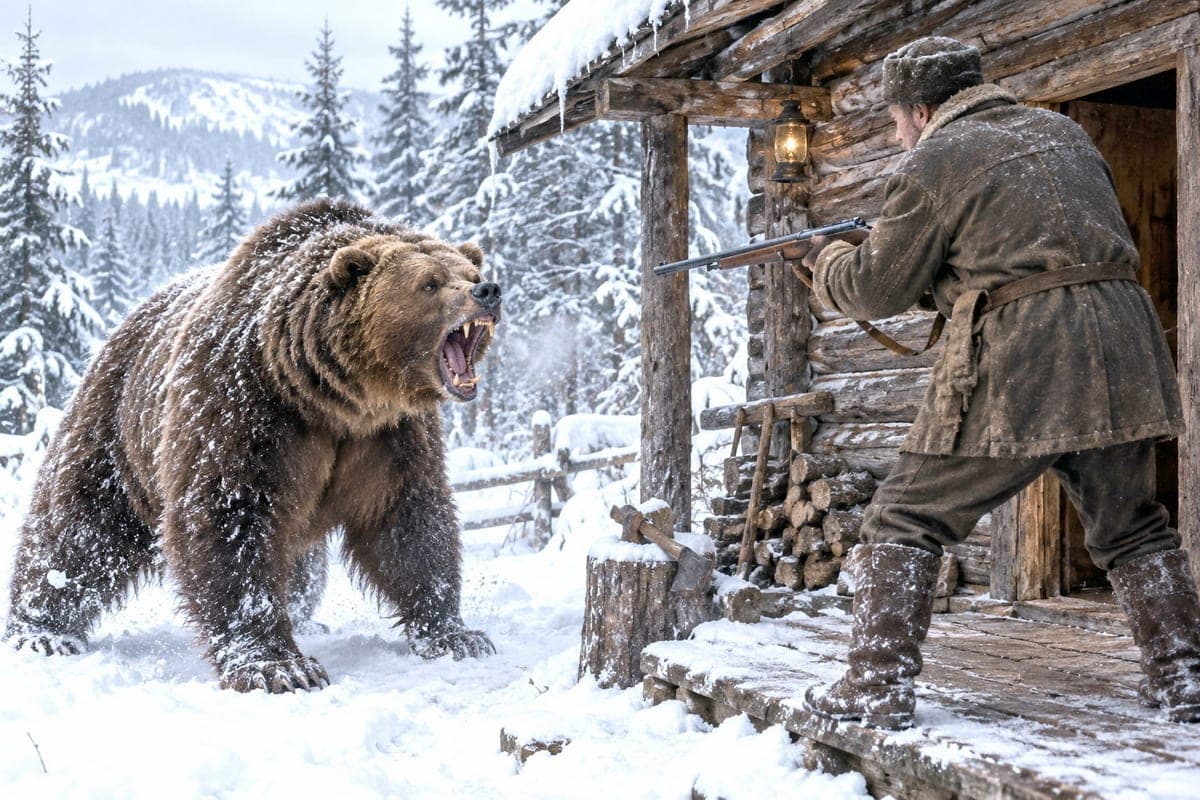
So, the field of research of Sanzhar Kantarbayev is focused on the expanses of the Kazakhstan part of the Altai. According to the zoologist, pristine nature has been preserved in this mountainous area. There are more wild conditions, more bears than in the Trans-Ili Alatau, so it is possible to collect material and conduct research with a statistically reliable sample. He says that in the Altai, in Siberia, it is not uncommon for bears to climb into human housing, in wintering grounds they even arrange dens. Sables are mined there, and hunters come to huts in the winter. Usually fishermen use small-caliber weapons and traps. And there is a man with such a gun in the house, and there sleeps a huge master of the taiga. The hunter opens the door, rejoicing at the opportunity to rest and warm up, and an awakened bear rushes at him. This often ends tragically.
“One of the purposes of the internship in Norway was to meet with my supervisor, Dr. Aimee Grace Tallian,” says Sanjar Sakenowicz. She has extensive experience in the study of large predators and is currently the coordinator of the Scandinavian Brown Bear Research Project. She had experience at Yellowstone National Park, where she studied the behavior of wolves and bears for ten years. Dr. Tallian now works at the Norwegian Institute for Wildlife Research (NINA). We are starting large-scale studies on the population of brown bears in the East Kazakhstan region, since no one has done this systematically before us. For the first time in 30 years, the Committee of Science of the Ministry of Health of Kazakhstan approved a project to study the population of brown bears in East Kazakhstan, and I am its head. We have published a highly rated article dedicated to the object “brown bear” in the journal Ecology and Evolution, on the pages of the publication (Wiley), which at one time published James Fenimore Cooper and Edgar Allan Poe.
Tourist, you smell like stew!
The famous naturalist writer Ernest Seton-Thompson described how bears turn into so-called beggars. From The Life of a Grey Bear: Many years ago, the government decided to turn an area near the upper reaches of Yellowstone into a nature reserve. Here, in this great wonderland, no one should have been afraid because no one should have been harmed. Both the beast and the bird knew no violence; the virgin forests did not know the axe, the factories and mines did not muddy the streams. Everything here is as it was before the appearance of the white man. In addition to tranquility, wild animals found plenty of food in Yellowstone Park, and therefore they gathered here in such quantities as nowhere else.
Seton-Thompson writes about a hotel in the center of Yellowstone Park. On the clearing in the forest, the ministers carried the garbage and remnants of food for a bear meal, and the bears became more and more. Very often there you could see at once almost a dozen bears of various breeds: black, brown, brown, gray, silver, large and small. There were whole families and wandering loners. Dozens of bears roamed around the hotel, but no bear ever attacked a person. Bears appeared during the summer season, when the hotel was open, and left when the hotel closed. No one knew where they were coming from or where they were going.”.
The hero of the story - a gray bear - once behaved inappropriately. He approached the hotel and fell inside through the front door, stretched his entire eight-foot height and walked to the office. The guests fled, and the clerk fled into the telegraph room. “Hence he telegraphed to the park manager that an old bear had entered the house, had entered the office and was apparently going to run the hotel. He also asked if he could shoot the bear. And telegraph received the answer that shooting in the park is not allowed, but you can act with the fire intestine. The clerk did. The bear, who did not expect such a turn of the case, began to flee from the hotel office. He stomped his paws hard, banged his claws on the floor. Lost, he ran to the back door and, passing through the kitchen, managed to steal a quarter of the bull’s carcass hanging there.”.
“These are the most striking examples of improper interaction between man and nature,” Kantarbayev says. The motivation of the people in Yellowstone was clear – it was necessary to attract tourists to the national park. Employees, campground and hotel administrators left food waste for bears to watch and photograph. My teacher, a great expert in the behavior of bears Valentin Pazhetnov, believed that over time, the smell of human food in a bear begins to be associated with the smell of a person. Conventionally, the tourist carries canned food in his backpack, he smells like canned food, and the bear is a very intelligent animal, he has a generalized type of eating behavior, that is, he is omnivorous. And over time, the beast realizes that if a person smells of food, you can hunt him.
Sanjar Sakenowicz said that in Yellowstone there is a photographer who brings pig carcasses and puts them in the forest where bears come. It has towers and photographers from all over the world come there. And at the end of the season, he kills the animals, because the fed bears will leave these places and begin to attack the pigs of the surrounding farms. And so that such problems do not arise, they are disposed of.
No bear is worse than a rod
Zoologist, well-known Kazakh ornithologist N.N. Berezovikov spent a lot of time in the Altai and wrote the book “Taiga Commandment”. There are stories about encounters with bears. In the story “Chatun”, the author describes a meeting with such a beast.
The craftsman Markel did not wait for guests, he had not seen people at his hut for two months, which stood in the forest, in a mountainous area. But for the sixth day they walked through the forest, from wintering to wintering, a hunter and fishermen from the Zagotkantor. Shatun killed a hunter. This has not happened since the 61st year, when due to forest fires in the Siberian taiga, many bears did not lie in the dens and visited the taiga villages. It was necessary to organize raid brigades that shot dangerous animals. So now it was necessary to find and eliminate the cannibal.
Having escorted the hunters, Markel selected new cartridges with "jacans" and went along the way to check the traps. In the evening, satisfied with the catch, he returned to his taiga house. Without reaching the hut, I saw that the slope of the shaft, on which hunters skied in the morning, crossed a deep ford.” Traces were found at the hut, the bear overtook the cameo on skis, destroyed the bait prepared for sables. The rod passed along the ski, eating the bait in the traps, he could return to the hut and plunder the winter.
The next morning, the bear stood near the winter under a canopy. Markel fired a duplette through the door and hoped the beast was gone. Meanwhile, Markel's son returned from the army. He wanted to see his father quickly and went to him for two days in the winter. The bear caught up with him at the hut, and the gun was loaded with a shotgun - on the way, the guy hunted grouse. He pulled the brace, but the hut was locked inside. At that moment Markel grabbed his weapon and was about to pull the trigger, but he heard screaming and shooting. Pink opened the door and Markel shot the bear point-blank.
Forced neighborhood
With our article in the scientific publication, we summed up the results, became the first in the world community to consecrate this field in world science in Kazakhstan, and this is a big step for Kazakhstan’s zoological science. Such articles have not been published in foreign journals before. Our project is to study the brown bear population and its impact on humans. We're studying how this predatory mammal interacts with humans. In the EKR, the bear is a hunting species, legal hunting is allowed for it, and there is a huge number of conflicts not only with beekeepers, but also with tourists. Recently, news broke that a bear attacked a farmer, and this is perhaps the first direct collision in 20 to 30 years. This problem is quite acute, there is no systematic approach, and our task is to understand this. We will have several approaches: we will install camera traps, we hope to purchase satellite traps. If we can do that, we're going to capture bears and tag collars to study their spatial distribution, their individual locations. It will then become clear how close and often they are to human infrastructure.
During an internship in Norway at one of the world’s leading universities, I took a course on the physical and chemical capture of Scandinavian mammals. These are universal techniques, and bears are caught in several ways. In Norway and Sweden, they are shot from helicopters with a tranquilizer. At our institute a couple of years ago, I was able to design a trap based on my drawings, which we are going to test. This design was used in Yellowstone - a barrel on wheels measuring two by one and a half meters with automatically closing doors. In fact, this is a large mousetrap, where the bait is placed, and a special cable is attached to the door, and it slams shut, Sanzhar Kantarbayev said.
There are many tips for tourists how to behave if you meet a bear: do not run so as not to consider you prey; fall to the ground and pretend to be dead; talk loudly so that the bear hears you from afar and leaves; lift a backpack high above your head to appear large. But the best meeting is the one that never happened. Going to the mountains and forest, do not forget that it is you who go to visit the river and trees, to birds and animals. Clubfoots are preparing for winter hibernation, they need to gain a lot of fat. Do not interfere with Toptygin in his labors and worries.


