
Eggs on autopilot: the chronicle of the next “miracle” of the Israeli bureaucracy
In Israel, where even an omelet is a political act, another egg price hike is turning into a national event
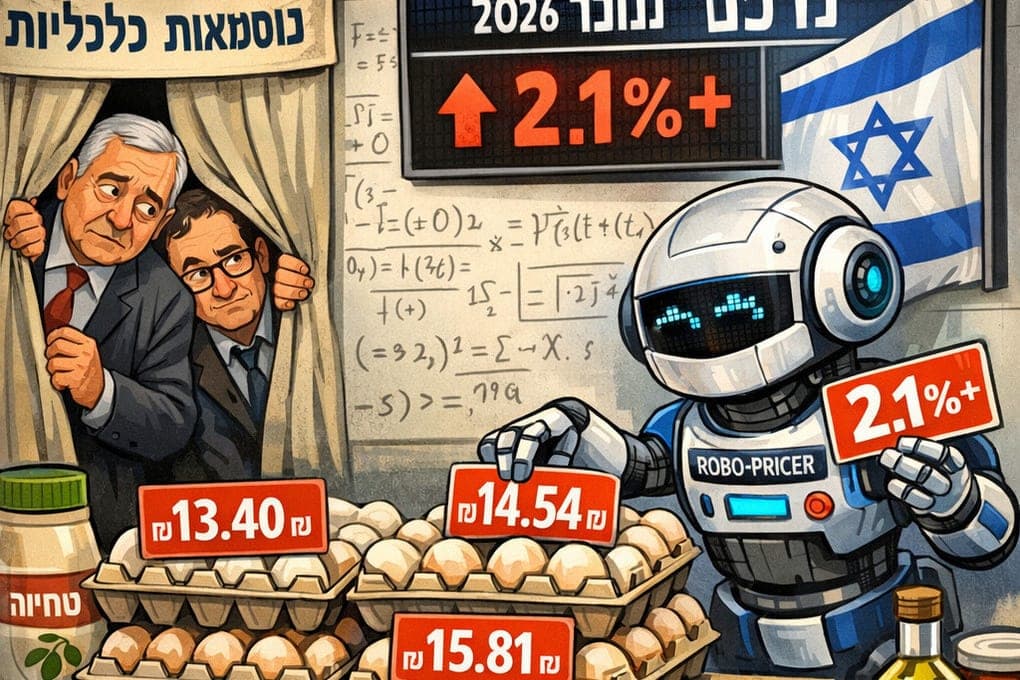
In Israel, where even an omelet is a political act, another egg price hike is turning into a national event. From November 1, 2026, according to a recent circular from the Ministry of Agriculture and Nutrition Safety, the maximum price for controlled eggs will increase by 2.1%. For those who like accuracy: a package of 12 eggs of size M will rise in price from 13.13 to 13.40 shekels (+27 agorot), L - from 14.24 to 14.54 (+30), XL - from 15.48 to 15.81 (+33). All this, of course, is due to rising prices for feed, wages, energy and packaging. The ministry calls this “moderate” growth, but moderation is a relative concept, especially when it comes to the wallet of the Israeli consumer.
However, the main thing is not in the number itself, but in how it appeared. After all, in an era when the political temperature in Jerusalem is higher than the boiling temperature of water on the Dead Sea, someone thought of transferring the most ungrateful business - raising the price of daily bread - to the hands of a soulless formula. Since 2023, the fate of the Israeli egg is decided by an automatic mechanism: once a quarter, a special algorithm compares the cost of feed, wages and electricity, and if the accumulated growth exceeds 3% for six months or 1% per year, prices are adjusted. Without the signature of a minister, without nightly debates in the Knesset, without theater of absurdity in government meetings. The Minister of Agriculture proudly states: "The mechanism reflects the real costs." Technically true. Politically, genius. After all, now that another pair of agorots disappears from the family budget, it is not the Minister, not the coalition, not even Netanyahu, but some formula that no one has seen, but everyone curses.
The opposition, of course, is not asleep. Members of the Knesset are pleased to recall that “hiding behind formulas does not absolve oneself of responsibility for structural failures.” Israel is still among the most expensive OECD countries for basic products. And according to recent polls, the cost of living is Israel’s biggest fear ahead of the election. The egg - modest, oval, universal - has become an involuntary barometer of the quality of government. In an age when every agorot is a voice of distrust, even automation does not save from popular anger.
History likes to repeat itself, but in Israel it does so with a special sense of humor. The last increase was in November 2025 - then prices rose by only 1.0-1.1%. Before automation, everything was much more dramatic: in June 2021 - +6.5% after a seven-year freeze, and in January 2023 - a shock +12-16% against the background of the war in Ukraine and a jump in feed and energy prices. At that time, each increase required ministerial signatures and was accompanied by a political scandal. The automatic mechanism was born out of this traumatic experience: instead of rare and painful jumps, we now get frequent but predictable adjustments. The November increase in 2026 is the third under the new system and the largest of the three: 2.1% against 0.9-7.3% in 2023 and 1.0-1.1% in 2025. Compared to inflation (1.9% per year), eggs are slightly ahead of the overall price increase – but who does?
Now, look beyond the horizon. In the U.S., where eggs are a market rather than a state cult, more than 150 million laying hens have been slaughtered in the past two years because of bird flu, and egg prices have soared by 80 percent: in Manhattan, packaging has become a luxury item and the word "eggflation" has become commonplace. In Europe, where food inflation has reached 16% (France), and wholesale egg prices have broken historical records, the authorities chose not formulas, but “gentlemen’s agreements” with supermarket chains – political theater with a tricolor in the background. In Turkey, VAT on eggs was reduced from 8% to 1% and state shops were opened, but inflation on products remained at the level of 44-78%. Against this backdrop, Israel’s 2.1 percent rise looks almost like a success story – forgetting that we started with prices that were already the sixth highest in the world before the 2023 jump. The formula is the most transparent among analogues, but structural problems have not gone away: there is little competition, production is protected by quotas, imports are subject to duties.
Again, we are faced with the eternal question: what is more important – stability or justice? Empires collapsed, dynasties changed, and the price of eggs was always the most honest test of the strength of the social contract. The 27-33 agorot added to the price of a dozen will not bring down the economy. But in a country where the cost of living is the main political nerve, every agorot is a small vote of no confidence. An election is ahead, and if the automatic mechanism continues to take on all the negativity, the government could go down in history as the inventor of the most elegant way to raise egg prices without leaving fingerprints. Or as the author of another bureaucratic joke, which no one appreciated.
Reference block: price dynamics for controlled eggs in Israel (2019-2026)
Date Size Old Price (та/12) New Price (та/12) Change (та)% Growth Mechanism
Jan 2019 M 10.53 10.40 -0.13 -1.2% Manual
June 2021 M 10.47 11.15 +0.68 +6.5% Manual
Jan 2023 M 11.50 12.89 +1.39 +12% Manual
Nov 2023 M 12.89 13.00 +0.11 +0.9% Automatic
Nov 2025 M 13.00 13.13 +0.13 +1.0% Automatic
Nov 2026 M 13.13 13.40 +0.27 +2.1% Automatic
For similar changes for sizes L and XL, see official data from the Department of Agriculture.
International context:
US: +80% in 2 years, no price controls, "eggflation" - the new reality.
France: Product inflation of 16%, network agreements, not formulas.
Turkey: VAT reduction, state-owned shops, inflation 44-78%.
Israel: Automatic formula, transparency, but prices are among the highest in the world.


