
Iron hands to replace the living
Today, humanoid robots put on virtual dressings and go to real factory shifts
China on the front line
Even yesterday, two-legged cars from science fiction films seemed expensive toys, able only to effectively dance at exhibitions and pour coffee in commercials. But they are already creating competition, or at least the appearance of competition.
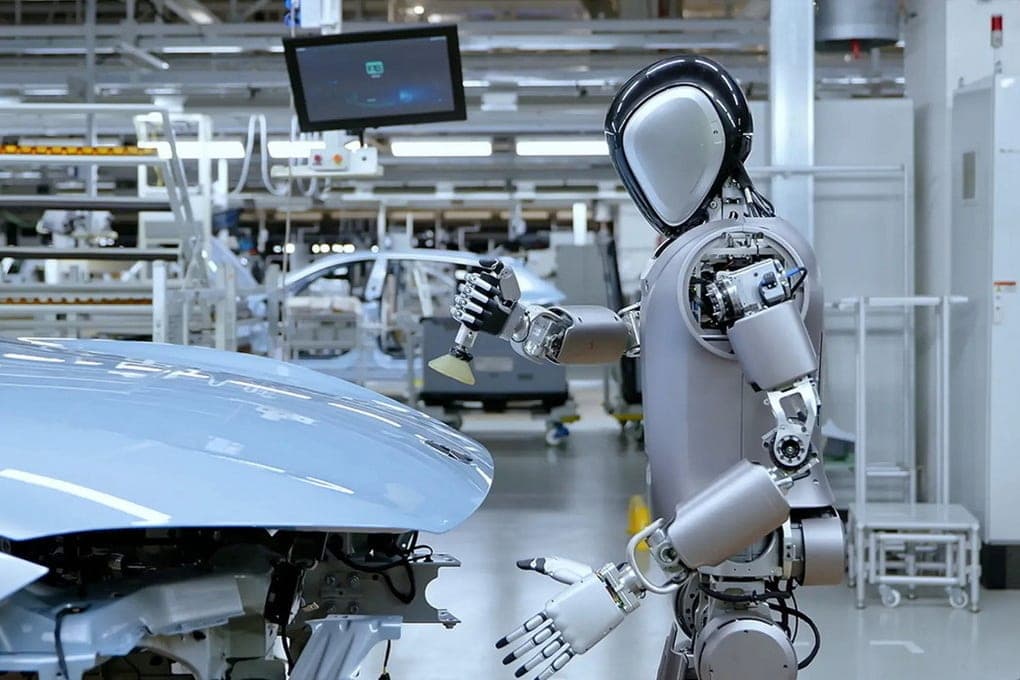
A demonstration experiment in 2025 was organized by the BMW concern at its plant in Spartanberg. For ten months, the humanoid robot Figure 02 worked alongside people there. His task was simple and monotonous: take sheet metal parts and feed them for welding. During the “shift”, the iron worker defended about 1,250 hours at the machine, dragged over 90,000 blanks and had a hand in the production of more than 30,000 BMW X3 crossovers. The test for professional fitness machine passed perfectly: no time off, sick leave and smoke breaks, only unquestioning dedication to work. However, when it came to money, the auto giant chose to remain silent: neither the price of the robot itself, nor the cost of its maintenance, nor the real savings were ever named.
It is this understatement that determines the fate of the entire industry today. Artificial intelligence has taught machines to see, think and adapt, but the wonders of technology do not guarantee miracles in bank accounts. Unlike software code, a robot is a complex mechanism of metal, wires and motors. For the factories, the decisive argument will not be the grace of the machine, but the price of one hour of its useful work. And for investors, the main test will be the ability of robot manufacturers not to eat all the revenue on development, assembly and endless repair.
The excitement around robotics will largely be fueled by the explosive growth in the popularity of neural networks. The AI market leaders’ figures are indeed laudable: NVIDIA’s data center division alone earned $193.7 billion in fiscal year 2026 (ended in January), up 68 percent.
But... comparing software to iron is not entirely correct. Computing power can be increased simply by adding servers to data centers. But each new workplace at the plant requires the creation of a physical device, its delivery and painstaking grinding to a specific conveyor. However, classical industrial robotics has long outgrown the stage of experimentation and turned into a giant industry. According to the latest data of the International Federation of Robotics (IFR), published in September 2026, in 2025, enterprises around the world purchased and installed more than 600,000 new industrial robots. The market added 11 percent compared to 2024, when about 541,000 cars were installed. The total army of iron workers on the planet has reached an impressive figure of about five million units. But we are not talking about humanoids, but about traditional industrial robots (manipulators, machines, etc.).
If you look at the map of this automation, it becomes clear who dictates the rules of the game. The main driver and consumer of robots on the planet is China. In 2025, China accounted for 59 percent of all new installations in the world, while the rest of the countries combined accounted for only 41 percent. Moreover, China is rapidly closing the market to itself: already 55 percent of the existing fleet of cars in the country is produced by local factories. So the global boom in automation does not mean that Western or Japanese engineers will automatically become rich on Chinese orders. Against the background of this mature market, a humanoid robot becomes a real rock star. Why even give the machine the shape of a human, if the usual mechanical “hand” on the stanza works faster and is cheaper?
How much does an hour of ironworker cost
The answer is simple: our world is built for people. Where the plant is designed from scratch, it is more profitable to put the usual manipulators. But rebuilding old workshops, staircases and narrow passageways under standard robots is too expensive. An anthropomorph can just walk through the door and stand up to a regular machine. Acute shortage of workers and expensive labor force business to seriously look at such innovations. According to analysts BofA Global Research (analytical agency) from March 2026, the world supply of humanoid robots by 2030 can soar more than 13 times — from the expected 90,000 pieces in 2026 to 1.2 million devices annually.
However, each industry has its own arithmetic.
On the assembly line, the cost of failure is measured in the millions: if the robot thinks about it and stops the line, the losses from downtime will cover all the savings on salaries. But in giant warehouses, where boxes and goods change every hour, a slow but versatile Android can be much more profitable than bulky sorting machines, sharpened only for one type of packaging.
Behind the futuristic presentations lurks the harsh reality of workshops and supply chains: assembling humanoid robots is still insanely expensive. Unlike a computer program that can be copied a million times at the touch of a button, metal and chips don’t get cheaper on their own.
According to McKinsey experts from April 2026, only a set of components for one typical humanoid costs the manufacturer from 30 to 150 thousand dollars. The lion’s share of the budget – 40 to 60 percent – is eaten by actuators, that is, high-precision motors and gears that make mechanical joints move smoothly. The rest goes to sensors, batteries and electronics. And this is only the price of scattering parts - without taking into account the work of assemblers, settings and quality control.
On the market, of course, there are much more affordable models – for example, the Chinese basic robot Unitree G1 is offered at a price of 13.5 thousand dollars excluding taxes and delivery. But buying a car is like buying a racing car without a team of mechanics and a track. The plant will have to pay for the robot’s integration into the production cycle, its training, fences for human safety, regular maintenance and salaries to live operators who will correct the workpieces if the machine is mistaken.
To determine whether such an employee is profitable, economists calculate the cost of one useful hour. Take an example: the introduction of the robot cost the company 100 thousand dollars, it will last three years, and the annual service requires another 10 thousand dollars. If a machine ploughs six thousand hours a year without a breath, its hour costs a reasonable seven dollars. For comparison: on average, a person leaves about 1970 working hours per year with a standard 40-hour work week.
But if due to reconfigurations, breakdowns or the specifics of the schedule, the robot only works 1,500 useful hours a year, the price of the hour jumps to $ 29. And this amount has not yet included interest on loans. Comparing these figures with a person’s salary is possible only when the machine is running at the same speed and does not drive the marriage.
In order not to scare customers with huge checks at the start, the developers offer to rent robots by subscription. Back in 2024, logistics giant GXO agreed with Agility Robotics to use their two-legged Digit machines as a service. It's convenient for a warehouse - you don't need to freeze millions. But for the manufacturer, such a scheme turns into a difficult financial test: he is forced to build robots at his own expense and wait for years for a refund through rental payments, where any breakdown directly eats up the profit.
Who will actually break the bank
On the stock exchanges, robotics has long ceased to be a venture dream - companies with multi-million and billion-dollar turnovers are traded here. But their 2026 reporting shows just how different the wallets of old giants and newcomers are.
The Japanese corporation FANUC is the embodiment of a classic, time-tested school. From July to September 2026, its robotics division increased revenue by 7.2 percent compared to the same period last year - from 91.6 billion to 98.2 billion yen. This is a reliable and profitable business, but its pulse beats in unison with the world industry: factories slow down and sales of Japanese manipulators slow down.
The American company Teradyne, which gathered under its wing the popular collaborative and mobile robots Universal Robots and Mobile Industrial Robots, showed much greater growth. In the first half of 2026, its robotic wing brought $191.2 million in revenue against $143.8 million a year earlier, showing an increase of 32.9 percent.
The most rapid rise demonstrates the Chinese UBTECH, betting on anthropomorphs. In the first half of 2026, its revenue from full-size humanoid robots and related services jumped more than 15 times, from 38.2 million to 590.3 million yuan. The figures are impressive, but the high-profile sales are still a trail of losses: for the same six months, the company lost 338.8 million yuan, and how much money industrial humanoids bring or burn, the management prefers not to disclose.
A much more tangible commercial history is built by the American developer of warehouse automation systems Symbotic. For the quarter ended June 27, 2026, the company's revenue grew by 22 percent and reached $720.8 million. A massive agreement with retail giant Walmart involves the robotization of 25 distribution centers with an initial investment of about six billion dollars over several years. Fixed resupply and service contracts promise the company a good margin. However, there is one alarming nuance: 90.5 percent of quarterly revenue was provided by only one buyer. If he slows down orders, the financial report will crack at the seams.
The main technological breakthrough that the entire industry is waiting for is universal learning. When a single neural network can teach a robot dozens of different jobs without expensive reprogramming for each pipeline, the economy will change forever. Cars will become truly flexible, and mass circulations will finally bring down the price of expensive engines and sensors.
But what is the paradox: even if robots become smart and cheap, the main cream can be removed not by their creators, but by ordinary factories and shops. Stiff competition will force manufacturers to bring down prices, giving the benefit to buyers. To survive and earn, developers will have to earn not so much on the hardware itself, but on smart software, subscriptions and unique details. The real maturity test will begin when companies start regularly reporting repeat orders from the same customers, uninterrupted hours and live cash flow. It is these figures that will show who will really make money from the new industrial revolution.


