
Zhezkazgan alloy of talent
Meeting with a previously unknown city - these emotions remain for life
In 1972, the book "Dzhezkazgan" was published in the publishing house "Kazakhstan". Yesterday, today, tomorrow”. Many of these documented and illustrated publications judge cities in which, perhaps, never visited. Since then, more than once published books introducing the copper capital of the country. But it was in that book of 1972 that the apt and bright lines of different poets about Zhezkazgan are given.
What exact definitions are found in these poems. Real poetry cannot be uninteresting or depend on what kind of "weather in the yard" is an era of stagnation or the wind of change. And still young in the 50-60s, the city was completely fondled by the muse, who visited local authors.
"The city of a daring dream, the city of brave good people," writes Boris Opeskin. “Dzhezkazgan is still a teenager, with him we, as comrades, are on you,” Anatoly Bolobonkin emphasizes. And here's another:
The sun burned you,
The winds swung you,
I put you in the blizzard steppe,
Only in trials is strong,
Every day with a crown victory
You built the city of Jezkazgan..
When you read these lines, involuntarily there is an association with the monument to the First Builders of Zhezkazgan on the square of the same name. And first of all, with people living nearby, who transformed this corner of Saryarka in the suburbs of the desert Betpak-Dala into a modern city with their work. And the author of this excerpt is a man with a poetic surname, at that time a guy from Polesie, mining precious copper in Central Kazakhstan, Georgy Gaiduk.
When the light was added
What do we know about Georgi Hayduk? We know he was a very talented poet. We know that he worked as an excavator machinist in a mine in Satpayev. We know he died early.
It is known that he was often invited to meetings of the literary association “Ingot”. But he rarely showed up. When he came, as noted by the poet and writer Zinaida Chumakova, light was added, the “Slitkovites” remember very well. At one literary meeting, he read in a quiet, sad voice:
And time tells me:
Open your mouth
And understand the raging army..
And only lips of warm blood
I'm not meant to kiss today.
He was listened to and admired for his ability to see and hear the world. Georgy Gaiduk graduated in absentia from the Gorky Literary Institute in Moscow, studying in the class of the famous poet Nikolai Dorizo, but even then he remained to work in the mine. Returning home after the next session, he told the “Slitkovtsy” about his classmate – the poet Boris Atrymov, who became a bright representative of the Don literary school, about what students were taught. Undoubtedly, Georgy Gayduk’s knowledge of literature, literary studies and other disciplines was much higher than that of his comrades in the unification, and they used everything they heard at meetings.
Georgy Gaiduk and Nikolai Guralov, also a student of the university, passed the knowledge acquired during the study period to the Zhezkazgans. Georgy perfectly owned a quarry four-cubic excavator, loaded ore into dumpkars and BelAZ, and Nikolai Guralov mined ore in the slaughter.
The search for truth
“Slitkovtsy” also studied during literary competitions on a given topic and disputes about the work of famous Soviet and foreign poets and writers, mutually enriching themselves with knowledge that helped create their own vision of the world around them.
There's nothing to say. And arguments to the hoarseness, and war for every word in a poem, the etymology of which was not always clear. They searched through dictionaries, looked for other authors in books, but they found the truth.
On November 21, 1956, the first meeting of the Zhezkazgan City Literary Association was held under the newspaper “Dzhezkazgan Worker”. For four years, the union had no name. And Georgy Gaiduk, who considered his fellow pen literary ingot, made a proposal to call the association so. The supported idea lives for many years to this day.
In the “Ingot” gathered beginner poets and prose writers. Here, in the circle of like-minded people, there was a discussion of what was written and the study of worker-peasant correspondents was conducted - this was the name of the freelance authors of the newspaper at that time.
In his article “The Way to Poetry”, written for the 50th anniversary of “Ingot”, the poet and writer Boris Opeskin of Zhezkazgan says:
- The sixties of the twentieth century were filled, as they say, with poems by talented poets. Our idols were Robert Rozhdestvensky, Evgeny Yevtushenko, Andrei Voznesensky, Olzhas Suleimenov, Boris Examples, Novella Matveeva, Larisa Rumarchuk, Rasul Gamzatov, Eduardas Mezhelaitis and many others - it is simply impossible to list all. Annually published collections "Day of Poetry" in Moscow and Leningrad. Poems filled our lives. People were looking for poetry books. I listened very much to the local poets. Among them were: Georgy Gaiduk, machinist of the excavator of the Northern mine; Muza Rozhdestvenskaya, teacher, participant of the Kursk battle, radio operator, front-line worker; Efim Kogan, stonemason of the trust "Kazmedstroy"; Yuri Grunin, architect of the Institute "NIPITZvetMet"; Yuri Shapovalov, employee of the CSPIEL (Central Design and Research Experimental Laboratory); Valery Shakhidzhanov, welder of the benefilling factory; Valentin Rybakov, a worker of the enrichment plant. The performances were successful with poetry lovers and were held in full audiences.
Poets of the city of copper were in demand, they were often invited to creative meetings in cultural palaces, clubs, schools, libraries, red corners of enterprises of the region. The performances of the members of the “Ingot” on V.I. Lenin Square on the Day of Soviet Youth, in the Pavka Korchagin club, at the evenings of rest in the Palace of Metallurgists were met with joy and respect – as a conversation with people close in spirit. Like your own, homegrown versification lovers. As it was customary to say – our local poets from excavators, welding units, fleet machines and underground, invisible to many, ore tricks and cleaning chambers.
The members of the association released a typewritten collection that walked around the city. The poet Yuri Grunin, more mature by age, who succeeded in skill, because he then printed in thick magazines, judged the creations of colleagues strictly, demanded equalization with Vladimir Mayakovsky, Robert Rozhdestvensky and many others.
Yuri Grunin published several books, became a member of the Writers’ Union of Kazakhstan, as well as the editorial board of the republican literary magazine Niva. His poems were included in the anthology of Russian poetry of the twentieth century “Story of the Century”, compiled by Yevgeny Yevtushenko.
The magazine “Prostor” published collections of poems by Zhezkazgan poets. “Ingot”, which is now 70 years old, was and still is a creative laboratory for many talents of Zhezkazgan.
Several generations of "Slitkovites"
Talented poems awaken a personality in the reader. The lines of Zhezkazgan authors are of particular value because it is the chronicle of the copper ore region. The rulers of words and inspiration continue to create in Zhezkazgan and nearby Satpayev. The works of poets of the generation of the first members of the literary association, as well as the one that came to replace them, elevate the region of Ulytau, make the word “patriotism” not detached and some distant, but close and understandable. I'll repeat Hayduk's lines:
Every day with a crown victory,
You built the city of Zhezkagan..
This is a ready-made preface to stories about such glorious names in the history of the city as Kanysh Satpayev, Gaziz Omarov, Aubakir Kusainov, Fedor Lukinsky, Viktor Gurba, Leonid Ivanchenkov, Anatoly Kichaty, Dmitry Populidi, Mikhail Bazhutov, Amankeldy Zamekbaev, Shakhmardan Yessenov, Ignatii Li... About many other people who have made a significant contribution to the formation and development of the city of copper, the region, sung by the "Slitkovites".
- Now such large-scale gatherings offline, as before, no longer exist, – says about today’s literary association teacher and journalist Vladimir Romankov. Someone died, someone moved to other cities and countries, someone for health reasons is difficult to meet in person. But, fortunately, the Internet came to the aid of the “slitkovists” in time. We have a chat on WhatsApp, where poets share their works, as well as other communities.
For example, a few years ago in Zhezkazgan, young people created a literary club that combines online and offline formats: participants read selected books, meet, spend time together. Among them is the famous Zhizkazgan actress and poet Natalia Sergushova, a permanent member of the litas association “Ingot”.
Remelting time
- In 2025, when I worked in the Satpayev city newspaper Sharaina, we decided to restart the legendary literary association, continues Vladimir Romankov. For this process, I even came up with my own word “remelting”. And that's how Barrier 2.0 came about. Now I continue to popularize the work of the authors of the Ulytau region on the platforms of Facebook and Instagram.
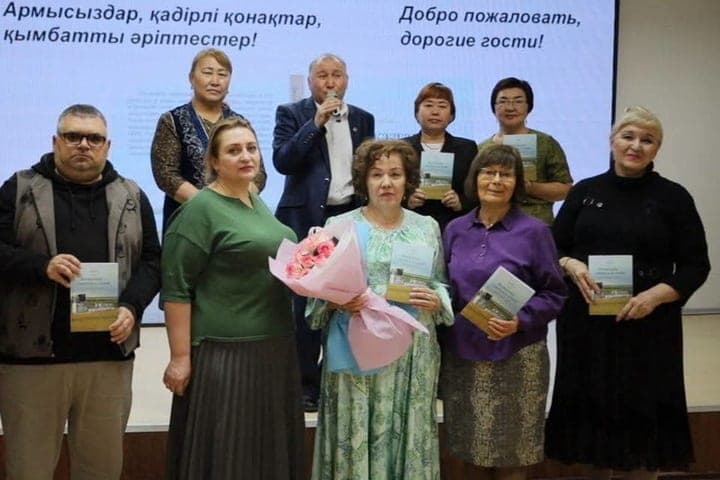
Special thanks to the veterans of the literary association, who help to preserve the traditions of “Ingot”, – Natalia Sergushova, Lyudmila Barlamova, Margarita Grin, Irina Chershneva, Oksana Idrisova, Alma Djumanbaeva... By the way, in October of this year, Alma Djumanbaeva published a wonderful book “Zhezkazgan – Unique in the Steppe”. Several chapters are devoted to our "Ingot" and the iconic members of the association - Zinaida Chumakova, Natalia Sergushova, Valery Popova ... Despite the difficulties, "Slitok" continues to live, albeit in a different format. The main thing, in my opinion, is that we still find our reader.
In Kazakhstan, poetry lovers are familiar with the names of Yuri Grunin, Yefim Kagan, Georgy Gaiduk, Sutemgen Bukurov, Boris Opeskin, Musa Rozhdestvenskaya, Valery Popov, Vissarion Pshenitsyn, Valentin Rybakov, Olga Shilenko, Valery Mogilnitsky, Konstantin Prigodich, Roman Soltis, Mikhail Krivonogov, Nikolai Pyatakov, Tatiana Vedenyakina, Sergei Toropkina, Mikhail Poseva, Alexander, Zhestakova, Nikolayevskaya Szova These and many other wonderful poets and writers are an integral part of the history of the region. It is an integral part of the modern literary process.
I did not think, did not guess, did not even imagine that in Zhezkazgan there are so many talented original poets – lovers and creators of true poetry. And now, having made such a discovery for himself, I was surprised and glad, wrote the famous Kazakh writer and translator Herold Belger in 2008.
Glorious traditions continue to live - "snipers of consonant words" from Zhezkazgan and Satpayev do not cease to create! And they write not to the table, but to people. Today, the bar is open to anyone who wants to join.
After all, literary associations are needed not only for those who write poetry and prose. They are needed by readers and the city itself, because they help to preserve their history, character, memory of people and events. In such creative communities there are representatives of various professions, ages and generations. For some, this is an opportunity to show their works to a wide audience for the first time, for others – to get an objective assessment, hear the opinions of colleagues, find new topics and gain confidence in their own abilities. And sometimes it is the friendly participation and support of like-minded people that help a person not to give up creativity, but to continue to develop and improve.
It is also important that literary associations become a kind of bridge between the author and the reader. After all, talented lines should not remain in personal notebooks and computer files. They need to live, find a response, cause emotions, make them think. And here a big role is played by people who are ready to notice new names, support aspiring authors, help them take their first steps in literature.
The history of “Ingot” proves that such a community has not only a past, but also a future. Generations, ways of communication, formats of meetings change, but the main thing remains unchanged - the desire to create and share your word with others. And while there are people in Zhezkazgan and in the Ulytau region as a whole who have something to say to the world, while there are those who are ready to hear and support them, the literary “Ingot” will be replenished with new names, which means that it will continue its life.


