
The stellar history of the Kremlin spires: a complete dossier on the ruby symbols of the country
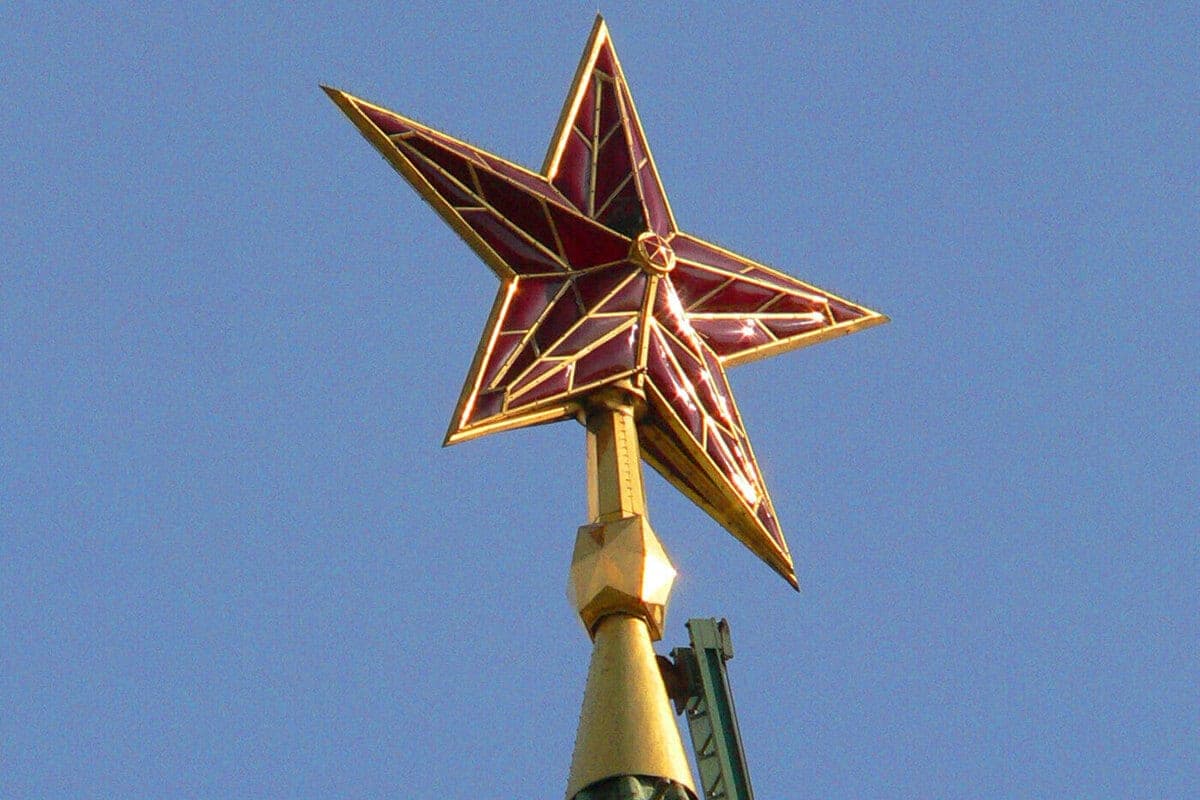
Star spires on the tops of the Kremlin towers are one of the most recognizable images of Red Square
Initially, the first decorated top was on the tent of the Spasskaya Tower. In the 50s of the 17th century, a double-headed eagle was installed on it. A little later, the Russian coat of arms was installed on other Kremlin towers (Nikolskaya, Troitskaya and Borovitskaya). The double-headed eagle itself was made of copper, wood or iron, but was always covered with gold. It is believed that the installation was approved by Boris Godunov, who encouraged talented architects and builders. But according to other sources, the double-headed eagle was installed by order of Alexei Mikhailovich, after the restoration of the Kremlin from the consequences of the fire of 1654. The coats of arms were changed about once a century, but how many of them were replaced by the XX century to say for sure is not possible.
After the October Revolution, the question of replacing the old symbols arose – this was demanded several times by Lenin. But the dismantling had several problems: the high cost and complexity in the technical part, and the lack of understanding what to replace the coats of arms of the previous government. There were several proposals: simple flags or weather vanes, gilded sickle and hammer. The most difficult of the proposals was the full coat of arms of the newly formed state.
In March 1927 a letter from T. Karpov came to the Central Executive Committee. In it, he proposed replacing the double-headed eagles with “our emblem, that is, a star.” This letter in those years was not taken for implementation and as a result, after familiarization with it by secretaries and members of the CEC, sent to the archive.
But why the red star? This is a complex question that has no clear answer. There is an assumption that for the first time the red star was proposed by the Bolshevik Konstantin Yermeev, a former member of the All-Russian Collegium for the Organization and Formation of the Red Army and trusted by Ilyich. Another assumption is that the star appeared thanks to military commissar Nikolai Polyansky. The red star as an emblem became a badge for all personnel of the Workers' and Peasants' Red Army.
Interestingly, the star was originally depicted with two ends to the top, and not to the bottom, as it is now. For this purpose, the Military Department of the All-Russian Central Executive Committee even issued a mass-circulation leaflet “Look, comrade, here is the Red Star”. But later the location of the star still changed to the known position.
The star is not only a military emblem, as it was present on the coat of arms of the USSR, as well as on the flag (since 1924). The red star is a symbol of the Red Army, the work of the people, and the final triumph of the ideas of communism on five continents of the globe.
The development of stars was carried out by the main artist-decorator of the Bolshoi Theatre Fyodor Fedorovsky. It is worth noting that Yevgeny Lancere also had a hand in the project, but Stalin did not like his project.
It was Fedorovsky who developed the project of four stars, thought out the material, size, features and shape. Initially, the stars wanted to cover with gold and even made a request for 67.9 kilograms of precious metal, but later the idea was abandoned because of the Moscow weather, which could quickly spoil the appearance.
The stars were made of high-alloy steel and red copper, with an overhead on both sides, a sickle and a hammer, and they were decorated with a total of seven thousand Ural gems, such as rock crystal, amethysts, topazes, aquamarines and alexandrites. The stars were deaf metal structures lined with red copper and gold on top. The glow familiar to modernity was not inside the stars, they were illuminated from below by spotlights.
Each star had a unique design: on the Spasskaya Tower, the rays diverged from the center to the sides, on the Trinity rays were made in the form of ears, on the Borovitskaya star was two-circuit, and there were no rays on Nikolskaya, it was simple and smooth.
The stars were massive, with a ray span of 4.5 meters and a weight of about a ton.
One of the main ideas was rotation on the axis, for which it was necessary to further strengthen the upper masonry of floors with brick. At the base were bearings, it was due to them that the stars could spin due to the wind.
On October 24, 1935, the first star was installed on the Spasskaya Tower. Especially for these works, specialists have developed an original crane to use it to install the symbol in its rightful place. October 25 set on the Troitskaya, October 26 on Nikolskaya, October 27 on the Borovitskaya tower. On October 28, the installation work was completed. But these aren't the stars we see on Red Square, are they? Yeah, that's right.
In 1937, on the 20th anniversary of October, it was decided to replace the stars with new ones. The main for the implementation of the project was still F.F. Fedorovsky. In the new plan, he took into account all the shortcomings of the old designs – over time, gold and gems faded from the weather, and the floodlights did not give enough glow, because of which the stars merged with the night sky. The size for each tower was also taken into account, on Spasskaya and Nikolskaya 3.75 meters, and the other three had a distance between the ends of the rays of 3 meters.
In 1937, the fifth star appeared on the Water Tower. From gem inserts and hammer sickle refused. Stars should be glazed with ruby glass, which Fedorovsky proposed. This allowed the structures to glow from the inside due to incandescent lamps. The very structure of the glass inside is not single-layer: outside ruby-red glass, the middle layer is transparent crystal, the inner one is opal glass. All this is necessary to sufficiently scatter light throughout the star, so that it is red both day and night. At the same time, the design was faceted with a metal frame, framed with red leaf copper and gold. Lamps inside the stars were also created by a separate plant specifically for the project and had a capacity of 5 and 3.7 kilowatts. By our time, lamps have been replaced by LEDs, which are brighter and more durable than incandescent lamps.
By the way, one of the old stars with gems that used to be on the spire of the Spasskaya Tower has been preserved and can be seen on the top of the building of the Northern River Station in Moscow.


