Music born of destiny
Theater of the author’s musical Triumff again on stage with “Vertical”, one of the most soulful musical works of Karina Sarsenova – a famous playwright, writer, poet, screenwriter, producer, psychologist and philanthropist
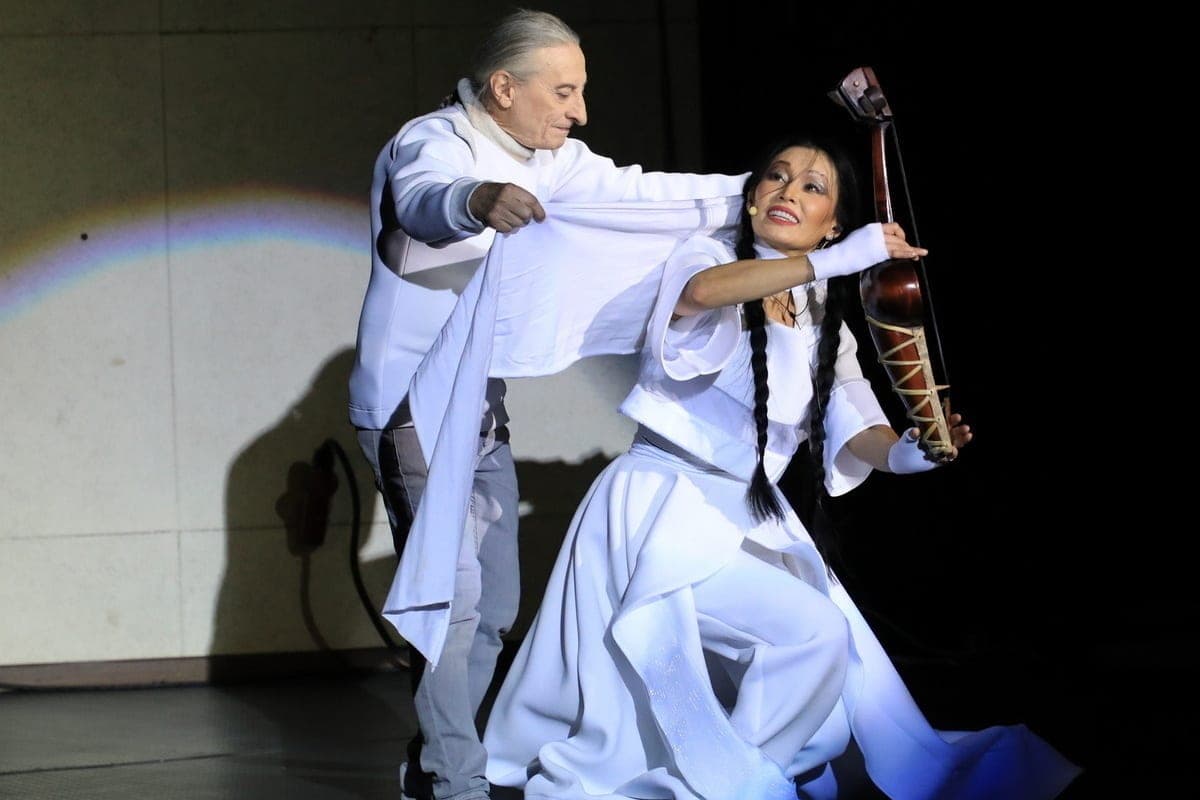
The show took place on Sunday, November 15, at the stage of Dostyk Hall.
The production was directed by the legendary pantomime artist Sergey Chervyakov and the master kobyza, honored cultural figure Yerlan Sabitov. For the musical component was responsible for the famous group Tengri under the leadership of the same maestro Sabitov.
In the center of "Vertical" - the confession of a woman whose path to love was a series of disappointments. Asem remembers three men, each of whom she once took for her knight, but for beautiful images, she repeatedly discovered someone else’s selfishness, illusions and empty promises.
Stage space "Vertical" is built on contrasts of light and shadow: a large stage sinks in darkness and smoke, and the spotlight snatchs from the darkness of the white figure Asem. Surprisingly, the scale of the room does not prevent the emergence of an almost intimate dialogue. It seems as if the heroine addresses himself to every viewer sitting in the hall, trusting the most intimate. Her loose costume, flying skirt, appearing closer to the final, and long dark braids, which have become a recognizable part of the stage image of the singer, complement this expressive play of contrasts.
A kobyz becomes a separate actor, the birth of which begins already in the first minutes of the performance. While Asem lives his history, Sergey Chervyakov, step by step, carves the outlines of the instrument, processes the tree, stretches the strings. Kobyz remains on stage throughout the action, gradually gaining shape and becoming a visible embodiment of the second, parallel, story of the production.
In the Kazakh tradition, kobyz is a subject of special sacred significance associated with the ancient rites of baksa, ideas about healing and interaction with the spirit world. Therefore, his birth acquires an additional meaning: from the experience, the suffering, the overcome arises something capable of sounding, conveying a whole palette of human feelings. In the finale, Asem appears to the audience with a ready-made, wrapped in white sheets instrument, as if with his own creation, the embodiment of the path traveled and found love. And this is the life-affirming nerve of the Vertical: even after the most painful falls, a person is able to rise, keep fearless to love and continue to create his life.
It seems difficult to imagine another artist who could live this story with such dedication. Asem Kopbaeva is full of scenic energy, passion and almost physical devotion to every moment of the performance. She is rapidly changing emotional registers: from the trusting, barely audible whisper of a woman looking for an understanding interlocutor, to the tearful intonations of anger, despair and pain when her voice breaks to hoarseness. And just as freely Asem moves from acting monologue to song, showing an impressive vocal range and musical versatility. Kazakh, Russian and Japanese compositions, modern songs, rock ballads and folk works about freedom, love for the homeland and an unquenchable dream are formed into a single emotional score of the work, holding the viewer’s attention to the last moments.
No less expressive is Sergey Chervyakov. The silent artist speaks body language, plastics and facial expressions. In his movements come to life the men from Asem's memories, her father, her pain, hopes and disappointments. His silence is extremely eloquent, and plastic expressiveness allows one performer to accommodate a whole gallery of images.
“Vertical” can be considered as a kind of excursion into psychotherapy: together with the main character, the viewer tries to get to the roots of her failures in relationships. In her monologue, the image of an absent father appears, who has not become an example of male love for his daughter, and a mother who is present physically, but emotionally detached, absorbed in life and care for the future of the child. In these family circumstances, it’s easy to recognize familiar scenarios that later define our perceptions of intimacy and love. Asem sometimes comes to a bitter doubt about the very existence of a real feeling between a woman and a man. But the range of her thoughts is much broader: it is love for parents and children, and attachment to the native land, and, finally, the ability to choose yourself as a source of inner strength and inspiration. Even the usual image of a “strong and independent” woman, author Karina Sarsenova plays with a fair amount of self-irony.
At the same time, the creators of the play do not offer the viewer ready-made answers, leaving space for their own discoveries. Having lived with the heroine of her fall, despair and liberation from previous illusions, we come with her to the love she has been looking for all her life. But beyond the stage, this path does not end: everyone has to return to their own life and continue to search for their happiness, their feelings, their love, the one that has a special, unique dimension for everyone.
Creating “Vertical”, Karina Sarsenova turned to Sergey Chervyakov, inspired by his art of pantomime. Thus was born the idea of a minimalist in form, but saturated with emotions, where the male silence and the female voice become the poles of stage action.
The production is based on reflection on the multinational and multi-confessional Kazakhstan. This idea is embodied in the stage action: Asem sings in Kazakh, Russian and Japanese, and Chervyakov’s hero creates a kobyz, a symbolic image of the connection of cultures and generations. More broadly, the author’s idea is addressed to peace and mutual understanding as the basis of human happiness and creation: it is from genuine, warm relations between people that something new is born, whether it is a life or a work of art.