How Imperial and Soviet Journals Wrote About Chelyabinsk Artists
Today, November 23, the world unofficially celebrates International Watercolor Day. Inspired by this fact, in our heading “On the Old Pages” we decided to find something event-artistic in the former life of the Chelyabinsk people.
To begin with, we remind you that the International Watercolor Day in 1991 was invented by Mexican artist Alfredo Guati Rojo, who was sure that watercolor can convey the beauty of the world no worse than oil painting. But the debate about the technique of drawing will leave art historians and artists, and just look through the capital magazines of previous times, which make an impression of the relationship of South Urals with fine art. On the eve of the fact that Chelyabinsk is preparing to raise the banner of the Cultural Capital of Russia, it seemed timely to address this topic.
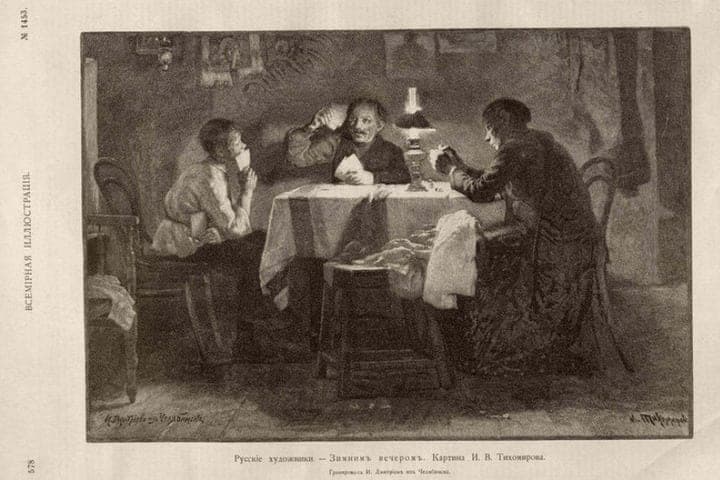
And they were naturally different at different stages, and in this material we do not seek to write their history. Just a quick look at some publications. So, for example, in a very colorful and very popular capital pre-revolutionary magazine "World Illustration" also found a place for Chelyabinsk residents. In No. 23 for 1896 on its pages was published as an illustration of the painting by I.V. Tikhomirov “Winter evening”. South Urals in this illustration was that the picture was engraved for the “World Illustration” by a resident of the city of Chelyabinsk I. Dmitriev. By the way, his work was adjacent to the engraving of another painting, made by a master from Paris Charles Baudet. As they say, where the artists of Paris, and where Chelyabinsk, but after all met on the pages of a fashion magazine.
But fast forward 30 years to 1926. In the magazine "Life of Arts" in the first issue of this year it is reported that in Chelyabinsk opened an exhibition of paintings organized by the society, fashionable then tradition hidden behind the clumsy contraction - Okrabis. The paintings were hung in one of the Chelyabinsk halls at the very end of 2025. Unfortunately, the presence at the exhibition in Chelyabinsk of works made in watercolor, not reported, but the news says that it has “60 with too much oil paintings, and 167 graphic drawings”. Their paintings at the Chelyabinsk exhibition were presented by artists N. Lebedev, A. Samokhvalov, N. Rusakov, A. Korabelnikov, Fekhner and others. The correspondent notes that “many artists touched on revolutionary themes.”.
And the magazine “People’s Creativity” in the tenth issue of 1937 published a little news that “in Chelyabinsk, on the XX anniversary of October, the House of Art Education opened a regional exhibition of children’s drawing, modeling and embroidery.”.
Photo news about another Chelyabinsk exhibition was published in the All-Union magazine "Cultural Life of Trade Unions" in No. 16 for 1938. It reports on the exhibition of paintings, drawings and sketches by amateur artists of the club of the Chelyabinsk Tractor Plant named after Stalin. In the same issue of this publication, a photo was published on which the designer of the Chelyabinsk Tractor Plant A.A. Shcherbin writes a picture at the art studio of the club.
Artistic issues interested the new government not only in terms of organizing exhibitions of paintings. She was also interested in the issues of training new personnel for the art sphere. Thus, in the tenth issue of the capital's magazine "Art and Children" for 1931, excerpts from the order No. 307 on the People's Commissariat for the RSFSR are published. Among other things, this document sets the task of completing the organization of an art technical school in Chelyabinsk by October 15 this year.
As we can see, even a cursory inspection shows that the capital’s magazines in the past quite found in Chelyabinsk reasons and people to cover topics dedicated to artists and their works. And on the International Watercolor Day, which is celebrated today, November 23, it is pleasant to remember this.
Earlier on the topic: Did the Chelyabinsk released teddy bears and sleds in the 30s.