Nikita Vysotsky: Modern cinema does not need my inner capabilities
We had a unique opportunity to meet with Nikita Vladimirovich Vysotsky. In a large interview, he candidly talks about the dialogue with his father decades later and about his own creative path, where he long ago took place as a brilliant actor, director, screenwriter and Honored Worker of Culture of the Russian Federation.
The voice is incredibly similar to my father’s, but the stories are very different
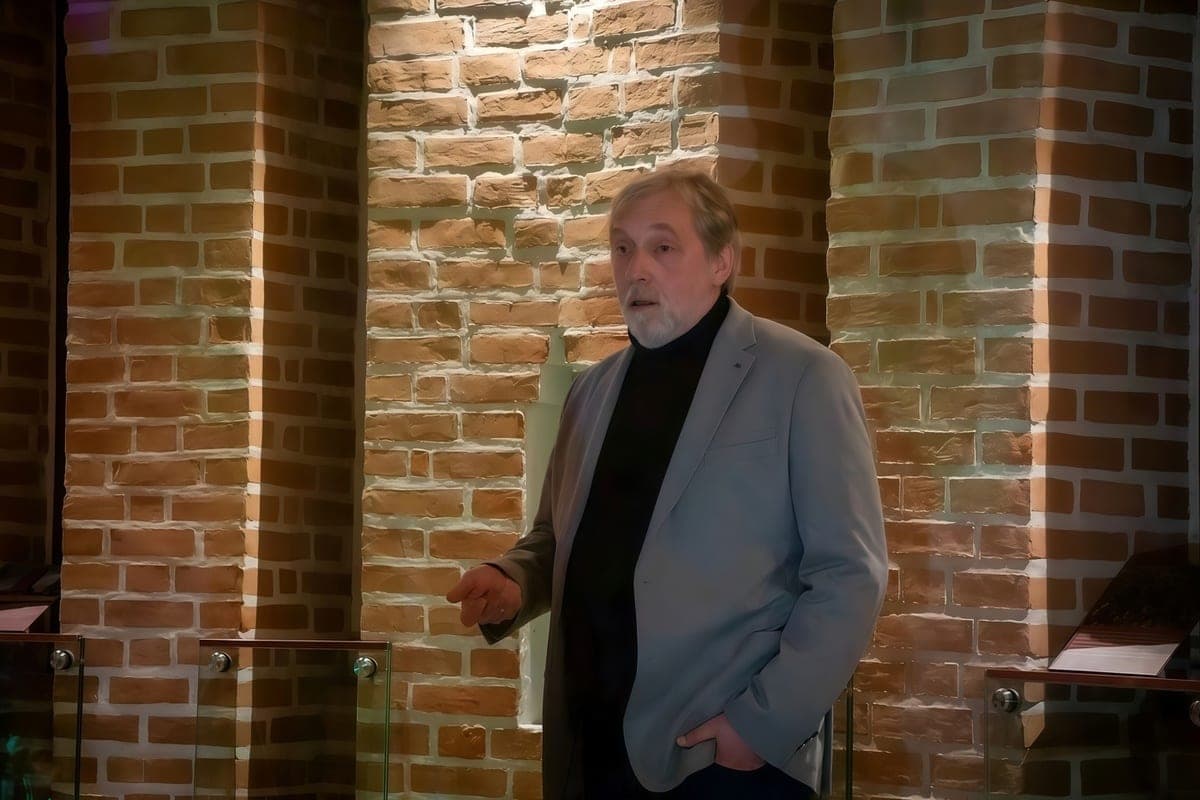
On his birthday Smolensk received a special gift. The festive program in the State Museum “Smolensk Fortress” was completed by the evening of Nikita Vysotsky. In the historical walls of the Tower of Thunder, where time seems to slow down the course, the son of the great bard spoke to the audience about eternal things.
We had a unique opportunity to meet with Nikita Vladimirovich face to face. In a large interview, he candidly talks about the dialogue with his father decades later and about his own creative path, where he long ago took place as a brilliant actor, director, screenwriter and Honored Worker of Culture of the Russian Federation.
I come from childhood
- First, I have to say thank you so much for agreeing to meet. For me it is a great honor, because my journalistic path began with an article about Vladimir Semyonovich Vysotsky.
2016 was the Year of the Cinema, and then I was analyzing the film I come from childhood. The film was partially shot in Smolensk, and one of the roles – tanker Volodya – was played by your father. It seemed to me that this film was an attempt to understand my childhood during the war.
You were born into an acting family, surrounded by incredibly talented people. How did your childhood affect you? When did you realize that you were talented? And was there a fear that you would be constantly compared to a famous father?
- A lot of questions. The position of our parents – mother and father – was that we had no preferences in childhood. We did not study in any special schools, we were not “Bohemian children” in the usual sense.
We were also doing creative things. My brother, for example, was fond of astronomy: he graduated from the Second Moscow Physics School and entered Moscow State University at the Faculty of Computational Mathematics and Cybernetics (VMC). And only, I think, in 1984 he went to the script faculty and became a professional screenwriter.
And I did sports. Although, of course, we did house plays, and you're right: such a family can't help but make an impact. But neither I nor Arkady, in any case, did not admit to either their parents or themselves that they wanted to go on a creative path.
Arkady, I repeat, was immersed in science: he had diplomas of the Olympiads, he went to the circle in the planetarium. I never knew what I was going to do.
When my father died, it was a very difficult situation. But, strangely enough, it was she who allowed me to admit to myself that I love the theater. I’ve been backstage since childhood, and I decided to...
It seems to me that modern people find it difficult to understand that time. We were raised, both by our parents and by our environment, not in the spirit of “becoming successful” or “continuing the dynasty.” If someone were asked in an interview, “What do you want your children to be?”, everyone would say, “Good people,” and it doesn’t matter what they do. We were taught that money is not the main thing, that there are things more important. You have to be better, do the right thing, not for your own benefit.
It must have left an imprint on us. When time changed and success became the main thing, we, as adults, were not ready for this. I understand that I am an “unmodern” person. I come from a childhood where everyone is equal. Not because everyone has the same abilities, but because everyone has the right to be themselves. From a time where your life is valued not by the money you were able to earn, but by something else.
In our Soviet childhood, there were probably many wrongs and injustices. But the people were good.
There's an expression I heard in the nineties that I hate. I was told by a very successful man at the time, who quickly became rich (he had already passed away, I treated him very warmly). He said, "If you're so smart, why are you so poor?"
So I think we were raised not so much by the acting environment, but by the time when something other than material goods was valued.
In Smolensk
- This is not the first time you have come to Smolensk with concerts dedicated to your father. Why is this important to you? Not every child is so proud of their parents
- I don't know, I can't speak for others. It's not a matter of trepidation per se. For me, it became an obligation at some point – not according to my desire, but simply because of the necessity of the profession. I became the director of the Vladimir Vysotsky Museum.
It happened when my father's parents, my grandparents, were already very old. Since then, I have been engaged in Vladimir Semyonovich’s creative heritage: his buildings, the use of his name and, in general, his image. It so happened that I headed the museum, even though I had not originally planned it.
So when I was called to Smolensk, I came. I have already been here once with the choir of the Moscow Conservatory – we performed here at the Philharmonic. Later, on the stage, I performed with Sasha Domogarov. He had a big concert, and he offered to make a joint program, which was called “Vysotsky Roads”.
And now I'm here for another reason. As I found out, your Thunder Tower (a cultural center) has very close ties to the institute where I work. The fact is that, in addition to managing the museum, I teach at the Institute of Culture (IPCC) at the Department of Directing and Actor Skills.
Here, even before me, came my students - the Turkmen director's group. So, coming back to our conversation, today’s meeting will, of course, be related in one way or another to my father, but also to the topic of education of young cadres, which I deal with. It will be called a creative meeting
Hamlet and Zheglov
What do you think your father’s main role and song was?
- The main role, of course, is Hamlet. He talked about it himself, and for all the actors who played it, it’s probably one of the most important roles in life, especially if it’s successful.
Movies are harder for me. He probably did less in the movies than an actor of his level could have done. It happened. But if you choose, then for him was very important picture “I come from childhood”. It is not so much the role as the music. “Brotherly Graves”, which was sung by Mark Bernes, Vladimir Semyonovich himself performed behind the scenes several songs that he wrote specifically for this film. This became possible thanks to his friendship with director Viktor Turov, who had a guerrilla childhood in Belarus.
If we talk about the main roles that determine his cinematic fate, I would mention three: Brusentsov in the film “Two Comrades Served”, Don Guan in “Little Tragedies” is his last role in the movie, Gleb Zheglov in the film “The Meeting Place Cannot Be Changed”.
It's hard to single out one thing. At the end of his life he wanted to shoot himself, wrote scripts in co-authorship, but fate did not work out. He was to film and play in The Green Van (a role later played by Dmitry Kharatyan). He wrote the script for “Vienna Holiday” (along with Eduard Volodarsky) and was also going to stage the film and play there. But it didn't.
In the theater, I think it’s Lopakhin in Cherry Orchard (except Hamlet), Hamlet and Khlopush in Pugachev. Whatever you name, all the iconic roles.
You asked about the song. The song probably isn't the same either. There's a very famous record. Vladimir Semenovich should play the role of hussar Krestovsky in the film “Sannikov Land” directed by Albert Mkrtchyan and Leonid Popov. In the final version of the film, these shots were not included, but on the record he sang three songs in a row: “Wolves Hunt”, “Fiction Horses” and “Russian Domes”.
I think that these three songs are as important in his work as, for example, Hamlet, Lopakhin or Brusentsov in his acting life.
Interrupted flight
- In 1987, Marina Vladi’s book “Vladimir, or Interrupted Flight” was published. I know you were very negative about this piece. In fact, in other interviews I’ve seen, you’ve said that you had a rather difficult relationship with Marina Vladi. In connection with her death (Marina Vladimirovna Vladi died on September 24, 2026 in France) I want to ask: did you manage to fix them?
Nope. Of course, I am also sad and sad. It's just that when death happens, it's an event where everything else -- my relationship with Marina and her relationship with me -- doesn't really matter.
The man left, and now many will probably remember her with a kind, very good word. And me too. She is, of course, a man of extraordinary destiny and diverse talents. She was not only an actress, but also a writer (you know, she wasn’t just writing about her father).
She knew how to keep her whole family: her father died very early, and she, being the eldest, became the head of the family. Later, she had children herself – three adult sons. I just know what a huge role she played in their lives until the very end.
And the role she played in my father's life is certainly worthy of gratitude, understanding and a good memory.
As for our relationship... First of all, it was a long time ago. Secondly, we were very different people. It was felt in my father's lifetime. He tried to bring us closer so that we would not just accept each other, but communicate with her sons, for example. We didn't mind, but we never became close.
With Marina, too, simply could not find a common language. Not because it’s bad or because we’re bad, but because we were different. I think the conflict that happened then was the result of the collision of two completely different worlds from which we emerged.
What was perfectly normal for Westerners at the time was impossible. It's not that the book was too explicit. It was probably one of the first books about a man of the same level as my father, written by a foreigner. Yes, she was Russian in origin, with Russian roots, but lived in France. The book was written in French and later translated by Julia Abdulova.
In general, this is a talented book in its own way, and I think that no one who is interested in Vysotsky will pass by it. That's right. But first of all, it's very subjective. And, I say this about a lot of people that I love and that I think she described unfairly.
Now it seems a trifle: well, wrote something unpleasant, hardly anyone writes. And then the word newspaper or book in our country had a completely different weight. People started, for example, my grandfather, about whom she wrote quite harshly, threatening, scratching doors, calling at night an elderly man, a war veteran, a decorated figure. A lot of people knew that back then. That's what the conflict was based on.
Now, let me repeat what is not written about Marina herself. In connection with her death began to post so many untruths and unpleasant assessments, despite the fact that the person died. It's either good or nothing, isn't it? But time has changed. Perhaps now, if this book had been translated again, it would have excited few people. And then... She was very excited, especially those people she drove through with an asphalt rink.
But she did it sincerely. She didn't mean evil, she just thought so. And she was very surprised by that reaction. She told me bluntly, I wrote what I think. Write your book”.
- So you wrote the script for the film “Vysotsky”. Thank you for being alive.
- By the way, I must also say in her honor: she did not accept this job, did not recognize for me the right to speak so. However, she gave her consent to the release of the film just a few hours before the official release, without this consent, the picture would not have taken place. I got a call and said, "Marina signed." I mean, it was hard for her, but she said, "Yes, I don't accept it, it's not true, it's not true, but it's good." Let him do it. And the painting came out.
So I repeat: she was a very difficult person, but certainly incredibly bright. She played a huge role in my father’s life and therefore in my family’s. And that role, of course, is positive. Not only because she, as she often said, “prolonged his life,” she gave him so much. He went abroad, he saw the world.
It was she who brought him to Hollywood through her acquaintances, and after that there were absolutely serious plans for his work there. That is, she did not only concerts in Paris - she contributed to the publication of his records in France and so on. It gave him the opportunity to try out in the West.
It was very difficult: he was Russian-speaking, he was a poet, for him the main thing was the word. Brodsky was able to write in English, and his father, of course, did not have this level of proficiency. He saw his translations, but he didn't know the language well enough to write it.
However, he felt a completely different level to which she had taken him. That was her level. She not only played The Witch, she starred with Godard, she worked with wonderful Italian directors. She was a world star.
This level of communication, this circle of cultural people - she gave it to him. No one here could give him that.
Father and son
- Tell me, for the 2011 film "Vysotsky". Thank you for being alive, you wrote the script and voiced your father. Didn't you want to play that role?
- There was a time when we tried ten people, probably a variety of actors. Including, by the way, and Sergey Bezrukov. And we realized we didn't have a protagonist. Despite the fact that the actors were decent, all were stars of the first magnitude, but when this actor took the guitar and started singing, or someone just said to him: “Volodya”, there was an intolerable dissonance.
He was a man with his own history, with his own face. We even tried foreigners, found someone to be an actor without a trail of roles in our country. But still, no. And then, when the money was already invested, and the shooting was about to begin, Alexander Naumovich Mitta, who was a semi-consultant, half-partner on the project, said: Here's Nikita. He's an actor. Let him play.
That is, in any case, it would be a gesture that the son plays the father. I don't look like him enough to be indistinguishable, but there's something. I’m taller (as Napoleon said, “You’re not taller, you’re longer” – we have a difference of 20 centimeters), we have a completely different psychophysics, everything else.
But I started mastering the guitar. I am a fairly consistent person in this regard. Once a decision is made, it means a decision. And then, you know, I kept saying, it's like an axe soup story: put an axe in there, and then they put meat in there, so-so, fifth, and then they threw the axe out and ate it.
I was this axe around which, at least, the picture did not stop. They tried classic plastic makeup on me. And in this makeup, I looked not so much like Vysotsky as like Depardieu.
I asked them to take those pictures, but they were still there. We realized that the classic plastic makeup can solve the problem when, conditionally, Sergey Bezrukov someone will shout from the hall “Volodya!”, and he will take the guitar and sing.
We tried plastic makeup on Sergey. It was a very difficult and long work. We started shooting but stopped because the makeup wasn’t ready. Our plastic makeup artist Peter Gorshenin is probably the best, and we have one of the most notable specialists in the world. He's made some progress.
Yes, we were scolded for this mask, they said it was "dead." But nevertheless, it worked as an image. We are not offended when, for example, an actor with a classic makeup plays in Stalin’s mask (Maksim Sukhanov played Stalin’s Weary of the Sun 2). He's up there and taller and everything. It is clear that this is not his face, you can see what is pasted, but the movie turned out cool.
If you go back to the question of whether I wanted to play... I almost agreed, frankly, not really believing in the story and not wanting it. I had been losing weight for several months, doing boxing to get some sharpness, looking for a gait, trying to master the guitar.
But thank God we tried makeup and then played Seryozh. In my opinion, he played wonderfully. It's very difficult. Classic makeup is a huge complexity, people do not understand how difficult it is physically and technically. But he found energy and rhythm and plasticity.
Anyway, I'm very grateful to him for doing that. No one else could.
The One with the Car
- There’s a near-death episode in the film where your family – you and your brother and mom – meet your father in the same shot, where he pulls the car out of the mud.
Tell me, why is the episode so small? Is it because only before we leave do we think about the most expensive? Or, in your opinion, for Vladimir Semyonovich, family and children did not play such a huge role? I'm really interested in your opinion.
- He was a normal person and family was important to him. The other thing is that, of course, when my mother and my father separated, he had another family, and we didn’t play such a significant role in his daily life. But again, he was a normal person, he treated us well and he treated our mother very respectfully.
As for this episode in the film, when I first started writing the script, it was all about flashbacks. The first option was the same story, but the bulk of it was memories that occurred at different times, including at the time of clinical death.
In the original script, there were four of them, but they didn't concern our family. Then there was only this episode. We took it off and, in my opinion, another flashback, but it did not work out and did not go into the picture – just in the process of editing we realized that it was unnecessary.
The idea to make the picture as you saw it (the story of a trip to Uzbekistan) came later. We realized that this story is solid, it does not need additional branches. We did not do a biopic in its pure form, but a drama of several days.
That's acceptable. For example, “26 Days in the Life of Dostoevsky” is also only a part of life, a very short period: acquaintance with his last wife, dictation of the novel “The Player”, will have time – will not have time to pass by the deadline, otherwise he is waiting for a debt pit. Is this a biopic about Dostoevsky? Hard to say, probably not.
Back to the picture, that decision was made. So the car and kids episode fell into place, it was needed, and I think it's the right thing to do. I am told that I put it there on purpose, but it was originally written and should have been there. In the installation, the picture was long and difficult to collect. I remember that shift when everything fell into place and it became clear: yes, it was done correctly.
Love of the Soviet Union
- And then there's your personal creativity. In 2024, the film “Love of the Soviet Union” was released. I literally watched it the other day and was impressed. But the critic Lilia Maslova wrote that everything shown in the film is “richly decorated girl fantasies and ladies’ dreams about how great it is to be a young pretty movie star and a girl of dreams of a brave pilot...” What is this movie about to you? Well, other than that it's obviously based on real events.
- I wouldn't say "how great." The prototype, actress Serova, had a difficult life. She died alone, there was a tragedy with her son and so on. To say that she was “very good” is not entirely fair.
Clearly, that's not what the picture is about. It's such a critic's joke, I understand, but the film is really about time - about tremendous love. About a time tragic, but incredibly beautiful. This is a time that gave birth to more than just aesthetics, architecture, works of art or great science.
This is a time of incredible love, without which we would not have won the war. And the name "Love of the Soviet Union" is not only that the actress was loved by the entire Soviet Union (although it is true, it is a historical fact). It's a story about loving.
The great poem of Simonov that sounds there, the story of the relationship between Simonov and Serova, as well as Serova and her deceased husband, pilot Anatoly Serov (played by Kuznetsov) is a story about this incredible takeoff.
We used to – and I don’t mind it at all – that these were dark years: the 37th year, everyone was imprisoned, Korolev, who then sent Gagarin into space, sat and miraculously came out of there, Meyerhold was destroyed, books were forbidden. That's all unfortunately true.
But in that time, in spite of everything, and perhaps in spite (but certainly not thanks!), there was just a moment of incredible rise of the country and incredible love. And there's a lot of filming about that time right now. They were giant people, both in the cinema and in the theater.
My film is about the love in whose name everything happens. I repeat: the poem “Wait for me” was a creation that every soldier had. People believed it. This was neither propaganda nor propaganda. It was true.
And people with that love left and won a war they didn't think they should have won. The great people won a great victory.
Yes, we have a heroine who herself seems to be from the elite: everyone is offended by the car she drives, the apartment in which she and the pilot lived. It's true. But that was the dream. A huge country built this dream, and did not build for itself.
Everyone says: “Here the miner dreamed of being a Stakhanovite, but everything was taken from him, he was deceived.” But they didn't build for themselves. They were built, I don't know, for space, for love. I have a lot of people that I love and works that have influenced me.
Non-documentary films
- One of the very strong scenes is when the heroine Galina Kovrova learns about the death of her husband right on the anniversary of their acquaintance. She is informed of this behind the scenes, she goes under the light of spotlights and faints. I know that in reality Valentina Serova also learned about the death of her husband literally behind the scenes, but she finished the play to the end and pretended that nothing happened. Why did the film decide to show this pain on stage? After all, it is unprofessional for an actress to show her real feelings on stage
- I was also initially of the opinion that she should finish the show. But this decision was made and I respect it. For a feature film, this is acceptable.
We did not make a film specifically about Serova or Simonov. This is a story that just starts from reality. We can't say "motivated," but we're starting from the real story. And maybe even this was our principle: to do a little differently, to change not only the name, but also the very outline of events.
- In my opinion, your character turned out to be more idealized than the real Valentina Serova.
- I think so. By the way, one very wonderful female director, who knew Serova personally (they lived next door), at first also said: “It’s not so, Serova was different.” But after watching, she said: "If there was a real Serov in your picture, the audience would just be torn to pieces.".
I still have a fantasy about that time. It's such an anthem to the era. And, in my opinion, the actress played this episode well, it was shot correctly. I think that's the kind of scene that allows the heroine to move into a different quality. This scene doesn’t just change her life; it changes her. She's getting a different face. We even worked with makeup artists to make her look years older.
In reality, a lot of things were wrong. I repeat: we did not make a documentary about Serova, or Rokossovsky, or Simonov. This is a film made with great respect for these people.
"Thank God they didn't ask me."
- In 2024 and 2025, two films were released – “Love of the Soviet Union” and “August”. I noticed they had a pretty similar cast. Was it intentional? Are you comfortable working with these actors? I think there are five people who play in both movies.
- Yeah, that happens a lot, but again, it's a production movie. I'm not evading responsibility, I'm not saying "it's not me." Just before the director played a big role in the process of approving the actors, his word had more meaning.
If it wasn’t for the production will, I wouldn’t think about it at all: we worked before or didn’t work. I'm looking at the auditions: is a person doing something that's interesting to see if he's a good fit. I'm convinced by the auditions. I don't care if an actor has played something like this before or never played it. I don't care at all.
But I think the actors in both films are the strength. For example, for “August” for the best male role gave “Golden Eagles” Pasha Tabakov, Sergey Bezrukov and Nikita Kologrivoy.
Moreover, I will tell you honestly: for example, Nikita Kologrivoy, according to the tests that I saw (I did not conduct them, but I saw them), I would not take. But a decision was made, and I think it's a brilliant choice. Thank God I wasn't asked because Nikita is a wonderful actor. The producers knew how much he could do.
I thought Nikita and Seryozhya (who is a much more experienced and very good actor) and Pasha were the best combination.
So the episodes don't go away
- One of the bright, in my opinion (albeit episodic) roles is the role of enemy agent Kazimir Pavlovsky, played by Roman Vasiliev. I specifically opened both the novel and the movie "In August of the 44th." Neither here nor there is the hero listed as handsome Apollo. It is said that he is strong, strong in spirit and character, that although cruel, he knows how to love. But nowhere does it say it's beautiful.
And you take on this role of a fantastic handsome man, and because of this, his death is perceived especially tragic, although, it would seem, should not
- That's why we did it. Vasiliev is a very good actor. It's hard for me to judge his other roles, but what I witnessed on the court where we worked was very good.
And for the film, it was important that the episodes do not “disappear”. Even people who almost pass by are big, they remember. For example, the story of a woman who collects information at the station.
If in the book about her almost "scattering in and out" is told (there are memories of Tamantsev from another period), then in the film it is a huge character, a huge volume! How she changed, how she suddenly woke up, when she was opened!
Therefore, Roman Vasiliev was chosen – these episodes were not supposed to be functional, they had to be very bright.
Or another memorable episode of Kirill Kuznetsov, who played captain Igor Anikushin, who blew up the truck. His character is not like the one in the book. In the piece, it's much flatter. But that was the kind of episode that was requested here, and Kirill, I think, played it very well too, even though the shooting took literally a few days.
It seems to me that in this picture there were people who could make a candy from a small piece of text. There is the last role of Roman Madianov (the actor died on September 25, 2024 – author’s note).
The picture went well, had many positive and negative reviews. As far as the actors are concerned, I think everything is fine.
Not a "cinema" man
- What are your plans for the future? What would you like to shoot?
- I'm not a movie person. I feel very comfortable with what I did in the movies. Not because I'm so humble, but because I'm a theater person. I cannot get used to this cinematic rhythm, to film relationships: people quickly converge on the project, disperse, and then may not even know each other when meeting.
I don’t know how to work at this level of interpenetration. I need time. Theatre gives that time, at least I think. No movie. We are going to finish the picture we are working on. But let me be clear: I do not have such a thing that “I will finish and take a new project now.”.
I’m like that parrot from the proverb: “Go like that,” said the parrot as the cat dragged him by the tail. I work out of necessity. I have friends who say, “You have a job!” We want one, and we don't have one. You're already on two other projects.
So I don't know... Now we need to finish the work that is going on. She still needs at least a big set, I think for a month, maybe more. I have a job that I'm supposed to sign for next year. But I'm not sure I'll sign it.
First of all, I’m many years old – sixty-two years old. Today I was dragged to your tower (Smolensk Fortress State Museum), I get up and think: “How will I get out?” Is it hard to breathe
In every sense it is difficult: both physically and emotionally.
And then, I repeat: modern cinema, not only Russian, as it seems to me, does not need my internal capabilities and my skills. Cinema goes in the direction of greater creativity, technology and such “made”.
And I love a movie that, even if it’s on its knee, is like Godard’s Last Breath, which is my favorite movie. A film in which production is subordinated to creativity.
I'm going to the set, the camera's already standing. I haven't made the scene yet. I understand why: there is a storyboard, there are deadlines, there are expensive actors who should shoot for this day as much as possible, if they were brought. But I can't stand it. I have to, and I know I'm not needed.
When I start doing something, the guys I work with are respectful. They're rearranging the camera even though they've already laid out the rails. No reproach, nothing. But I understand that as a result we are getting out of timing, a lot of people will go into recycling.
In the loop..
- And the last question is, what work, a film or a role, is the most important in your creative life?
- I'll tell you this: I think it will happen at some point. My brother and I have some ideas. He asked me several times, “Let’s do it together.” Let's write together, we'll find a manufacturing company together! Thanks to our name, we can do that.” And I refuse, because if such a project “breaks down”, then only in the loop.
But I think something like that will happen. There will be something I really invest in. If you have enough strength, if you have enough health, of course.
I have a few ideas, but it’s not necessarily them. Maybe it will be some completely random story.
Of all the paintings I made, I invested the most, of course, in Vysotsky. Thank you for being alive.” Although I wasn't a director there, I was basically a producer, a writer. I was just humanly invested in it. I remember how it happens, how difficult it is, how painful it is sometimes, because cinema is a production, not a sentimental thing. And yet, if this happens, if such work arises, I would go and spit on some benefits, disadvantages of the contract and even risk.
This is what my brother Arkady offers. He said, “Come on, let’s not wait.” He is also, I think, not fully realized person, he is a very good screenwriter, very talented. He says, “I don’t want to slam the door for good-bye, but I want to try to do something for myself.”.
Another thing, very often it happens that a person has invested everything from himself, everything is serious, and everything is right. And the result was disappointing.
You know, I was at the screening, in my opinion, of Bondarchuk’s (senior) film Boris Godunov, in which I starred in the extras. The audience left the premiere! Sergey Fedorovich was sitting with his loved ones, turned around, stood up and said: “My people did not understand me.” Just kidding, not kidding.
But actually, if you look at this picture, I know what he wanted to do. I understand how he warned this country, this people, about the impostors, about what was coming. He is a great director, actor and person. He probably just had an antenna there. No wonder he took this picture, he played himself. I was on set, I was a student. I saw him ploughing in this picture, and she "did not go."
It happens. And it happens the opposite: “left foot” filmed – “Five evenings” by Nikita Mikhalkov, for example. You know? In my opinion, this is his best painting.
- Thank you so much for taking the time to meet! I wish you creative ideas!