Sampo is back on the music scene after 70 years. To some extent, a historic moment has come for the audience - several generations of music lovers have spent their lives without this action. This is how our Victoria Nikitina saw version 2.0.
In the Karelian-Finnish epic "Kalevala", the Sampo mill is a magical object forged by Ilmarinen for the bride's ransom in Pohjela. Moreover, he used materials more for a witch potion than for a tangible mechanism capable of grinding anything - a bunch of wool, a winch feather, cow's milk, a particle of spindle, a grain of barley ... Researchers easily discover these symbols - all these signs refer to different branches of agriculture, that is, necessary for human production.
Wisdom is clear - happiness for people consists in prosperity, in the satisfaction of basic needs.
The magical mechanism was eventually stolen, and later lost, broken, but even the wreckage of the sampo was useful. Here, too, everything is clear - the dream of providing easily does not leave the minds of people. But the concepts of happiness and prosperity change over time. We don't need a car that grinds salt, because there's a lot of choice in the store. Therefore, in the concept of the authors of the new version of the legendary ballet of the Musical Theatre "Sampo", the magic mill produces energy. In this sense, the Theatre very logically and beautifully held a promotion of the premiere in partnership with Petrozavodskmash-Rosatom. A month before the stage release of the performance, a presentation of music for the ballet took place right in the huge factory shop. A powerful and beautiful idea.
The 1959 ballet used the symbolism of the folk tale to demonstrate the national identity of the republic, to raise the spirit of people who experienced losses, the most difficult period in the life of the country. The original music of Helmer Sinisalo was created for the production, which became recognizable for several generations of residents of Karelia. It has become part of our cultural code. The performance lived a record number of years in the repertoire and was filmed most likely due to the loss of relevance of the language of dance.
The idea of staging a new version of the legendary ballet did not disappear, there was a lot of talk about it and there is also historical justice in the fact of the release of the new ballet.
The choreographer Kirill Simonov faced a difficult task. The return of the stage legend provides a field for comparisons. Simonov was not afraid to speak the modern language of dance. Choreography author, recognizable and relevant. The performance dedicated to the folk epic masterfully preserved the traditional elements of Karelian dance and classical canons within the framework of modern ballet.
As well as for the production in 1959, new music was created by composer Efim Podgajets. But our contemporary paid tribute to the work of his predecessor, the most important themes from Sinisalo’s composition were included in the musical canvas. The music of Efim Podgaits easily fits into the style of the musical range of modern man, but at the same time remains an original significant work, emphasizing the importance of the play for Karelia.
In the logic of translating the legend into an understandable and attractive language for the modern viewer, the entire production team worked. It is impossible not to mention the work of production artist Alona Pikalova, costume designer Tatiana Noginova. Alona used drawings by the artist of the first version of the ballet Andrei Shelkovnikov to create supercurtains semantically separating the scenes of the play. Laconic scenography, however, was multilayered, containing many symbolic references. For example, the Sampo vault is a huge pine tree referring to the famous Lennroth pine. The ascending stage - the path of the hero, the fence with the skulls of animals - the realm of magical pagan gloomy Pohjela.
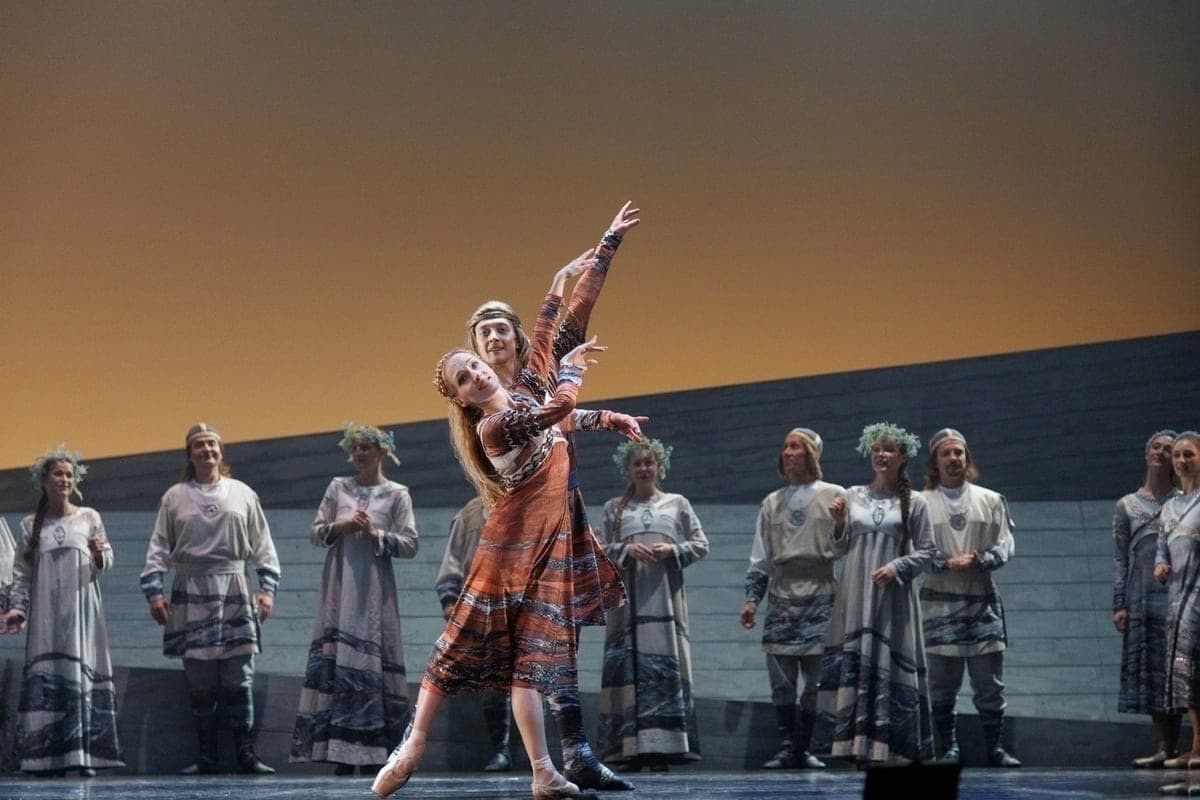
Tatiana Noginova invented an original fabric for making costumes based on paintings of Karelian nature.
In the decision of the images of the play, too, a lot of interesting. The appearance of the old woman Louhi has always been controversial among the researchers of the epic. In Kirill Simonov’s decision, Louhi (Anna Markova) is a very seductive woman who enchants Kalevala’s character Lemminkäinen (Anton Diachok) with what she needs. In the play, the Ice Maidens appear, who lull Vainemeinen (Dagba-Dojo Garmaev) and in this scene the ballet finds its voice. In modern trends, the director uses the soloist and choir of the opera troupe of the theater.
The bride of Ilmarinen is distinguished in the performance of Love of Earthling. Beautiful clean performance of a gentle girl's party. In accordance with the courageous drawing of Ilmarinen (Denis Tarasov).
In general, the ballet made a strong impression on the audience.
I congratulate the theater on its premiere and traditionally wish the show a long life.