A motorist's paradise
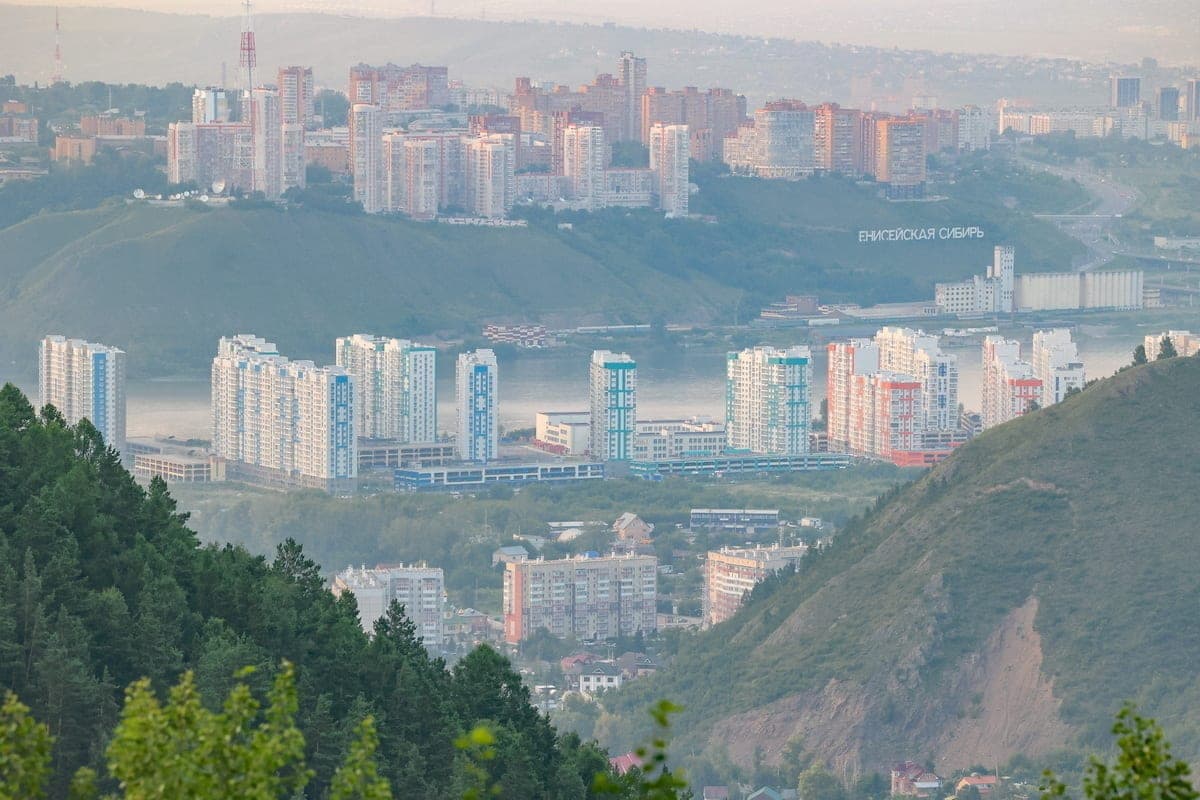
Almaty Krasnoyarsk is an unusual city because it stands on the Yenisei River, which divides it into two parts - left-bank and right-bank. The city is located in a basin surrounded by hills and hills, which the locals proudly call the mountains. Let it be so, although by Almaty standards they still grow and grow to the mountains. But the city is problematic because of the “mountain” cordon to grow in breadth, so it creeps in length, along the Yenisei, which contributes to the specifics of road traffic.
The first thing that catches your eye when you enter the heart of Siberia is the competent road infrastructure. Despite the fact that Krasnoyarsk was founded in 1628, and today the population is almost 1.3 million people, it seems that it was designed with a margin of safety of three million so. Wide streets, many interchanges that easily unload the main arteries of the city. Yes, the historical center is surrounded by small streets, but it is very comfortable to drive there.
Cycles of many traffic lights also do not work in Almaty: as a rule, they are divided into four phases, alternately passing streams from each side. In Almaty, almost everywhere, the system of two phases, when first simultaneously let oncoming flows, then just synchronously perpendicular.
Another distinguishing feature is dynamic driving. The speed limit is 60-40, just like us. But! In Russia, the non-penalty threshold of speeding 19 kilometers per hour against nine in Kazakhstan. That is, the city is more dynamic, since the average speed of traffic is 70-75 kilometers per hour. Remarkably, the locals rarely exceed this limit and for the most part, everyone moves in unison. However, there is a feature: from the traffic light, everyone starts as if they feel in the Formula 1 Grand Prix. Fast start, followed by measured driving within speed limits. Why? I could not find the answer to this question during my three weeks in the city. But motorists rarely use horns, which adds another plus to the comfort graph.
It is also good to note that the vast majority of motorists give way. As a foreigner, I often found myself in the wrong lane, and every time the friendly Krasnoyarsk people let me in. Little change, that's nice.
What the problems in Krasnoyarsk are with the quality of the roadway: pits, bumps, deep cracks. It was like being in Almaty in the 2000s. Another nuance is congestion. The same 2GIS shows yellow or even red mode, when more than four cars gather at the intersection. In general, you very quickly join the Krasnoyarsk rhythm, which is very comfortable to be in. It is not clear how such traffic can generally get into an accident, but they happen, albeit incomparably less often than in Almaty. Compare the statistics, they will surprise you.
Living corner
More positive emotions can be gained by walking. Krasnoyarsk is a city where you can and should be a pedestrian for a while. In the city there are many zones for every taste and age. Undoubtedly, the most popular place for walking is the island of Tatyshev, located in the very center of the city, surrounded by the mighty Yenisei. It has a convenient access both from the left bank and from the right bank. Large parking areas, entrance to the territory - all free.
Almost from the threshold of people meets a kaleidoscope of rental vehicles: bicycles, rollers, scooters, bicycles and electric rickshaws. All this eco-transport is in great demand, because Tatyshev is really big - 637 hectares. For comparison, the Central Park of Culture and Recreation in Almaty has a total area of about 47 hectares.
According to various sources, from 53 to 60 percent of the city's residents regularly engage in physical education and active recreation, which is clearly visible from visitors to the park. It rarely meets a person with a cigarette in his teeth, and there are no drinking establishments / shops there in principle. On the island there are many sports grounds, bike paths, towns and other areas for various activities, as well as just leisure.
Another feature of this zone is the phenomenon, which demonstrates that the wild world can harmoniously coexist with man. The island is simply strewn with gopher burrows, the guests of which will gladly take carrots or any other delicacy from the hands of the tourist. If you approach the coastline, then there will be wild mallards waiting for you, which also expect from visitors not only attention, but also something tasty. In the quieter corners of the island you can see chipmunks, hares and foxes. All this wild world without cages and fences exists in the center of the city.
The second most popular walking area is the Central (left-bank) embankment, which is considered one of the hallmarks of the city. In addition to a unique panorama of the most full-flowing river of Russia in walking distance there is a whole string of museums, a river station, a communal bridge with a ten-ruble bill and many more interesting things. We emphasize that the city has not one, but four main embankments, each of which is landscaped and unique in its own way.
The historical center of Krasnoyarsk itself is also diverse, and along with modern architecture on many streets of the city you can see merchant architecture of the XIX century and other ancient buildings. One of these architectural monuments is the Paraskeva Friday chapel. This is the famous Orthodox chapel and the main symbol of Krasnoyarsk, located on the top of the Guard Mountain. On the site of the chapel in the XVII century was a wooden watchtower. Cossack settlers carried guards there in time to notice the approach of enemies to the Krasnoyarsk prison. In 1805, the first wooden chapel was erected on the mountain, and by the middle of the XIX century the existing stone building was built. From the top there is a stunning view of Krasnoyarsk, bridges across the Yenisei, rowing canal and even the distant contours of the Sayan Mountains. A place where you want to stay longer.
Frozen time
Even more opportunities and amazing landscapes open to those who are used to and like to walk on the mountains. Even in the city you can find a route that for many can be a real challenge. We are talking about the stairs to the Torgashin Ridge. This is the longest ladder not only in Russia, but also in the whole CIS. The route consists of 1683 steps with an altitude difference of about 240 meters. For comparison, the health ladder on Almaty Medeu has about 850 steps with a difference of 100 meters of vertical ascent. Panorama from the Torgashinsky ridge gives you the opportunity to enjoy the incredible velvet of the Siberian taiga.
For those who find such a march-throw an easy walk, there are more loaded routes. There is no competition in the Krasnoyarsk Pillars National Park. It is one of the most visited natural places in Russia, annually receiving more than a million tourists. However, it is not entirely clear where the statistical data come from, because the entrance to the national park is also free. In any case, we have become part of this statistic this year.
In addition to the untouched nature, the main attraction of the location are the so-called pillars - formations that took more than one million years to form. According to the certificate, about 400-600 million years ago, magma poured out on the place where the park is located, which froze in the thickness of the earth's crust, turning into a solid rock - syenite. In subsequent geological epochs, under the influence of wind, water and sun, soft rocks collapsed, and strong syenite remains stand in the form of giant vertical columns and towers. In the outlines of many of them you can see the images of animals and even people. In total, there are about 99 named cliffs and about 500 common syenite outlets scattered throughout the park. The most famous of them: the First and Second Pillars, Grandmother, Granddaughter, Grandfather, Feathers and Lion’s Gate are the points that we have designated as mandatory goals to visit.
Since it is impossible to climb to the national park by personal transport, the whole count is solely on your strength and perseverance. According to the tourist calculator, the route mentioned above was about 17-18 kilometers. Together with the inspection of each location, we got about 21 kilometers, which took all daylight hours. The insidiousness of the route is that the first kilometers of the path are very comfortable, the trail is laid in the shadow of the crowns of Siberian trees along the Laletina River. But then the angle of rise becomes steeper, and the most protracted area is a talking and fully justified name Pykhtun. We didn’t give up, we closed our prank on the target list.
There is also a star in the national park - Krasnoyarsk Stolbist Andrei Andronovich Didukh (local call him Spider-Man), who at his 72 regularly arranges a show on the rock of Peria (height 42 meters). He deftly and without insurance climbs the rock, and then descends from it upside down. We will give an interview with him in a separate publication.
On the border with the national park "Krasnoyarsk Pillars" there is another tourist zone - the all-season sports and recreation fan park "Beaver log". The cable car works there all year round, lifting guests to observation decks with panoramic views of the surroundings and taiga. In winter it is a popular ski resort with slopes of different difficulty levels. In the warm season, there is an outdoor heated pool and attractions, there are many pedestrian ecotropes. Among others, Rodelban is very popular - an extreme attraction that combines elements of bobsleigh and roller coasters, where two-seater sleds move along the track at a speed of up to 45 kilometers per hour, carrying the rider through the taiga massif.
Summing up, we can say with confidence that one trip to Krasnoyarsk is clearly not enough to visit all the sights. Yes, you can enjoy local beauty and even feel the spirit of Siberia. But he is the one who wants to return to these places.