What we do not notice in the city: the exhibition of Mila Nishatova
In the Moscow Museum of Modern Art opened a personal exhibition of Mila Nishatova – “Sometimes water moves towards the moon”
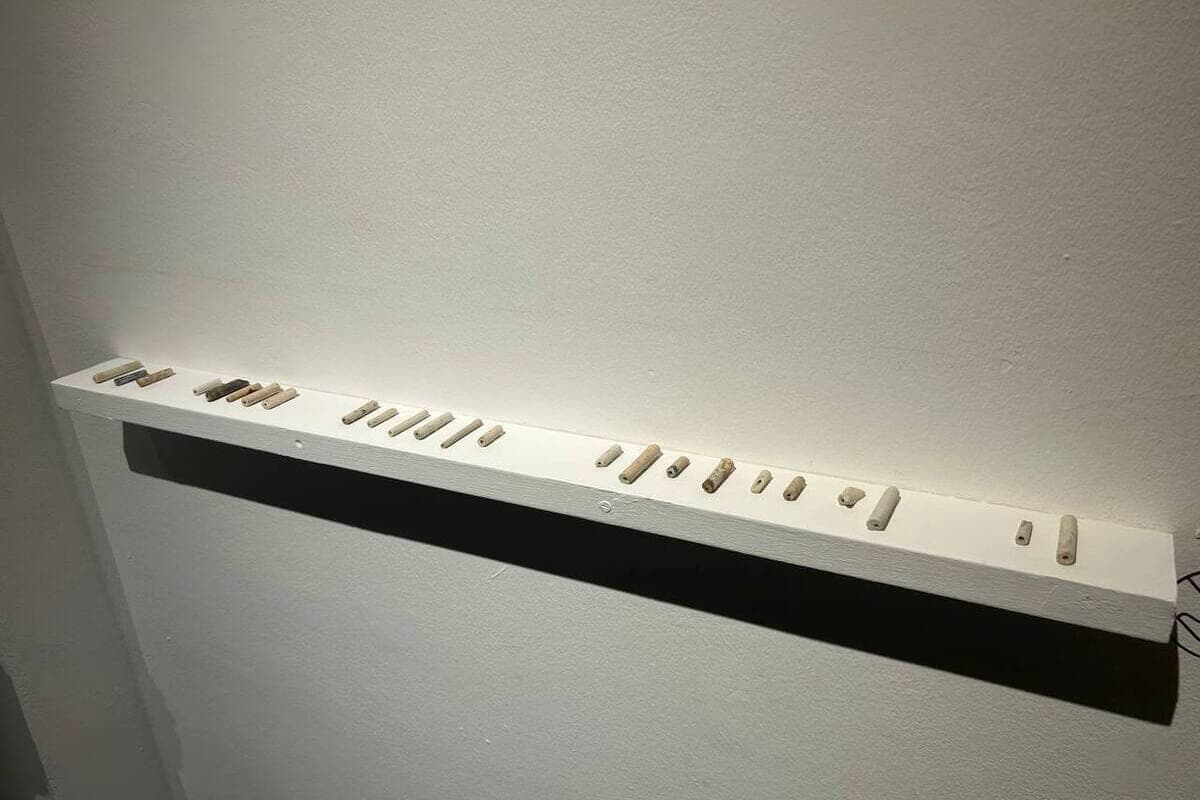
Entering the exhibition hall, there is a feeling of confusion, and in my head the question: “What is this?” How do I understand that? At the entrance, the first thing that catches the eye is two glass tanks with neon-salad water located in the center of the room. They are girdled in metal pipes, as if chained in them, from each aquarium there are two tubes to the pumps. It felt like it was in a secret laboratory, and these aquariums were supposed to live mutated amphibians. Looking around the walls, you notice a picture of the sea from above and a movie — modern footage, we see how strange tubes are discovered, a bucket in the river, then a black and white movie is shown, which shows the production of these strange objects found on the riverbank. And after looking more closely in search of an answer to the question, what is happening here, you notice those very incomprehensible objects - elongated sticks, hollow inside.
The exhibition presents the history of one phenomenon - ebb and flow, and the history of one object - pipes. Through the tanks, the viewer is shown how the tides occur in urban water bodies. This process is not like the sea on the islands, which can be seen with the naked eye. In the urban environment, they are manifested not by bright waste and water parishes, but by changes in its level in reservoirs and in the riverbed. Through the pump, the water is distilled from the tank to the tank, at this moment in one aquarium there is a decrease - a decrease in the water level, and in another tide - an increase in the water level. Metal pipes in which aquariums are chained symbolize scaffolding - they are the city itself, which contains both rivers and reservoirs.
The most unknown objects are fragments of smoking pipes made of white clay. The film, broadcast in the hall, is the key to unlocking their mystery, telling the story of their origin: from their discovery to production and creation. This craft appeared at the end of the XVI century in Holland, in the era of the popularity of tobacco use, after it spread to England and later became popular. Now the creation of such pipes from mass use has moved into a narrow channel, and products are more in demand among collectors and connoisseurs.
One amazing event invites us to think about what we are used to noticing. The ebb and flow, the mechanics of these phenomena most know and can even imagine, but most likely the majority will represent the sea, and how it happens in our urban area and did not even think. Shards of pipes, which were once a common craft, and many with accuracy could tell from these pieces what kind of object it was. And to modern man it seems a mysterious and amazing subject, the mystery of which has to be solved. And this despite the fact that the technology of production and the objects themselves have survived to our days!