Creativity of Leo Tolstoy through the eyes of the artist: In Smolensk opened an exhibition of Alexander Zorin
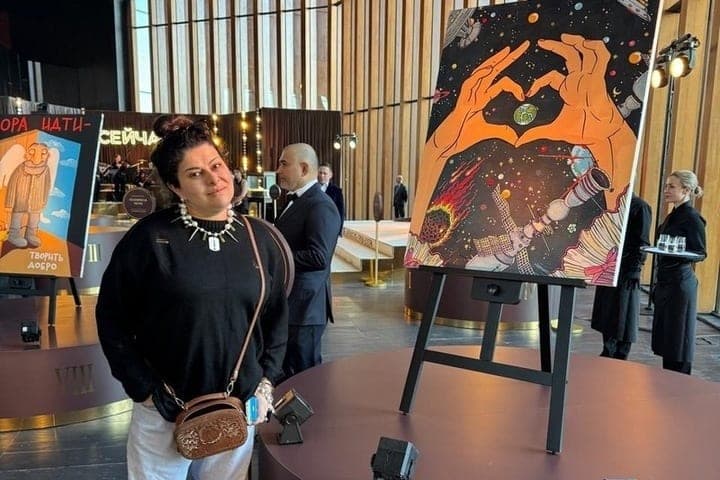
Within the walls of the Smolensk Drama Theater named after A.S. Griboyedov, on the eve of the big premiere of the play “Anna Karenina”, a personal exhibition of the artist Alexander Zorin entitled “The Artist’s View on the Writer’s Thoughts” opened.
Within the walls of the Smolensk Drama Theater named after A.S. Griboyedov, on the eve of the big premiere of the play “Anna Karenina”, a personal exhibition of the artist Alexander Zorin entitled “The Artist’s View on the Writer’s Thoughts” opened. This event became an independent artistic statement, a bridge between visual art and great literature, preparing the viewer to meet one of the most complex novels of world culture.
Dialogue through the century
The idea of combining theatrical premiere and art exhibition arose spontaneously, but proved surprisingly accurate. According to Andrey Shanin, Director of Theatre Development, cooperation with Alexander Zorin is a good tradition. A year ago, the artist created a visual rhyme for the premiere of Bulgakov’s “Fatal Eggs”. However, if then it was a dialogue with the absurdity and satire of the XX century, today Zorin took up the block – Lev Nikolaevich Tolstoy.
- We want our audience to know not only the language of the theater, says Andrei Shanin. Our format is an ecosystem. Yesterday we had an amazing lecture by Irina Viktorovna Romanova on the literature of the stream of consciousness, today – painting, and tomorrow – the premiere. We're digging deeper. If the language of the theater is not always possible to convey the complexity of the novel, we are looking for other ways. The audience should leave the theater richer than they came.
The exhibition, assembled in just two weeks, was the result of this desire. It does not illustrate the plot - it translates the complex psychological vibe of the novel into the language of color, light and texture.
The role of detail and flow of consciousness
The central place in the exhibition is oil pastel. At first glance, this material may seem too soft, lyrical to describe the tragic fate of Anna or large-scale philosophical deviations of the author. However, as Alexander Zorin himself notes, pastel proved to be an ideal tool for transmitting the “stream of consciousness” that Tolstoy so masterfully wielded.
“Tolstoy is a writer of details,” the artist reflects in an interview at the opening. - Oil pastel loves detailing, but it also allows you to go into a stroke, in half tones. When I read a piece, I pass it through me. What I feel is very important to convey.
In the works of Zorin there is no photographic accuracy of costumes of the era or a detailed drawing of the interiors of the estates. Instead, the viewer sees what is usually hidden behind the text: the inner tension of the characters. Zorin’s pastel is velvety, deep, it seems to absorb excess light, leaving only the most important thing – emotion. This fits perfectly with Tolstoy’s method, which, according to lecturer Irina Romanova, anticipated the literary experiments of James Joyce, immersing the reader in the continuous stream of thoughts and feelings of his characters.
Geography of the soul
The exhibition is not limited to Anna Karenina. Tolstoy for Zorin is a whole universe, and the artist generously shares it with the viewer. On the walls of the theater there are works of different years, united by the theme of the search for truth.
There are paintings dedicated to “War and Peace” and “Haji Murat” – the favorite works of the artist himself. They feel the space, air, Russian nature, which, according to Zorin, Tolstoy conveyed the language of incredible beauty.
- I was always amazed at how well he was able to convey nature, says Alexander, and quotes passages from Haji Murat.
A special place is occupied by a work inspired by an episode from the life of the writer himself – the so-called “Arzamas horror”. This is a watershed moment in Tolstoy’s biography when, in a hotel room in Arzamas, he was suddenly overwhelmed by an irrational, animal fear of death.
- That’s what I wanted to show too, the artist points to one of the paintings. - Right side. This is the moment when a person is left alone with the abyss.
In these works, pastel becomes disturbing. Colors thicken, lines lose confidence, conveying the existential horror that would later become the foundation of late Tolstoy's philosophy.
The color of tragedy and the light of hope
One of the most interesting questions asked the artist at the opening was about color: what colors Tolstoy? Is it sad and inevitable?
Zorin does not agree with the philistine idea of the gloom of the classic. In his palette there is a lot of cold air, gray Smolensk and Tula snows, but there are also warm, almost icon-painting ochres. In the painting dedicated to Levin’s return to the village through a snowstorm (one of the artist’s favorite works in this exhibition), there is no sense of death. On the contrary, in the swirling snow, in the heavy sky, cleansing is read. This is the “scene from the novel” about which the theater speaks: not just a household sketch, but a philosophical search for happiness, family and one’s place in the world.
- Yes, the question of happiness, the question of family, the question of loneliness in the family and without family – this is reflected in the paintings, confirms Zorin. His work lacks didactics. They do not teach how to live, they show what it is like to live on a rupture of the aorta, how Anna lived, and what it is like to seek a foothold in the ground, as Levin sought.
Master of the Russian Province
To understand the scale of the phenomenon that Alexander Zorin is for the contemporary art of the Smolensk region, it is worth turning to his creative path. Born in 1983, a graduate of the Art and Graphic Faculty of the Smolensk State Pedagogical Institute, he has been a member of the Union of Artists of Russia since 2010.
Zorin is a convinced landscape painter, a devoted knight of the genre. He is known as a singer of a departing Russian village. Abandoned houses, forgotten photos, abandoned furniture - the artist feels the uselessness of these things, their imminent death and as if trying to prolong their life through the canvas.
However, the technique of oil pastels, which he elevated to the rank of high art, allowed him to go beyond pure landscape. If earlier his works were permeated with light nostalgia and lyrics, in recent years they have developed a different depth. Tenderness was replaced by drama, and the “smoke” turned into a powerful expressive tool.
The geography of his exhibitions in recent years is impressive: Moscow, St. Petersburg, Novosibirsk, Krasnodar, Bryansk... Zorin is an artist in demand far beyond his native region, but always returning to his roots. His participation in the drama project is not just an order, it is a meeting of people for whom Russian culture is the main source of inspiration.
Creative community
The exhibition in the dramatic is the result of the work of a whole circle of like-minded people. As the photographer and musician Alexander Gubarev told, he became the link between the artist and the theater.
“Sasha before that painted a philharmonic,” recalls Gubarev. He was interested in the theme of the theater. He was accepted with joy, issued a pass, allowed to go to rehearsals. He spent time here, drawing.
This openness of the theatrical environment allowed Zorin not just to come up with paintings based on the book, but to soak up the atmosphere of the future performance. He saw how actors work, how the director builds mise-en-scene.
Colleagues in the workshop also highly appreciate the contribution of Zorin.
Artist Tatiana Kondrat does not hide her emotions:
- I even get goosebumps right now. I wouldn’t even compare it to anyone, because for me Alexander Zorin is a separate value. I always follow his creativity. His talent is striking... Once we were in the open air, I came out with a little sketch, and Sasha came out with three huge swamp landscapes. And I heard that he paints in any weather and at any time of the day.
A look at the final
Anna Karenina is not a story about a woman being hit by a train. It is about how duty and feeling, nature and society, life and death collide in a person.
Smolensk residents will be able to enjoy the exhibition in the next two months, and then, perhaps, they will be able to see new joint projects of Smolensk artists and theatergoers.