In Birsk opened a museum of thousands of kettles
Birsk continues to amaze with new cultural projects
It would seem that it is a very small city, and how many things are interesting here: tourists are attracted by souvenir shops and master classes. This summer, the museum "Chirkov Merchant's Shop", which has long become one of the main tourist attractions of Birsk, received an unusual continuation. Now the new point of attraction for tourists has become the museum "1000 kettles".
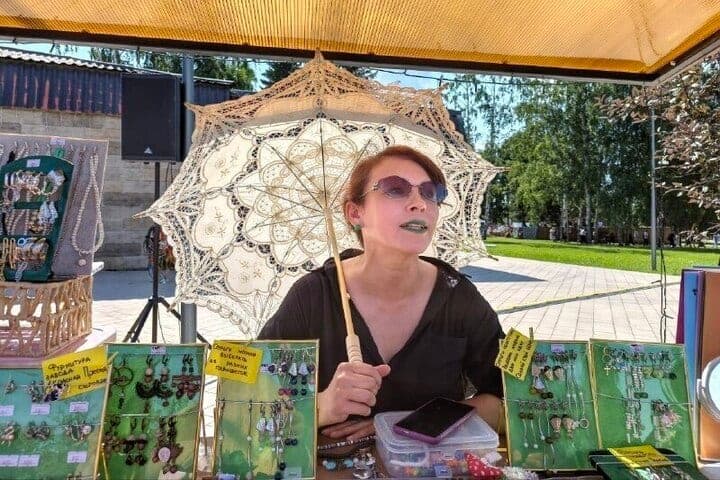
The author of the project Elvira Fakhrislamova has been developing a network of creative spaces in Birsk for several years, united by the history of the merchant city. It includes the “Shop of the merchant Chirkov”, “Labaz of the merchant Chirkov”, the museum of ceramics and pottery, the workshop “Four Elements”, and now a unique tea salon.
It took almost two years to create a new space. During this time, the premises were renovated, the concept of the exposition was developed and thematic halls were decorated, conveying the atmosphere of a leisurely merchant tea party.
During the tour, visitors get acquainted with the history of domestic porcelain, learn about the fate of the owners of famous factories, the features of painting and the development of tea culture. The trip ends with a traditional tea party prepared according to historical recipes.
The idea of a new museum arose a few years ago, when Elvira Fakhrislamova was approached by a resident of Karaidel district Irina Pushkareva. Salon - because in this museum you can get acquainted with more than twenty porcelain factories of Russia, near and far abroad. In addition, it will be possible to drink tea as Dostoevsky, Omar Khayam or Lenin drank. In order to drink tea in the way that great people preferred, think about who I am, the tea drinker in this world.
“I collected kettles on the way,” admits Elvira. I have been collecting antiquities for over thirty years. We have more than two thousand headscarves in the fund, a huge number of vinyl records. But there was a call. I was approached by Irina Pushkareva, a creative person, collector of a collection of kettles. It so happened that one was given, the second she bought, and then it went: friends began to bring her kettles, and she herself could not pass the kettles and eventually collected a collection of a thousand pieces. Irina, due to various circumstances, offered to buy her collection. I came and looked at everything and couldn’t leave without this collection. But most importantly, Irina said that she collected it for more than twenty years. As a result, we combined our collections, which turned into a museum-salon.
Elvira admits that it was important for her to have a collection of two complete strangers in the museum.
Today, more than a thousand teapots are presented to tourists. The rarest are merchant kettles with a brand in the form of a camel. In Russia, they did not drink tea, but drank sbiten, and even samovars were for sbitn. Initially, teapots were called people who traded tea, and later they began to call dishes. On excursions, we talk about how tea came to Russia.
Interestingly, teapots are very attractive to visitors. And, as it turns out, for a reason.
People read the beauty of the form, ornaments, patterns - kettles are very responsive to them. They remember that exactly such a kettle was their grandmother or mother, a neighbor, in the house of friends.
Elvira notes that it is difficult to identify the rarest kettle in her collection, since the fate of many exhibits is unknown.
We have some very interesting stories about our exhibits. One grandmother brings a teapot to the museum and says she bought it for her first salary at 16. I asked her why you needed a teapot when you were 16. And it turned out that then there was a terrible shortage, she goes to the store, and there brought teapots. And a 16-year-old girl with such pride on her first salary bought and brought home a kettle. And for 15 years, the whole family used it, and for 15 years, he listened to their conversations at the table. And now it's in our museum. This may not be the most interesting story, but it is alive, real and therefore very attractive.
There is a kettle in the museum, which was given by a tourist.
People often come to us and say, "Oh, if we had known, we would have brought you our kettles." And one day, after a visit to us, a woman sent a kettle with other tourists, which stood in the sideboard, it was never used. It is fractional, very large, and it is because of its solid size that money was stored in it - a stash. In connection with its purpose, I called it a teapot. I advise all tourists to whisper their wishes there, because he will fulfill everything, he has such a mission all his life. There was no tea in him, but he had more important things to do, Elvira smiles.