
How the exchange trade between Belarus and China is developing
For the Belarusian Universal Commodity Exchange, China is a strategic direction. So, now the PRC is in second place in terms of trade, while ...
For the Belarusian Universal Commodity Exchange, China is a strategic direction. So, now China is in second place in terms of trade, despite the fact that the potential for increasing cooperation is huge. About how they intend to disclose it and what positions are seen as the most promising, said the head of the Department of foreign economic activities of BUCE Yaroslav Kovalchuk.

He drew attention to the fact that today China ranks second in terms of trade turnover and fourth in terms of the number of accredited participants among all countries represented at BUCE, despite the fact that five years ago China was not even in the top ten in both indicators.
- To bring cooperation with China in the exchange sector to a qualitatively new level allowed a set of measures aimed at increasing the attractiveness of the exchange for Chinese business. Namely, the introduction of a simplified accreditation procedure, the launch of the Chinese version of the BUCE website, support and support of bidders from China in their native language, providing the opportunity to settle transactions in yuan. Thanks to these measures, it was possible to form a primary pool of Chinese companies and ensure the regularity of transactions, Yaroslav Kovalchuk introduced the case.
He stressed that the really turning point in cooperation with China was the opening of BUCE office in Shanghai in 2023.
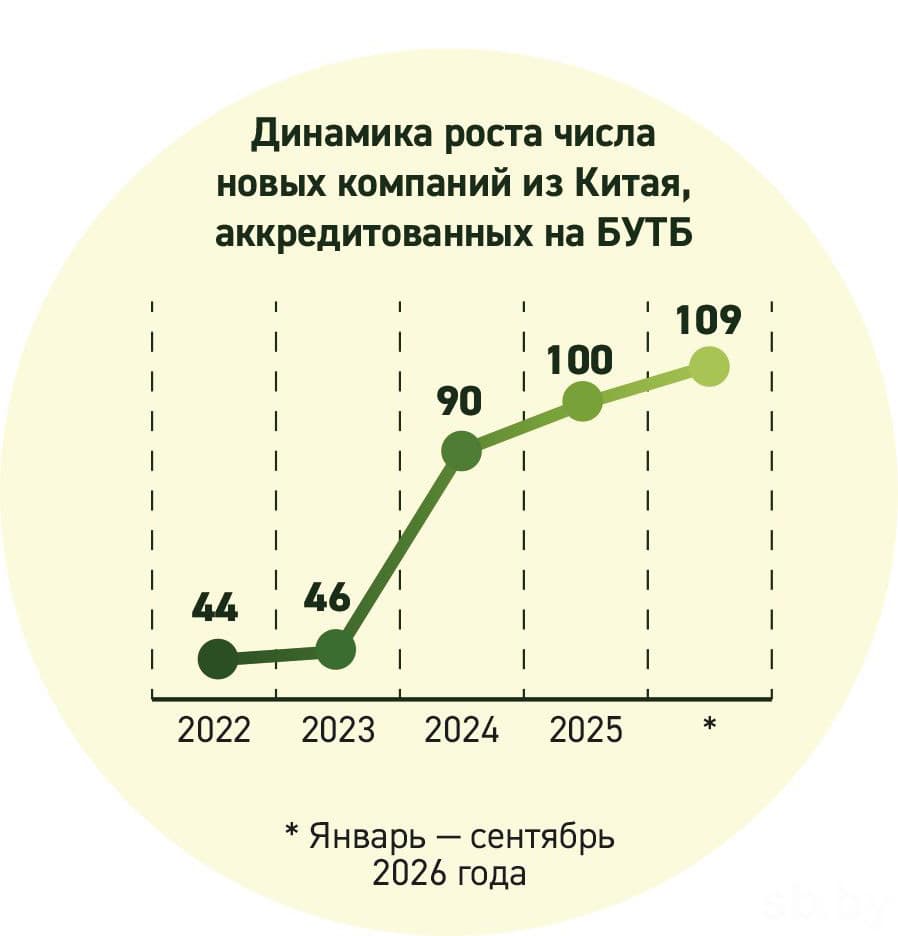
- Having an office in the main financial and economic center of China, we have direct access to Chinese companies interested in trade with Belarusian enterprises. Thanks to the representative office in Shanghai, it became much easier to work with Chinese businesses. This applies to business meetings, participation in exhibition events, accreditation of new companies, and support of existing clients of the exchange. Of course, the representative office maintains close contact with the central office, which allows coordinating efforts and obtaining maximum efficiency. Due to this, the efficiency of work to attract participants from China has increased significantly - from 20-30 new companies per year to 90-100, said Yaroslav Kovalchuk. By the way, this year we predict an even higher result – about 130 companies.
As of October 1, 2026, 456 residents of the People’s Republic of China were accredited to BUCE. Of these, 109 went to the stock exchange this year.
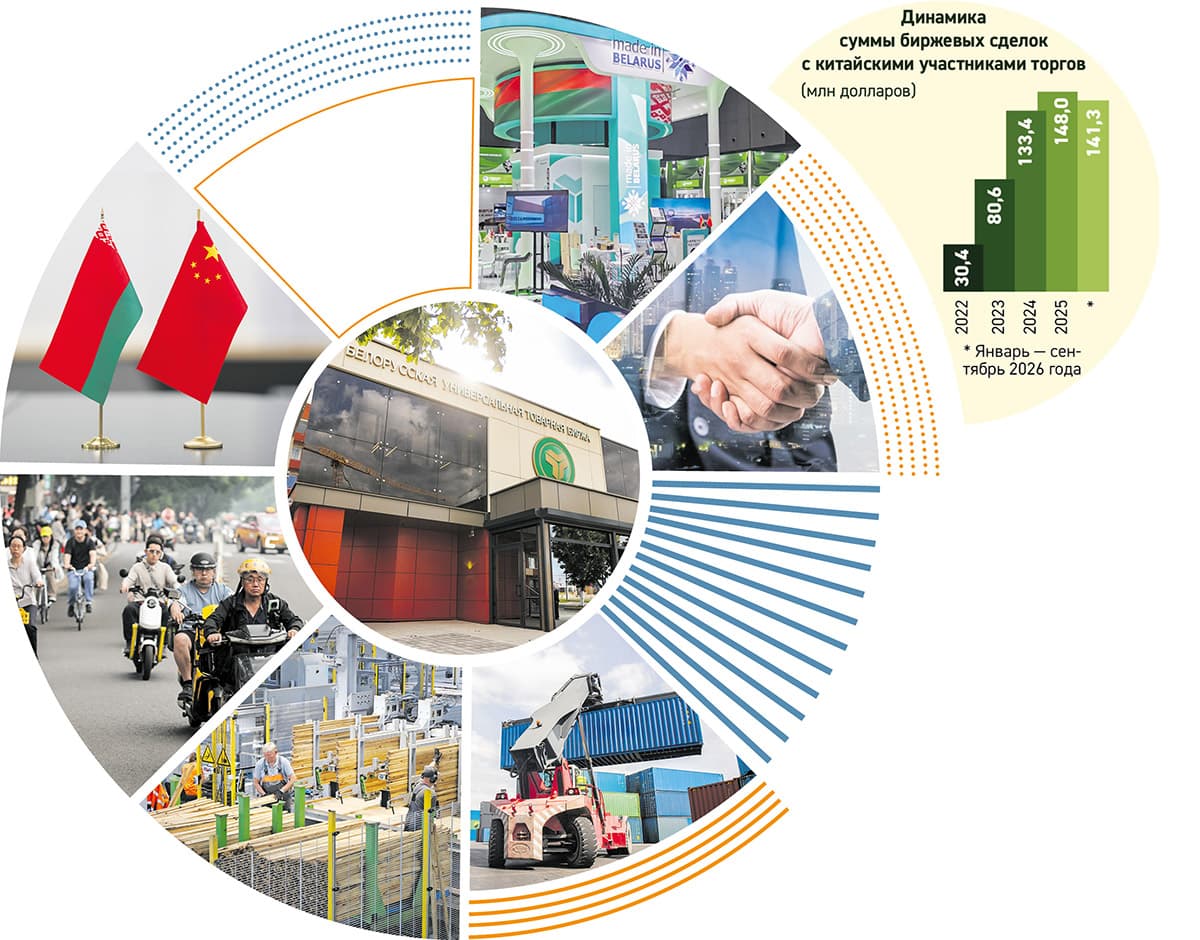
Following the increase in the number of participants, trade volumes also increase. Thus, the amount of exchange transactions with residents of China in January-September 2026 reached 141.3 million dollars. This is 12 percent more than in the same period of 2025. In value terms, 90 percent of all exchange transactions made by Chinese residents in January-September of this year accounted for the purchase of our goods. Thus, the surplus amounted to $112.3 million in favor of Belarus. The largest share in the structure of exchange turnover of the two countries is still occupied by the products of the woodworking industry - 54 percent of the total amount of transactions. At the same time, the share of agricultural products has significantly increased: now it is 38 percent against 13 percent last year. In the segments of industrial and consumer goods and metal products, there were no significant changes over the year. Thus, the share of the first commodity group decreased by 2 percent to 7 percent, and the second remained at the level of 2025 and amounted to 1 percent, said Yaroslav Kovalchuk.
He said that this year the five most popular Belarusian goods from Chinese bidders include lumber, milk powder, meat products, flax fiber and fur raw materials (mink skins). At the same time, among Belarusian traders, various types of equipment and equipment, spare parts for them, as well as products made of ferrous and non-ferrous metals are most in demand. As for new commodity items, there are not very many of them. In exports from Belarus it is chicken legs and scrap metals, and in imports from China – medical products, wind turbines and industrial robots, – said the representative of BUCE.
At the same time, in terms of exports to China, dry whey shows a particularly high positive dynamics - an increase of 8.6 times, as well as flax processing products - an increase of 7 times. And in imports from China there is a similar situation to last year: as before, the most demanded technological equipment, spare parts and components.
- We try to focus on the needs of domestic enterprises and often attract Chinese producers for specific purchase requests. As a result, Belarusian bidders not only get the opportunity to purchase the goods they need, but also do it without intermediaries on more favorable terms than outside the exchange, Yaroslav Kovalchuk emphasized.
Speaking about the promotion of domestic products to the Chinese market, he stressed that the focus now is not on the search for new commodity items, but on expanding the use of the exchange mechanism in the export of products that are already supplied to China through over-the-counter channels. This, in particular, canola oil, dry whey, cellulose, particle boards.
- There are significant growth reserves for all these commodity groups, the representative of BUCE noted. As for the immediate plans to expand exchange cooperation between the countries, one of the priority tasks is to establish closer cooperation with the commodity exchanges of China to exchange experience, technologies and price information.
- While we cooperate only with the Xinjiang exchange AEEX within the framework of the International Association of Exchanges, however, taking into account the scale of the Chinese market, the network of partner platforms, of course, needs to be developed, concluded Yaroslav Kovalchuk.
OUR COMPANY
In the first nine months of 2026, the share of supplies to China in the total amount of exchange exports is 7.5 percent. In monetary terms, this is 126.8 million dollars. In January-September last year, these figures were equal to 8.6 percent and $110.1 million, respectively.
At the same time, according to the amount of transactions, Chinese bidders, as last year, take second place. The decrease in the indicator can be considered as a positive event, indicating a greater diversification of the geography of exchange trading. In particular, this year, trade with Uzbekistan, the UAE and Azerbaijan has significantly increased, and a number of new markets have opened - Indonesia, North Korea, Myanmar, Oman. All this has led to a reduction in the share of leading countries such as Russia and China.
druk@sb.by
